Introduction
The meticulous pursuit of justice is not always confined to the names originally penned on a police charge sheet. Indeed, the very integrity of the judicial process demands that a court possess the authority to peer beyond the initial investigation and ensure that the full complement of perpetrators is brought to the bar. This extraordinary, yet essential, discretionary power is conferred upon the trial court by Section 319 of the Code of Criminal Procedure, 1973 (CrPC). The Supreme Court of India, in its recent, decisive judgment, Neeraj Kumar @ Neeraj Yadav v. State of U.P. & Ors1., provided a crucial clarification on the appropriate exercise of this power, anchoring its rationale firmly in a centuries-old principle. The very essence of Section 319 rests on the profound legal mandate: judex damnatur cum nocens absolvitur which means, “a judge is condemned when a guilty person is acquitted.” This potent doctrine underscores the judicial duty to ensure that the real offender does not escape punishment, thereby realising the fundamental concept of a complete and fair trial.
The Constitutional Bar: The “Strong and Cogent Evidence” Test
The foundational law governing this provision was definitively established by the Constitution Bench in Hardeep Singh v. State of Punjab2 (2014). Recognising the gravity of compelling a person to face trial without having been charged by the police, this landmark ruling decreed the mandatory use of the “Strong and Cogent Evidence” Test. The rationale for this heightened standard lies in balancing the rights of the newly accused with the integrity of the trial. As the Constitution Bench held, the required degree of satisfaction is uniquely positioned within the criminal trial structure: it is unequivocally higher than the prima facie case required merely for framing a charge, but less than the final standard of proof beyond a reasonable doubt required for a conviction. This was reinforced in cases like Brijendra Singh v. State of U.P3. (2011) and Lal Suraj v. State of Jharkhand4 (2007), where the Court emphasized that this is an “extraordinary” power to be exercised sparingly, and only when “strong and cogent evidence occurs against a person from the evidence led before the court.” The power cannot be invoked in a “casual and cavalier manner.” The Neeraj Kumar case serves as a contemporary application of this high standard, underscoring that the evidence must be robust enough that, if left unrebutted, it would lead to a strong possibility of conviction.
The Judicial Distinction: Sufficiency vs. Credibility
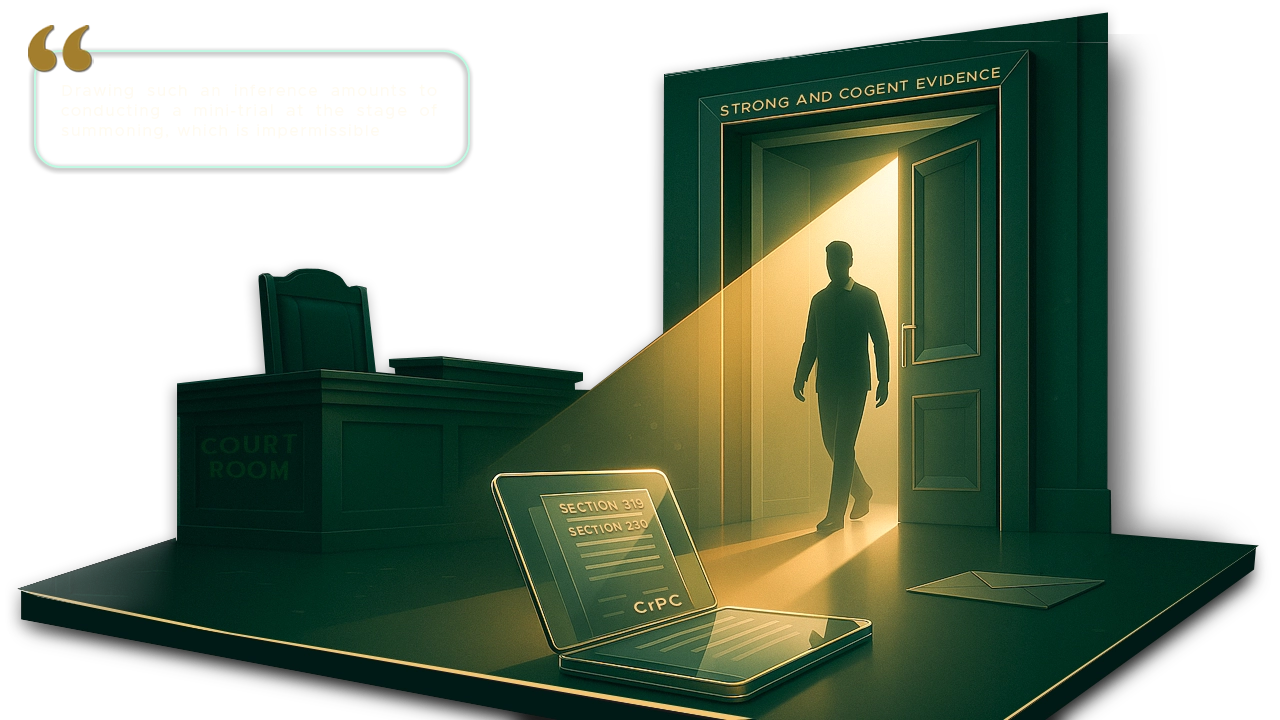
One of the most significant clarifications provided by the recent Supreme Court ruling concerns the erroneous practice of conducting a “mini-trial” before summoning an accused. The Court firmly established the distinction between the sufficiency of the evidence and its ultimate credibility. The rationale, as articulated in Neeraj Kumar, is that the trial court, at the stage of Section 319 CrPC, is merely determining whether the material “reasonably indicates involvement of the proposed accused so as to exercise extraordinary power.” The Court stated that: “Drawing such an inference amounts to conducting a mini-trial at the stage of summoning, which is impermissible.”
Issues like alleged tutoring of a minor witness, omission of names in the initial police report, or inconsistencies in statements are strictly reserved for the final judgment stage, when the evidence has been tested on the anvil of cross-examination. To prematurely judge these factors is to assume the role of the final verdict and unjustly impede the trial. The principle that the court need not wait for cross-examination to be complete was clarified in Hardeep Singh, reinforcing that the focus is on the existence and cogency of the evidence, not its final reliability.
Conclusion
This crucial legal clarification arrives at a pivotal moment, as the Code of Criminal Procedure, 1973 (CrPC), is set to be replaced by the Bharatiya Nagarik Suraksha Sanhita (BNSS), 2023. The power to summon an additional accused has been re-enacted: Section 319 CrPC is succeeded by Section 230 in the BNSS, 2023. The judgment in Neeraj Kumar thus acts as a vital bridge, establishing that the authoritative interpretation of this power—the “Strong and Cogent Evidence” Test and the key distinction between sufficiency and credibility will continue to be the governing legal standard for interpreting and exercising the equivalent power under Section 230 of the BNSS, 2023. The ruling ensures that the judicial duty to summon the uncharged will not be compromised by procedural technicalities or premature assessment of evidence, ultimately reinforcing the enduring principle that every individual against whom a strong case emerges must face trial, ensuring the law’s integrity is preserved for the future.
Citations
- Neeraj Kumar @ Neeraj Yadav v. State of U.P. & Ors. 2025 INSC 1386
- Hardeep Singh v. State of Punjab AIR 2014 SUPREME COURT 1400
- Brijendra Singh v. State of U.P 2018:AHC:123440
- Lal Suraj v. State of Jharkhand Arising out of SLP (Crl.) No. 1179 of 2008
Expositor(s): Adv. Archana Shukla