Labour Law
The OSHWC Code 2020: A Unified Vision for Workplace Safety, Inclusivity, and Modern Compliance
On this page

Introduction
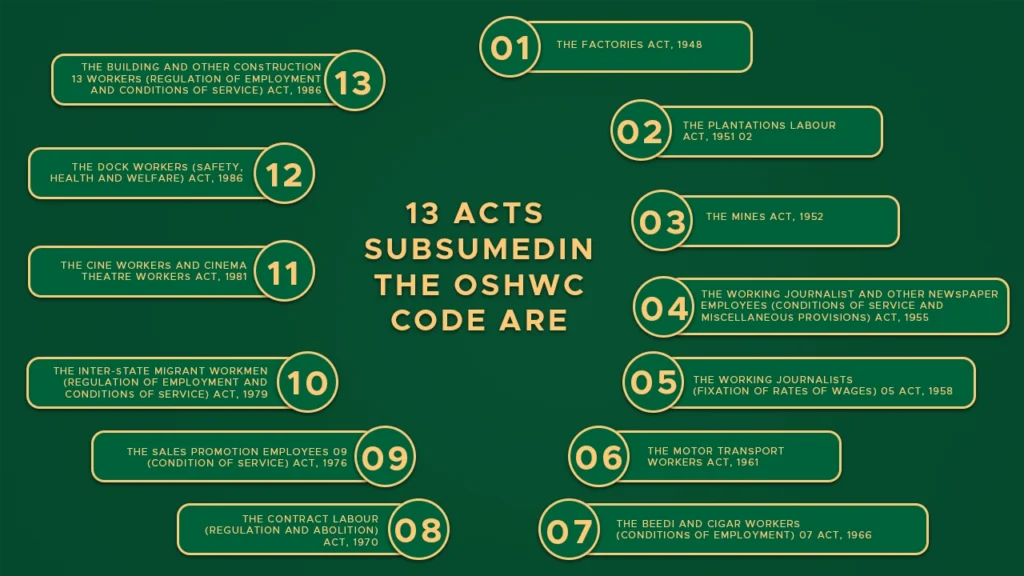
The Occupational Safety, Health and Working Conditions Code, 2020 (OSHWC Code) unifies 13 labour laws into a comprehensive framework for workplace safety, health, and welfare. It establishes uniform standards including an 8-hour day/48-hour week baseline, mandatory appointment letters, and risk-based compliance. The Code applies across factories, mines, plantations, transport, and service sectors. By simplifying registration and inspections, it reduces regulatory complexity while strengthening worker protection and welfare facilities.
Redefining Applicability and Scope
Broadening the ‘Establishment’- The Code replaces complex criteria with a simple, unified threshold. An “Establishment” is now defined as any place carrying out industry, trade, or business employing 10 or more workers.
This effectively eliminates the “grey area” for the IT, ITES, and service sectors. Companies that previously escaped factory-style regulations are now under the formal umbrella of mandatory safety and welfare standards.
The Evolution of the ‘Worker’- In alignment with the goal of universal protection, the OSH Code introduces a revised and expansive definition of a ‘Worker’. This new classification moves away from restrictive traditional categories to reflect the diversity of the modern Indian workforce.
The scope of who qualifies for legal protection has been significantly widened through three key shifts:
- Inclusion of Diverse Roles: Beyond traditional manual labor, the definition now encompasses individuals engaged in technical, operational, clerical, and supervisory work. This ensures that safety and welfare rights are not limited to the factory floor but extend to the office and the laboratory alike.
- The Supervisory Wage Shift: In a major move to protect mid-level employees, the Code has significantly raised the supervisory wage threshold. By setting this limit at ₹18,000 per month, the law now formally covers a vast group of supervisors who were previously excluded from such protections. Any supervisor drawing wages below this amount is now entitled to the same statutory rights as other workers.
- Recognition of Specialized Professions: The Code further bridges regulatory gaps by explicitly including specialized roles that were once governed by separate, fragmented statutes. Specifically, working journalists and sales promotion employees are now formally integrated into this unified protective ambit.
Protecting ‘Core Activities’- To preserve the integrity of the workforce, the OSH Code introduces a strategic framework centered on ‘Core Activities’. This measure prevents the dilution of worker rights by ensuring that the primary functions of a business remain staffed by its own employees rather than being outsourced to precarious labor.
The Code balances this protection with business reality through two key pillars:
- The Prohibitive Guardrail: Hiring contract labor for an establishment’s “Core Activities”, the essential functions for which the business was primarily set up, is now strictly prohibited. This mandate ensures job security and prevents the systemic displacement of permanent roles.
- Operational Flexibility: Recognising that business demands fluctuate, the Code allows for specific exceptions. Contract labor may still be engaged for sudden surges in work volume, intermittent tasks, or activities traditionally handled via contractors, ensuring efficiency is maintained without compromising worker dignity.
Key Employer and Employee Obligations
Moving beyond definitions, the OSH Code shifts the regulatory focus from mere “paper compliance” to a genuine “culture of safety” built on mutual accountability. This transformation is realized through a more humane approach to working standards and a rigorous enforcement framework that aligns with India’s constitutional ideals.
Harmonisation of Work-Life Standards- To ensure a balanced professional life, the Code establishes a consistent legal standard for time and compensation across all sectors:
- Structured Hours: Work is strictly capped at 8 hours per day and 48 hours per week, providing a predictable baseline for the workforce.
- Empowered Overtime: While the Code allows for extended hours, it mandates that employers pay double the wage rate for such work. Crucially, overtime is no longer a unilateral demand; employers must now obtain the explicit consent of the worker.
- Modernized Leave: The framework simplifies leave accrual at a rate of one day for every 20 days worked. To ensure these benefits are tangible, the Code mandates leave encashment allowing workers to receive payment for unused leave both during their tenure and upon separation or resignation.
Safety, Welfare, and Gender Inclusivity- The core of the Code lies in its ability to foster a safe and inclusive environment through specific mandates:
- Employer & Employee Roles: Employers are legally bound to provide a hazard-free workplace, free annual health check-ups, and formal appointment letters. In tandem, employees are empowered with the right to report safety hazards without retaliation, though they are also duty-bound to follow safety protocols, with penalties of up to ₹10,000 for personal negligence.
- Breaking Gender Barriers: In a landmark step toward parity, women are now permitted to work in any role and any shift, including night shifts. This progress is safeguarded by requiring the woman’s consent and ensuring the employer provides adequate safety and transportation.
Enhanced Protections for Migrant Workers- The Code specifically addresses the vulnerabilities of inter-state migrant workers by expanding its protective reach to include those who relocate on their own initiative.
- Financial Support: Employers engaging 10 or more migrant workers are now obligated to provide a lump-sum journey allowance to cover travel to and from their home state.
- Inclusive Coverage: By setting a wage threshold of ₹18,000 per month and removing exclusions for administrative roles, the Code ensures that a much larger segment of the migrating workforce is legally protected.
Enforcement and Constitutional Alignment- To ensure these provisions are more than mere suggestions, the Code introduces a rigorous yet streamlined enforcement framework:
- Stringent Penalties: General non-compliance can now attract fines of up to ₹5,00,000, creating a strong financial incentive for adherence.
- Offence Composition: To reduce the burden on the judiciary, minor or first-time offences can be settled through “composition,” where an employer pays 50% to 75% of the maximum fine to resolve the matter out of court.
- A Constitutional Legacy: The Code serves as a legislative vehicle to fulfill the Directive Principles of State Policy (DPSP). It directly gives effect to Article 39(e), Article 42, and Article 43, bridging the gap between constitutional promise and workplace reality.
Conclusion
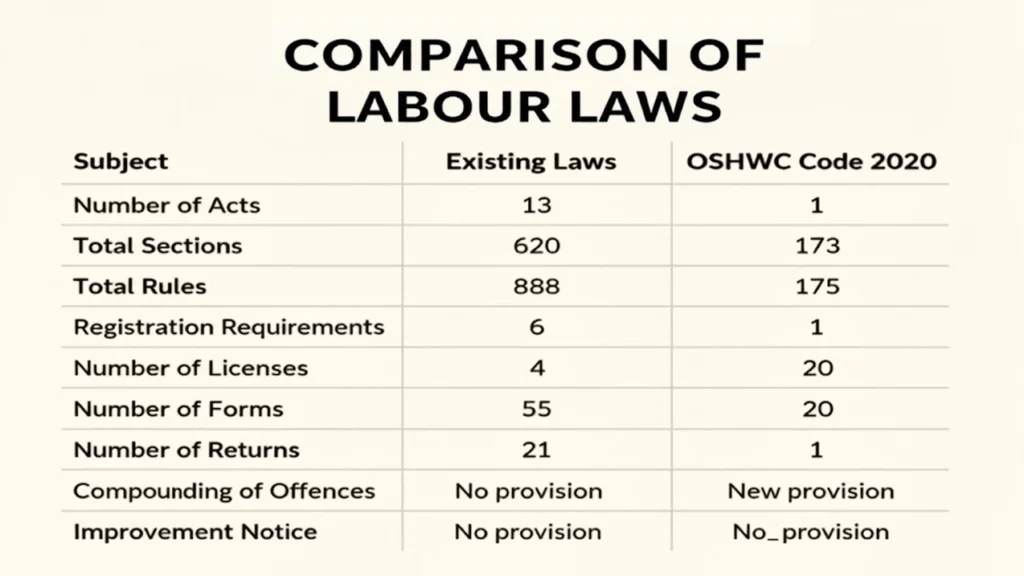
The Occupational Safety, Health and Working Conditions (OSHWC) Code, 2020, consolidates 13 legacy labor laws into a single, unified framework to modernise workplace safety and simplify compliance. It significantly reduces regulatory complexity by cutting the number of sections from 620 to 143 and rules from 868 to 175, while streamlining administrative hurdles through a single registration and a massive reduction in required forms and returns. Beyond administrative efficiency, the Code universalises safety standards across all sectors including IT and services and introduces progressive measures such as gender inclusivity for all shifts, enhanced protections for migrant workers, and the “Compounding of Offences” to resolve minor legal issues out of court. By aligning legislative mandates with constitutional principles, the Code aims to foster a genuine culture of safety while promoting economic growth and the ease of doing business in India.
Expositor(s): Adv. Archana Shukla
This article is for information only and is not legal advice. Read the disclaimer