Introduction
As modern Indian jurisprudence evolves in response to rising economic offences from fraud and money laundering to environmental degradation, a critical question arises: when does corporate oversight cross the line and transform into the “directing mind and will”, thereby attracting vicarious liability of directors? This question lies at the heart of a delicate balancing exercise, where courts must ensure accountability for financial misconduct while preserving foundational principles of criminal law, such as mens rea, separate legal personality, and the fair attribution of culpability.
In India, this tension is framed by a robust statutory landscape. While a company is an artificial person and a separate legal entity, it operates through its Board of Directors. The Companies Act, 2013, under Section 2(60), introduces the concept of an “officer who is in default,” providing a specific gateway to personal liability when a director is demonstrably responsible for an act or omission. However, broad criminal statutes like the Indian Penal Code (IPC) notably lack general deeming provisions that automatically make directors vicariously liable for offences committed by the company. This distinction is vital because, as the Supreme Court highlighted in Rabindranath Bajpe v. Mangalore SEZ Ltd1., IPC offences demand proof of personal culpability that cannot be bypassed by mere corporate designation.
The judicial narrative on this issue has evolved through a series of landmark tests. In S.M.S. Pharmaceuticals Ltd. v. Neeta Bhalla2, the Supreme Court clarified that under Section 141 of the Negotiable Instruments Act, liability is not a byproduct of status; it requires evidence that the director was “in charge of and responsible for” the business operations linked to the offence. This was further refined in K.K. Ahuja v. V.K. Vora3, which established a dual criterion: a factual inquiry into who was “in charge” of operations and a legal inquiry into who was “responsible to” the company for its conduct. These cases ensure that non-executive or independent directors, who lack day-to-day operational control, are not unfairly ensnared in criminal prosecution.
This legal caution is not merely a matter of corporate policy; it is anchored in the Constitution of India. The Supreme Court has repeatedly held that criminal prosecution impacts Article 21, the right to life and personal liberty. Arraying a director as an accused solely due to their designation is viewed by the courts as a potential abuse of process and an arbitrary deprivation of liberty. Consequently, the “Doctrine of Attribution” which links the “mind and will” of the corporation to the individuals directing its actions must be applied sparingly. As seen in Sunil Bharti Mittal v. CBI4, The court rejected the mechanical application of the “alter ego” doctrine, insisting instead on proof of active involvement, consent, or knowledge.
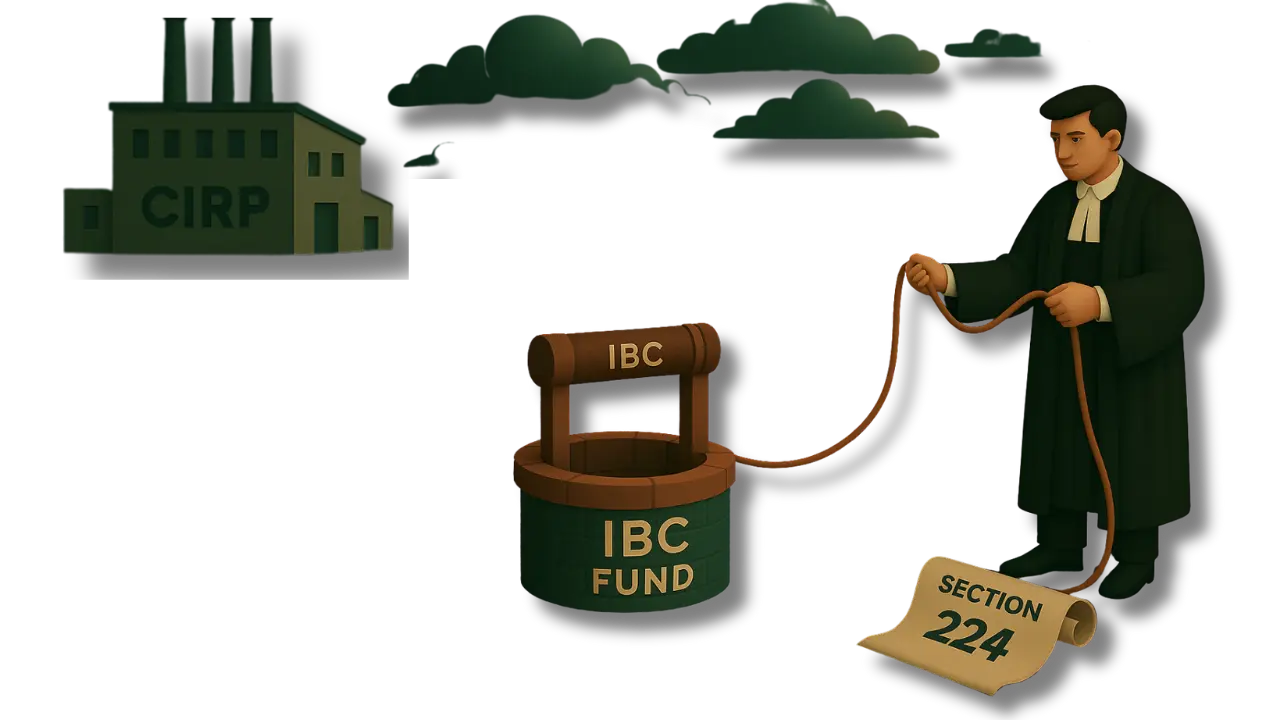
The intersection of corporate governance with specialized legal frameworks creates a sophisticated matrix of liability that demands high-level legal precision. In the landscape of the Insolvency and Bankruptcy Code (IBC) 2016, the focus shifts from punitive measures to the resolution of financial distress; however, directors are not immune, as Sections 66 and 69 act as a critical checkpoint for fraudulent or wrongful trading.
Similarly, SEBI regulations employ a bifurcated approach: they enforce strict control-based liability for executive directors while offering a protective buffer to independent directors, ensuring that “controlling minds” cannot hide behind corporate structures while shielding those without access to price-sensitive information.
This nuanced approach extends to Environmental Law, where the 2025 precedent of Sanjay Dutt & Ors. v. State of Haryana (2025)5 established that when a corporate entity is the primary offender, a director’s liability is not automatic. It requires a distinct “derivative link” and specific factual allegations to bridge the gap between corporate action and individual responsibility. This was further fortified by the Supreme Court in Anil Khandelwal v. M/s Phoenix India (2025)6, which decisively clarified that the Indian Penal Code (IPC) lacks a general provision for vicarious liability, effectively closing the door on attempts to prosecute directors based solely on their corporate designation.
The landmark English judgment in H.L. Bolton (Engineering) Co. Ltd. v. T.J. Graham & Sons Ltd7. established the “Organic Theory” of corporate liability, famously comparing a company to a human body. Lord Denning distinguished between the “hands” employees who execute tasks and the “mind and will” directors and managers who represent the company’s controlling intent. This foundational principle ensures that a corporation’s state of mind is legally identified through the individuals who truly steer its course, allowing for the attribution of criminal intent.
Ultimately, the vicarious liability of directors is an exception to the rule of personal criminal responsibility. Borrowing from the “directing mind and will” doctrine of the UK and the prosecutorial restraint practiced in the US, Indian courts have adopted a narrow, fact-specific approach. This jurisprudential paradox ensures that while the individuals steering a company are held accountable for substantial economic harm, the fundamental principles of fairness, personal culpability, and economic rationality are not sacrificed. For directors and legal teams, the message is clear: vigilance and robust compliance frameworks are essential, as the law will only extend liability to those whose personal actions mirror the company’s misconduct.
Conclusion
The evolving jurisprudence surrounding the vicarious liability of directors in India reflects a profound shift from mechanical, positional prosecution to a nuanced, evidence-based inquiry that preserves the sanctity of separate legal personality. As reaffirmed in recent rulings like Sanjay Dutt & Ors. v. State of Haryana (2025) and the principles of Sunil Bharti Mittal, this “judicial tightrope” is anchored in Article 21 of the Constitution, ensuring that criminal liability is never an automatic consequence of a corporate title but is contingent upon the established “directing mind and will” of the accused. By strictly interpreting the statutory requirements of being “in charge of” and “responsible to” the company’s affairs, the judiciary has sent a clear message: while accountability for economic harm is paramount, it cannot be achieved through the arbitrary deprivation of liberty or the bypass of mens rea. Consequently, for the corporate world, this necessitates a proactive shift toward clearly defined roles and robust compliance frameworks to ensure that the law targets only those who truly orchestrate or negligently permit a crime.
Citations
Expositor(s): Adv. Archana Shukla, Devansh Gautam(Intern)