Introduction
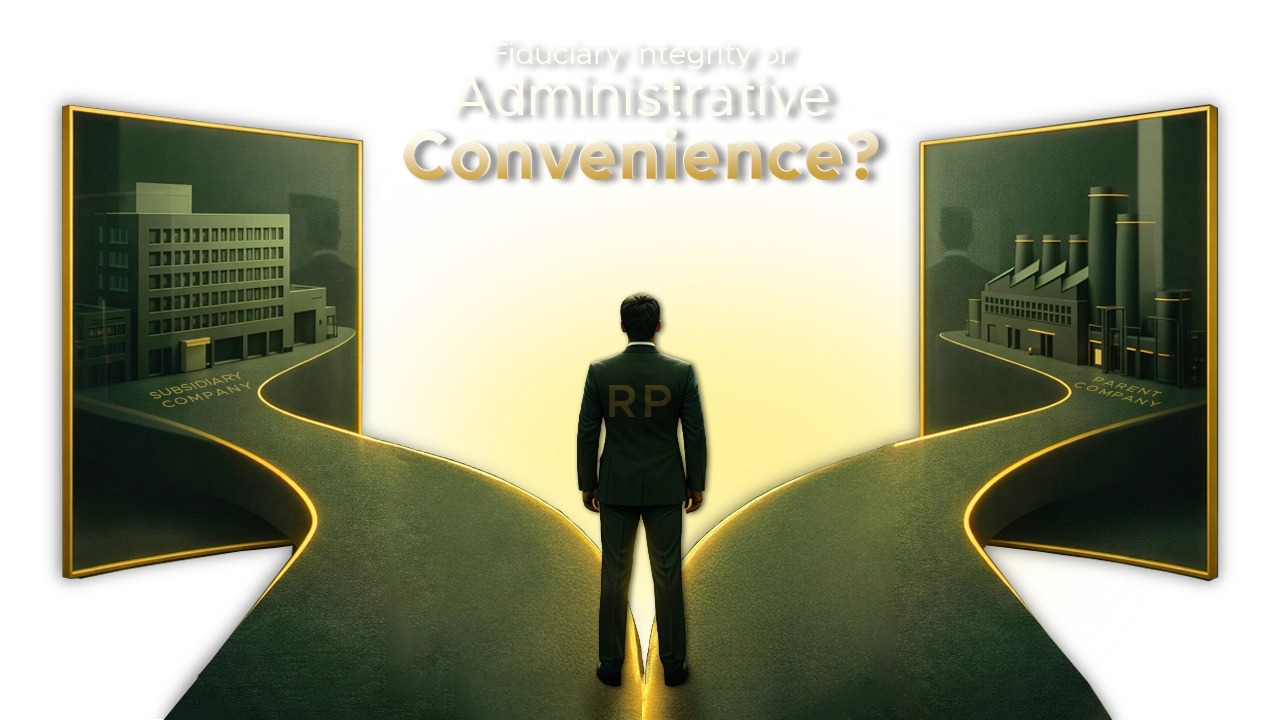
The fundamental tenet that the scales of justice must not only be balanced but must be seen to remain untainted by the shadow of competing loyalties serves as the bedrock of a credible insolvency framework. In any adjudicatory or fiduciary role, the mere appearance of a conflict can be as damaging to the public trust as an actual instance of bias or impropriety. In the jurisprudence of complex corporate structures, the IBC1 faces a recurring dilemma: whether a single RP2 can effectively manage both a parent company and its subsidiary without compromising the integrity of either process.
This fundamental question of professional ethics and systemic efficiency lies at the heart of Jubin Kishore Thakkar vs. Ashutosh Agarwala & Ors3. adjudicated by the National Company Law Tribunal (NCLT), Mumbai Bench, Court – III. Presided over by Hon’ble Smt. Lakshmi Gurung (Judicial Member) and Hon’ble Shri Hariharan Neelakanta Iyer (Technical Member), held that a common RP cannot simultaneously manage a parent and subsidiary if it creates a conflict of interest in adjudicating inter-company claims, thereby necessitating the RP’s replacement to preserve the fiduciary integrity of the insolvency process.
The Corporate Debtor was admitted into CIRP4 and its subsidiary was already under CIRP, with Respondent No. 1 eventually appointed as its RP. Conflict arose when Respondent No. 1, acting as RP for the subsidiary, rejected a massive claim of large sum and categorized part of the sum as contingent liability filed by the parent, only to later be appointed as the RP for parent as well. The Applicant, an erstwhile promoter, sought the RP’s removal, alleging that the RP could not impartially recover debts for the parent company from the subsidiary while acting as the gatekeeper for the subsidiary.
The “Dichotomy” of Neutrality: When a Common RP Faces Overlapping Claims
The Applicant contended that a “clear and present” conflict of interest exists because the RP is essentially the claimant and the adjudicator of that claim. They argued that the RP failed to protect the parent company’s interests by not challenging his own prior rejection of its claims in the subsidiary proceedings. Furthermore, the Applicant alleged that the RP violated the IBBI5 Code of Conduct by failing to disclose this conflict, leading to the destruction of value for the parent company.
The Respondent and the CoC6 argued that the rejection of claims occurred five months before the parent company entered insolvency, meaning no overlap existed at the time of the decision. They maintained that the rejection was based on a lack of documentary evidence rather than bias. The CoC further emphasized that they were fully aware of the RP’s dual role and unanimously voted for his appointment, believing that a common RP would ensure a more efficient and speedy resolution of the group companies.
In its analysis, the Tribunal scrutinized Regulation 3(1) and 7(2)(h) of the IBBI Regulations, 20167, which mandates integrity, objectivity, and the disclosure of any conflict of interest. It also examined the “Code of Conduct” which requires an insolvency professional to be “honest, straightforward, and forthright.” The NCLAT in Anil Kumar Ojha v Chandramouli Ramasubramaniam8 held that the CoC holds the exclusive authority to replace an RP during the insolvency process, provided they do so with a 66% majority vote. A suspended Board of Directors has no power or authority under IBC to remove an existing RP or seek the replacement of another RP.
The Bench observed that while the law does not explicitly bar a common RP for sister companies, the RP is a “fiduciary” whose primary duty is to protect the assets of the Corporate Debtor. The court analyzed whether the RP’s refusal to admit the parent company’s claim despite audited balance sheets suggesting a debt amounted to a breach of this fiduciary duty. It noted that the RP’s dual role created a “dichotomy” where he was required to sue himself to recover dues from the subsidiary company, a situation that naturally hinders the adversarial rigor required in insolvency proceedings.
The NCLT resolved the dichotomy by emphasizing that the “perception of independence” is as crucial as independence itself. It found that the RP’s continued stance against the parent company’s claims in the subsidiary matter made it impossible for him to represent the parent’s interests effectively as an Operational Creditor. The CoC’s commercial wisdom, while significant, cannot override the fundamental requirement of an RP being “independent and impartial.” By failing to bridge the gap between his duty to maximize parent’s value and his prior rejection of its claims, the RP’s position became untenable.
Conclusion
The case of Jubin Kishore Thakkar (Supra) serves as a pivotal check on the practice of appointing common RPs in group insolvencies. While the NCLT recognized the administrative benefits of a unified resolution process, it prioritized the ethical mandate of “conflict-free” adjudication, especially when significant inter-corporate claims are at stake.
This sets a high bar for transparency in group insolvency. It signals to Resolution Professionals that they must proactively disclose potential overlaps and may be forced to step down if their prior decisions in one entity negatively impact the recovery prospects of another. It reinforces the idea that an RP is an officer of the court first and a nominee of the CoC second.
Should the IBBI introduce a mandatory “Neutrality Assessment” before an RP is appointed to multiple companies within the same group? How can the law better protect a parent company’s claims when the management is suspended and the common RP holds the evidence? It is suggested that in cases of significant inter-company debt, the NCLT should appoint a “Special Independent RP” solely to adjudicate the inter-company claims, while allowing the main RP to handle the broader restructuring to maintain efficiency without sacrificing fairness.
Citations
Expositor(s): Adv. Shreya Mishra, Srijan Sahay (Intern)