Arbitration · Supreme Court
Arbitration Clause Cannot Divert Admitted Consumer Complaint: T.K.A. Padmanabhan v. Abhiyan CGHS – Supreme Court
On this page
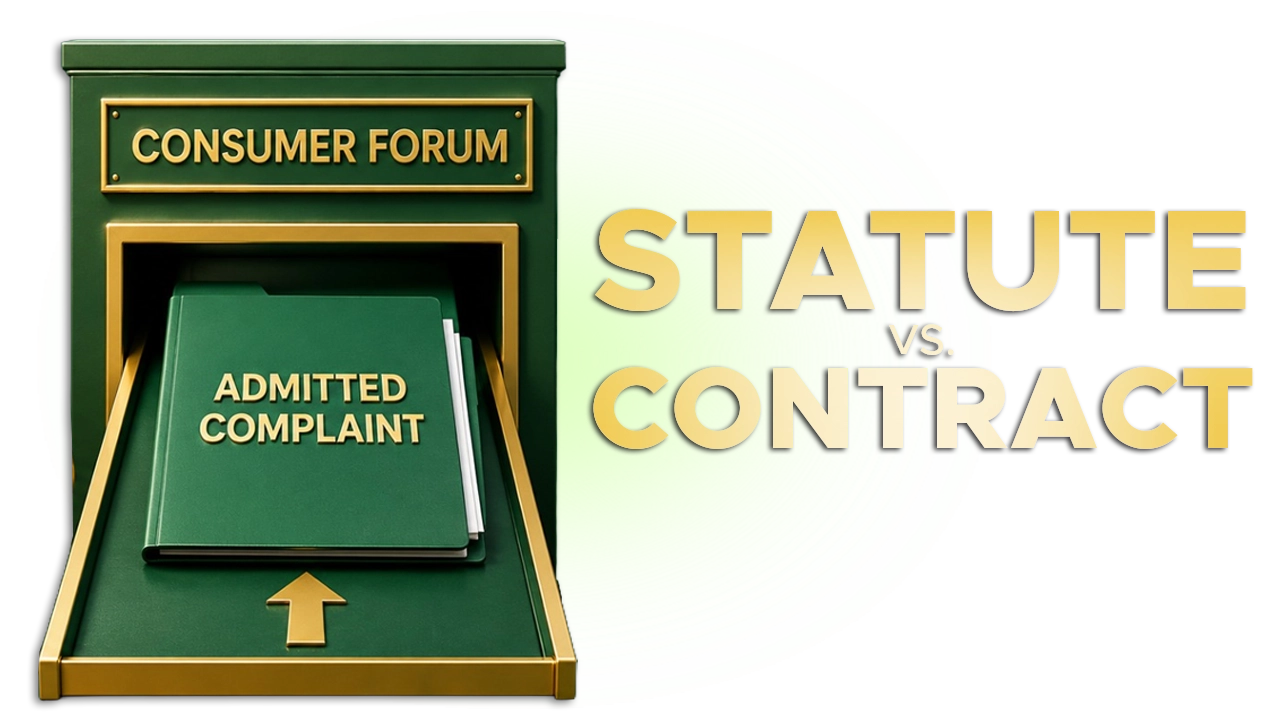
Can a private contractual arbitration clause strip away the jurisdiction of a statutory consumer forum once a consumer complaint has been formally admitted? This fundamental conflict between alternative dispute resolution and public welfare legislation lies at the heart of the Supreme Court of India’s ruling in T.K.A. Padmanabhan v. Abhiyan Cooperative Group Housing Society Ltd1. The apex court has rejected the contention, establishing that a pre-existing arbitration agreement cannot derail a validly instituted consumer proceeding. The Court reinforced the principle that the Consumer Protection Act, 1986, serves as a special, beneficial legislation designed to provide inexpensive and summary remedies. Consequently, private agreements cannot be used to bypass public law protections, and consumer forums are legally bound to decide admitted complaints on their merits rather than redirecting parties to private tribunals.
The dispute originated in January 2003 when the appellant, T.K.A. Padmanabhan, became a member of the respondent housing society and paid the full amount for a flat allotment. Following an agreement signed on February 27, 2004, for Flat No. 232, the appellant encountered significant delays in receiving possession. This prompted him to file Consumer Complaint No. 579 of 2005 before District Consumer Forum-VII, New Delhi, seeking compensation for the delay. Although the complaint was admitted and notice was issued, the respondent society sought to stall the statutory proceedings by filing an application under Section 8 of the Arbitration and Conciliation Act, 1996, pointing to an arbitration clause in their agreement. While the District Forum initially rejected this application, a protracted procedural battle across the High Court and a subsequent remand led the District Forum, by an order dated July 27, 2009, to reverse its stance and refer the parties to arbitration. This referral was later upheld by the Delhi State Consumer Disputes Redressal Commission in 2013. When the appellant moved the National Consumer Disputes Redressal Commission (NCDRC) in revision, the NCDRC dismissed his petition on January 4, 2016, adding a new dimension by holding that the appellant was no longer a “consumer” because he had prior to filing the complaint taken possession of the flat.
The Supreme Court dismantled this multi-layered procedural history by examining the structural statutory framework of the Consumer Protection Act, 1986. Justice Vikram Nath, delivering the judgment, highlighted the explicit mandate of Section 3 of the 1986 Act, which declares that its provisions are in addition to, and not in derogation of, any other law in force. This ensures that the availability of an alternative remedy does not strip a consumer forum of its jurisdiction. The Court relied heavily on a robust line of precedents to support this rationale, noting that Fair Air Engineers Pvt. Ltd. v. N.K. Modi2 originally established that an arbitration clause does not automatically oust consumer jurisdiction. This baseline was later fortified by Secretary, Thirumurugan Cooperative Agricultural Credit Society v. M. Lallitha3 and National Seeds Corporation Ltd. v. M. Madhusudhan Reddy4, which collectively affirmed that alternative statutory or contractual mechanisms do not bar consumer claims. Ultimately, the apex court pointed to the definitive ruling in Emaar MGF Land Ltd. v. Aftab Singh5, which clarified beyond doubt that the special remedy under consumer law remains entirely untouched by private arbitration agreements.
Beyond Section 3, the Court brought a strict textual and policy-based focus to Section 12(4) of the 1986 Act. The statutory sequence is explicit: once a District Forum exercises its mind at the threshold, allows a complaint to be proceeded with, and formally admits it, a statutory lock-in occurs. The proviso to Section 12(4) contains an absolute legislative restraint, stipulating that an admitted complaint shall not be transferred to any other court, tribunal, or authority under any other law. Reading Section 3 and Section 12(4) harmoniously, the Court determined that the law purposefully protects consumers from being driven out of a forum they have validly invoked, preventing private contracts from rendering statutory remedies illusory. Therefore, the consumer forums committed a grave legal error by relegating the appellant to arbitration after his complaint had been admitted and noticed.
Furthermore, the Supreme Court severely criticized the NCDRC for failing to address this core jurisdictional question and inventing a flawed threshold barrier regarding the appellant’s status. The NCDRC’s view that taking possession of a flat erases an individual’s status as a consumer was deemed entirely unsustainable. The appellant’s claim was not a possessory suit but an action for compensation tied directly to the period of delay suffered prior to delivery. The Court observed that subsequent physical receipt of a flat cannot magically extinguish an accrued substantive right to seek damages for late performance. Factual issues such as the actual extent of delay, liability, or whether possession was accepted unconditionally are triable merits that require formal evidence, none of which had been adjudicated by any forum in over a decade of litigation.
Conclusion
Ultimately, the Supreme Court allowed the civil appeal and swept aside the orders of the District Forum, State Commission, and National Commission. To rectify the procedural injustice and avoid further inconvenience, the Court restored the original consumer complaint and transferred it to the newly established District Consumer Disputes Redressal Commission at Dwarka, where both parties reside. Emphasizing that the dispute dates back to 2005, the Supreme Court directed the Dwarka Commission to afford both sides an opportunity to lead evidence and to make every endeavor to resolve the long-delayed matter on its merits within one year. Through this decision, the Court firmly re-established that public-interest consumer protections remain insulated from contractually engineered bypasses.
Citations
- T.K.A. Padmanabhan v. Abhiyan Cooperative Group Housing Society Ltd. : Civil Appeal No. 10724 of 2016 (Supreme Court of India, Decided on June 4, 2026) ↩︎
- Fair Air Engineers Pvt. Ltd. v. N.K. Modi, (1996) 6 SCC 385 ↩︎
- Secretary, Thirumurugan Cooperative Agricultural Credit Society v. M. Lalitha, (2004) 1 SCC 305 ↩︎
- National Seeds Corporation Ltd. v. M. Madhusudhan Reddy, (2012) 2 SCC 506 ↩︎
- Emaar MGF Land Ltd. v. Aftab Singh, (2019) 12 SCC 751 ↩︎
Expositor(s): Adv. Jahnobi Paul, Shreya Shukla (Intern)
This article is for information only and is not legal advice. Read the disclaimer