Case Docket · Consumer Protection
The Fine Print Deception: CCPA Acts Against Britannia’s 100% Whole Wheat Bread Claims
On this page
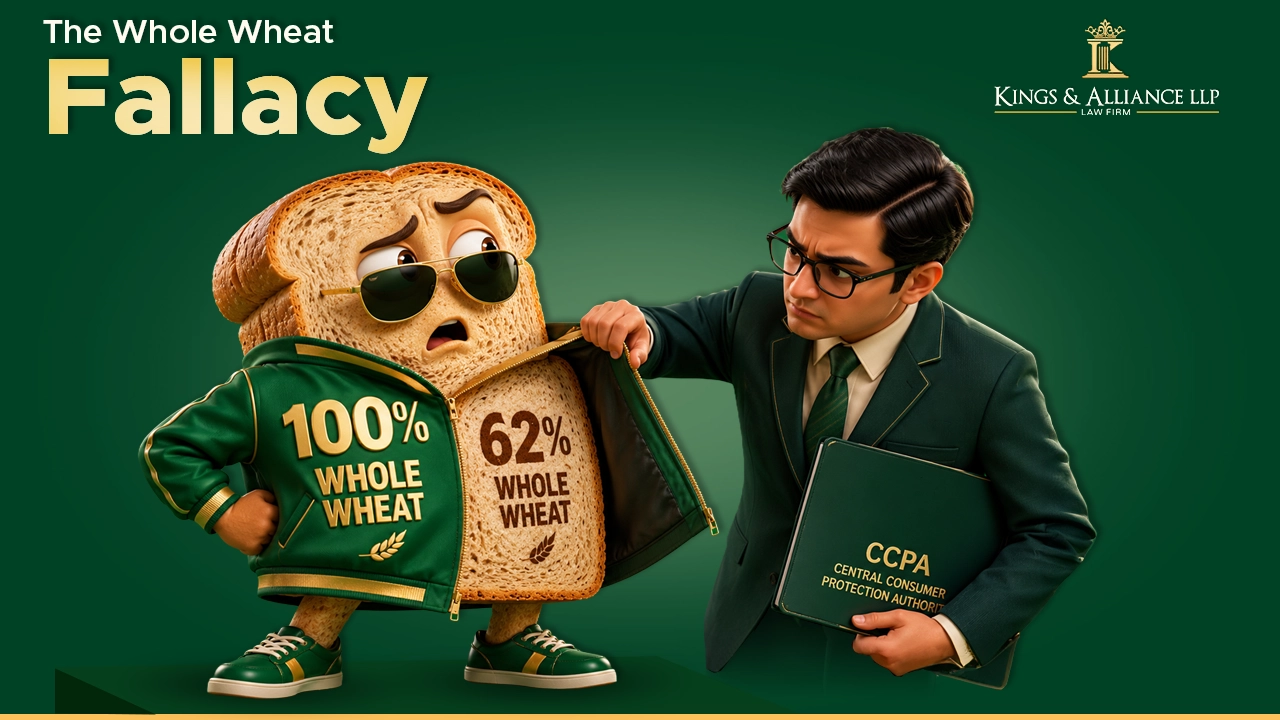
The reality of packaged food products often lies in the fine print on the back of the packaging, rather than in the glossy claims displayed in bold fonts on the front. The Central Consumer Protection Authority (CCPA) order passed on 22 October 2026 serves as a stark reminder of this gap. The CCPA found that Britannia’s whole wheat bread contained only 62% whole wheat, despite being marketed as “100% Whole Wheat Bread”. Exercising its powers under Section 211 of the Consumer Protection Act, 2019 (the Act), the CCPA imposed a penalty of ₹1,00,000 on Britannia Industries for making misleading claims. It further directed Britannia to immediately discontinue the false and misleading advertisement across all print and electronic media, including social media.
The CCPA took suo motu cognizance under Section 18(1)2 of the Act against Britannia Industries for advertising its product as “100% Whole Wheat Bread.” A preliminary inquiry revealed a discrepancy between the advertising claim and the product composition, which declared only 62 % wheat flour. The CCPA also noted that Regulation 2.6 on the labelling of different types of bread, under the Food Safety and Standards (Labelling and Display) Second Amendment Regulations, 2022, requires a minimum of 75% whole wheat flour to use the nomenclature “Whole Wheat.” Finding that the claim could mislead consumers and influence their purchasing decisions, the CCPA issued a notice to Britannia seeking its response and supporting documents before deciding whether to initiate an investigation.
Britannia contended that its “100% Whole Wheat Bread” claim was justified because the product contains 100% whole wheat flour on a flour basis, satisfying Clause 2.6(1)3 of Schedule II of the Food Safety and Standards (Labelling and Display) Regulations, 2020, and that “100%” signalled that no maida (refined flour) was used. However, the CCPA observed that the product contains only 62 % wheat flour (atta), potentially misleading consumers. It held that a prima facie case existed and that Britannia’s assertion of compliance did not preclude independent scrutiny under the Act. Accordingly, the matter was referred to the Director General (DG), Investigation, CCPA, under Section 19(1)4 of the Act for further investigation. Initially, six claims were considered, but after the report of the DG (Investigation), the CCPA adjudicated on three claims made by Britannia, which employed “100%” as a prefix.
i. “100% Whole Wheat Bread”
ii. “Britannia 100% Whole Wheat Bread pairs perfectly well with a healthy diet”.
iii. “Milled from 100% whole wheat grains, this Atta-based bread is the perfect blend of wheat flour (Atta) and wheat bran. No added Maida and low in saturated fat, this Atta bread is a good source of fiber. “Britannia 100% Whole Wheat Bread pairs perfectly well with a healthy diet”.
Regarding the claim “100% Whole Wheat Bread,” the DG found that the prominent claim could mislead consumers, as the product contains only 62.5% whole wheat flour and the qualifying statement appears in substantially smaller font. FSSAI further observed that the claim was inconsistent with the Food Safety and Standards (Advertising and Claims) Regulations, 2018 (the 2018 Regulation), and its Advisory dated 28 May 2025,5 which advised food business operators to discontinue the use of “100%” on product labels and promotional materials. The DG noted that Britannia continued the use of the claim on its website. FSSAI also noted that, on a flour basis, the product meets the minimum compositional requirement for ‘Whole Wheat Bread’. Britannia had begun renaming it “Zero Maida Whole Wheat Bread”, which the DG called a positive step but held that it does not absolve past liability.
The CCPA rejected Britannia’s reliance on Regulation 2.6 of the Food Safety and Standards (Labelling and Display) Regulations, 2020,6 observing that the absence of an express prohibition does not permit misleading claims. It held that the test is not the subjective intent of the manufacturer, but the objective understanding of an average consumer of ordinary prudence, who would reasonably construe “100% Whole Wheat Bread” to mean that the product is entirely composed of wheat. Further, the CCPA noted that Clause 11(2) of the Guidelines for Prevention of Misleading Advertisements and Endorsements for Misleading Advertisements, 20227 (the 2022 Guidelines) requires the font used in a disclaimer to be the same as that used in the claim. The CCPA observed that the qualifying statement, “Made From 100% Whole Wheat Flour on Flour Basis,” linked by the symbol “#”, did not cure the potentially misleading claim, as it appeared in a much smaller, barely visible font. The “No Maida” claim did not cure the misrepresentation either: read with “100% Whole Wheat Bread”, it reinforced the impression that the product was made entirely of whole wheat flour. Accordingly, the CCPA found the claim misleading and factually incorrect, contrary to the principles governing fair advertising.
The CCPA observed that the claim “Britannia 100% Whole Wheat Bread pairs perfectly well with a healthy diet” implies that the product is suitable for a healthy diet and makes representations about its health-related attributes. Such claims must be accurate, substantiated, and consistent with applicable regulations. The CCPA further observed that the representation could mislead consumers regarding the product’s usefulness or its suitability as a substitute for natural foods, thereby constituting an unfair trade practice under Section 2(47)8 of the Act. Given the brand’s extensive reach through quick-commerce platforms, the CCPA considered the claim prima facie dishonest, deliberate and mala fide, potentially exploiting consumer trust and the brand’s goodwill.
Lastly, the CCPA held that the claim “Britannia 100% Whole Wheat Bread pairs perfectly well with a healthy diet,” read alongside the representation that three slices provide dietary fibre equivalent to one roti, creates an impression of nutritional equivalence and suitability as a substitute for a traditionally prepared wheat roti. It rejected Britannia’s justification that the claims merely conveyed wholesomeness, holding that such representations must comply with applicable consumer protection and food-labelling laws and cannot be justified if they mislead consumers. The CCPA further noted that accepting such reasoning would allow products containing as little as 5% atta and no maida to be marketed as “100% Atta Bread.”
Upholding the DG’s finding, the CCPA concluded that the claims constituted a violation of Sections 2(28), 2(47) and 2(9) of the Act, Regulation 4(1) of the 2018 Regulation, and Clauses 4(1) and 12(d) of the 2022 Guidelines. It directed Britannia to immediately discontinue the misleading advertisement across all print, electronic, and social media platforms, imposed a penalty of ₹1,00,000 for misleading advertising and unfair trade practices, and required the company to submit a compliance report within 15 days of the order.
Citations
- The Consumer Protection Act, 2019, s. 21. ↩︎
- The Consumer Protection Act, 2019, s. 18(1). ↩︎
- Food Safety and Standards (Labelling and Display) Regulations, 2020, sch. II, cl. 2.6(1). ↩︎
- The Consumer Protection Act, 2019, s. 19(1). ↩︎
- Food Safety and Standards Authority of India, Advisory on the Use of “100%” Claims on Food Labels and Promotional Materials (May 29, 2025). ↩︎
- Food Safety and Standards (Labelling and Display) Regulations, 2020, reg. 2.6. ↩︎
- Guidelines for Prevention of Misleading Advertisements and Endorsements for Misleading Advertisements, 2022, cl. 11(2). ↩︎
- The Consumer Protection Act, 2019, s. 2(47). ↩︎
Expositor(s): Adv. Siddharath Shrivastava
This article is for information only and is not legal advice. Read the disclaimer