Case Docket · Arbitration
Supreme Court Holds Exclusive Jurisdiction Clause Fixes Seat When Arbitration Clause Names Two Places
On this page
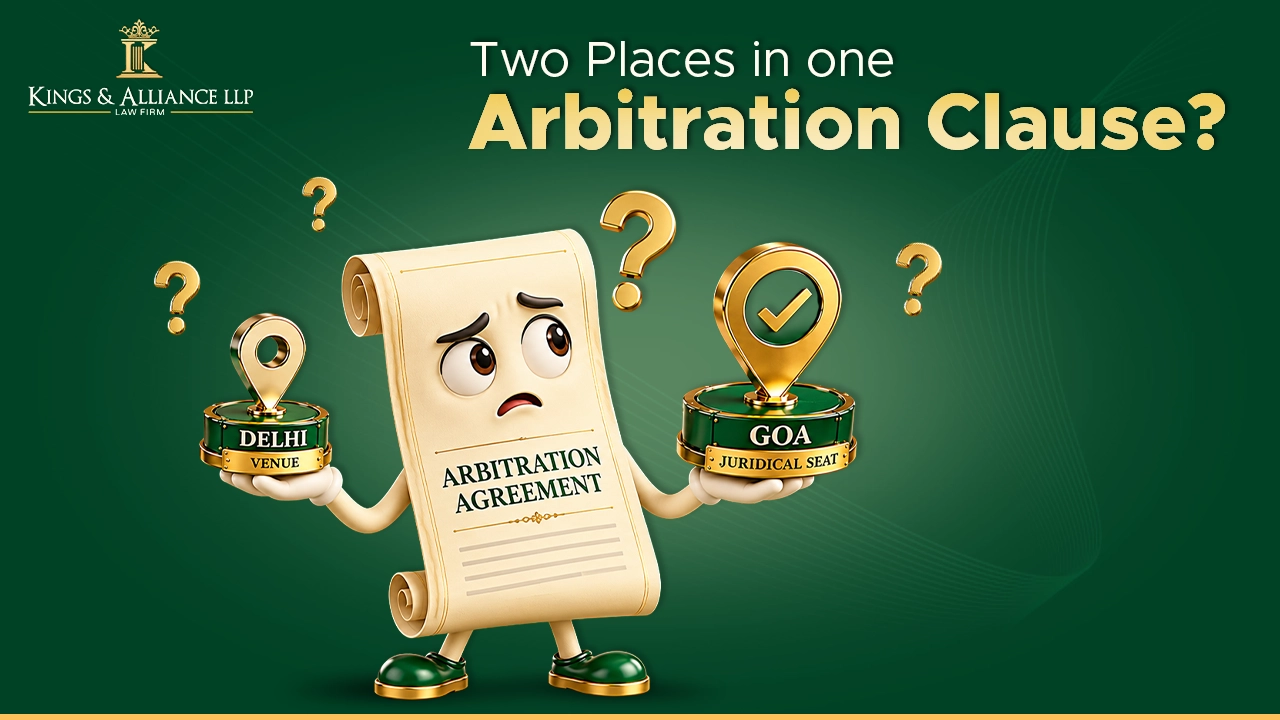
Arcis Clean Energy Pvt. Ltd. v. Parshva Innovation, an appeal against the Delhi High Court’s order dated 11.11.2025, which had appointed a sole arbitrator under Section 11(6)1 of the Arbitration and Conciliation Act, 1996 for disputes under a Franchise Agreement dated 03.08.2023. Clause 32 of the agreement provided for 30 days of negotiation, failing which disputes would go to a sole arbitrator. Clause 32.4 stated that the location of the arbitration “shall be within Delhi”, Clause 32.5 stated that proceedings “will be held in Goa”, and Clause 38 submitted the parties to the exclusive jurisdiction of competent courts in Goa.
Parshva Innovation proposed an arbitrator by notice dated 25.03.2025, which Arcis rejected on 19.04.2025. Parshva then approached the Delhi High Court, which appointed the arbitrator and left the venue of hearings to be fixed in consultation with the parties.
Arcis argued that the Delhi High Court lacked jurisdiction because the seat was Goa. According to it, Clause 32.4 only identified a venue, while Clauses 32.5 and 38 fixed the seat, so the High Court had mistaken the venue for seat. It relied on Arif Azim,2 Indus Mobile,3 Swastik Gases,4 BGS SGS SOMA5 and Activitas Management.6 Parshva argued that an arbitration clause is independent of the rest of the contract, so Clause 38 could not determine the seat. It added that Clause 32.4 specifically fixed Delhi and, appearing first, prevailed over Clause 32.5. It relied on Sasan Power,7 Cable Corporation of India,8 Sunil Kumar Chandra,9 Ramkishorelal,10 Shree Bhowani Cotton Mills11 and Lyrus Life Sciences.12
The question was whether Delhi was the juridical seat or only a venue, which decided whether the Delhi High Court had jurisdiction under Section 11(6). The Court began with settled law. Indus Mobile treats the seat as akin to an exclusive jurisdiction clause. Swastik Gases held that the absence of words like “exclusive” or “only” is not decisive, a view followed in Brahmani River Pellets and Activitas Management. Where an agreement names a place of arbitration but gives exclusive jurisdiction to courts elsewhere, the question is whether the place is a mere venue or the seat. For that, BGS SGS SOMA and Arif Azim require that only one place be designated, that the proceedings be anchored to it alone, and that there be no significant contrary indicia.
Applying this, the Court held that Delhi was not the only place named, since both Delhi and Goa appeared in the arbitration clause itself. The designated venue therefore could not automatically be treated as the seat. In such a situation, the Governing Law clause becomes helpful, and since Clause 38 gave exclusive jurisdiction to Goa courts and Clause 32.5 provided for proceedings in Goa, the parties had agreed that Goa was the seat and Delhi merely a venue.
The Court rejected the argument that the arbitration clause alone determines the seat, because that clause itself mentioned two places. Relying on Mankastu Impex,13 it noted that the mere expression “place of arbitration” cannot establish the parties’ intention on seat, which must be gathered from other clauses and conduct. It also observed that Clauses 32.4 and 32.5 appear to conflict, but read harmoniously with Clause 38 so that neither becomes redundant, the seat is clearly Goa.
Parshva’s authorities were distinguished one by one. Sasan Power correctly holds that the arbitration clause is independent, but here the clause itself names two places, one of which the parties chose for exclusive jurisdiction. Cable Corporation involved a clause specifying a single place. In Sunil Kumar Chandra, the clause was not extracted and it was unclear whether the other place was for arbitration. Ramkishorelal only states the general principle of ascertaining intention from all words, and Shree Bhowani concerned whether an exclusive jurisdiction clause nullifies an arbitration agreement, which was not in dispute here.
On a holistic reading, the Court held that the juridical seat was Goa and that the Delhi High Court lacked jurisdiction under Section 11(6). The appeal was allowed, the High Court’s order was set aside, and the parties were left at liberty to take recourse to appropriate proceedings before the jurisdictional High Court.
Citations
- Arbitration and Conciliation Act, 1996, s. 11(6) ↩︎
- Arif Azim Co. Ltd. v. Micromax Informatics FZE, (2025) 9 SCC 750 ↩︎
- Indus Mobile Distribution (P) Ltd. v. Datawind Innovations (P) Ltd., (2017) 7 SCC 678 ↩︎
- Swastik Gases (P) Ltd. v. Indian Oil Corpn. Ltd., (2013) 9 SCC 32 ↩︎
- BGS SGS SOMA JV v. NHPC Ltd., (2020) 4 SCC 234 ↩︎
- Activitas Management Advisor (P) Ltd. v. Mind Plus Healthcare (P) Ltd., 2025 SCC OnLine SC 3069 ↩︎
- Sasan Power Ltd. v. North American Coal Corpn. (India) (P) Ltd., (2016) 10 SCC 813 ↩︎
- Cable Corpn. of India Ltd. v. Jay Pee Sports International Ltd., 2023 SCC OnLine Del 3446 ↩︎
- Sunil Kumar Chandra v. Spire Techpark (P) Ltd., 2022 SCC OnLine Del 3129 ↩︎
- Ramkishorelal v. Kamal Narayan, AIR 1963 SC 890 ↩︎
- Shree Bhowani Cotton Mills v. Union Textile Traders, AIR 1960 SC 200 ↩︎
- Lyrus Life Sciences (P) Ltd. v. Acme Generics LLP, Civil Misc. Petition No. 192 of 2020 ↩︎
- Mankastu Impex (P) Ltd. v. Airvisual Ltd (2020) 5 SCC 399 ↩︎
Expositor(s): Adv. Pratistha Dahiya
This article is for information only and is not legal advice. Read the disclaimer