Trending topic · Constitution
Courting Chennai: The Law Behind the Demand for a regional supreme court bench
On this page
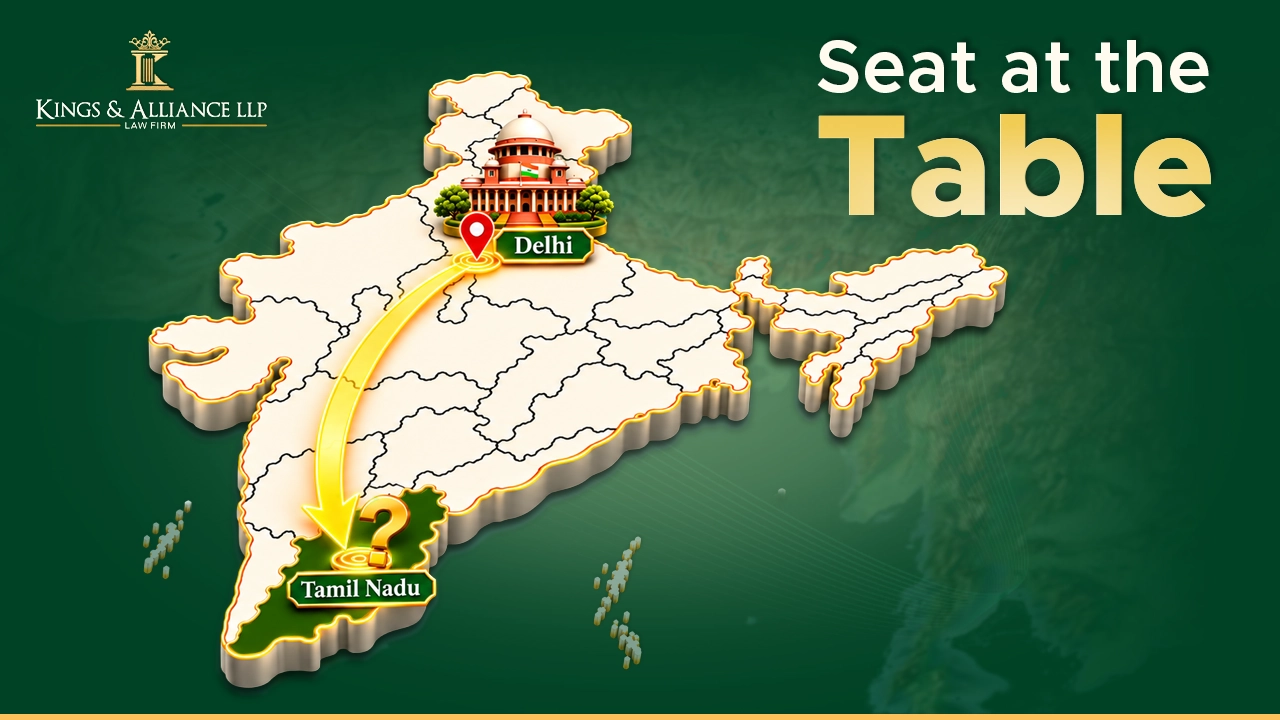
For more than seventy-five years, the Supreme Court of India has sat in Delhi. The Constitution, however, Article 1301 lets the Chief Justice, with the President’s approval, appoint other places for the Court to sit, a power exercised in the past in Hyderabad and Kashmir. Tamil Nadu’s Chief Minister has now revived the demand for a bench in Chennai.On 4 November 2026, Chief Minister C. Joseph Vijay wrote to the Prime Minister asking him to take steps to set up a regional Supreme Court bench in Chennai. The letter calls this a demand Tamil Nadu first raised in 1980, relies on Article 130, cites Parliamentary Standing Committee recommendations of 2004, 2006, 2008 and 2021 along with Law Commission reports, and recalls that the Full Court on 7 August 2007 stood by its earlier resolutions even after the State offered infrastructure and judges’ residences.
What Article 130 Says
Article 130 provides that the Supreme Court sits in Delhi or at such other place or places as the Chief Justice of India appoints with the President’s approval. In Union of India v. S.P. Anand,2 a three-judge bench held that Article 130 is an enabling provision, that the decision lies with the Chief Justice and the President, and that no court can direct either of them to use it. A writ seeking sittings at Indore failed. In Madhya Pradesh High Court Advocates Bar Association v. Union of India,3 the Court rejected an inaccessibility argument against the National Green Tribunal Act and observed that the same argument would question Delhi itself as the seat, noting that the Court has no bench away from Delhi despite Article 130.
So the power is real, its holder is clear, and it cannot be compelled. What remains is the history of how it has been used. Secondary accounts say the Court has sat outside Delhi twice, once for a bench dealing with Hyderabad appeals under Chief Justice Kania and once for Kashmir appeals in 1954 under Chief Justice Mahajan, both transferred from the Privy Council. These were temporary arrangements for a bulky inherited docket, not permanent benches.
How the Idea Kept Returning
In Bihar Legal Support Society v. Chief Justice of India,4 a Constitution Bench said in 1986 that the Court was never meant to be a regular court of appeal from the High Courts and that a National Court of Appeal would be desirable. The Law Commission’s 95th Report (1984)5 had proposed a Constitutional Division. Its 125th Report (1988)6 added that litigants from places like Tamil Nadu, Gujarat and Assam face heavy travel costs, and that a Federal Court of Appeal sitting in benches across the country would raise no serious objection. Its 229th Report (2009)7 proposed a Constitution Bench at Delhi and four Cassation Benches at Delhi, Chennai or Hyderabad, Kolkata and Mumbai, suggesting Article 130 might be read liberally to do this, failing which Parliament should legislate. The Court has shared the diagnosis. In Mathai @ Joby v. George,8 it lamented that special leave petitions were turning it into an ordinary appellate court, and in 2016 it said the same in V. Vasanthakumar v. H.C. Bhatia,9 where it also noted that more than three-quarters of fresh filings are dismissed at the threshold.
Parliament’s committees kept pressing. The Standing Committee’s 20th (2007), 26th and 28th (2008)10 reports urged at least a trial bench in Chennai. Its 133rd Report, presented in August 2023,11 still holds that the Court may invoke Article 130 for regional benches at four or five locations, with constitutional questions at Delhi and appellate matters elsewhere, though not as a final extra layer. It also records near unanimity among members, while noting that some wanted the effect of e-courts examined more carefully.
The Court’s Answer
Against that long run of recommendations, the Court’s answer has been brief. After the Committee’s 20th Report, Chief Justice K.G. Balakrishnan informed the Law Minister that the Full Court, meeting on 7 August 2007, found no justification for deviating from its earlier resolutions and unanimously resolved that the recommendation could not be accepted. After the 229th Report, the Full Court on 18 February 2010 again found no justification for benches outside Delhi. The Government repeated this to the Rajya Sabha on 25 July 2024 and again to Parliament in early February 2026.
The Full Court, the Supreme Court’s judges meeting on the administrative side, has twice declined to set up benches outside Delhi, in August 2007 and again in February 2010, when it found no justification for them. Parliament has since been told the same thing, with the added line that the question is now before the Court and there is no proposal at present for the same.
The reasons behind that “no” come mostly second-hand. The one most often reported is that splitting the Court would damage its unitary character, meaning that India has a single Supreme Court and benches in other cities would start to turn it into several. The Chief Justice at the time, K.G. Balakrishnan, put it more bluntly: a divided Supreme Court would no longer be the apex court. His answer to pending cases was more judges in Delhi, not benches elsewhere.
The Centre’s argument in the Court itself went one step further. It said a regional court of appeal would need a constitutional amendment, and that citizens have a right under Article 13612 to bring their appeals to the Supreme Court itself, a right that cannot be handed to another court. The Court did not accept or reject this. It sent the question, with 11 questions of law, to a five-judge Constitution Bench, where it still sits undecided.
Where This Leaves the Law
The legal questions are narrower than the political noise. First, can Article 130 support permanent regional benches without an amendment? The Law Commission and the Committee think so; critics say that stretches its intent. Second, is such a bench consistent with the basic structure? That is among the eleven questions framed in Vasanthakumar.13 They ask, among other things, whether long delay denies access to justice, whether more judges would answer it, whether splitting the Court into a constitutional and an appellate wing would help, whether the Court’s location in the far north deters litigants from the south, and whether sitting in benches in different places would meet that problem.
One distinction also deserves care. The Chief Minister’s letter asks for a Bench of the Supreme Court. The Law Commission’s Cassation Benches would take on all appellate work from each region’s High Courts. Our reading is that a bench sitting under Article 130 remains the Supreme Court, so it would raise the Article 136 question the Union pressed in 2016, but the scale of what is asked decides how much of the docket moves.
Third, who can act? Under S.P. Anand,14 only the Chief Justice with the President’s approval, so a State’s letter to the Prime Minister can request but not compel.The Law Commission also treated the Chief Justice as acting on his own under Article 130, without needing to consult anyone.
Weaknesses on Both Sides
Neither side’s position is airtight. The demand has its own gaps. The 229th Report named Chennai or Hyderabad, not Chennai alone, and the Committee spoke of four or five locations, so any decision would draw competing claims. The latest committee report we found is from 2023, which the reported letter does not mention. And the 2007 offer of infrastructure did not change the Court’s answer, which suggests the objection was never logistical. On the other side, an unexplained policy is hard to defend when the Court itself called a National Court of Appeal desirable in 1986 and referred the question to a Constitution Bench in 2016.
What Happens Next
There are three paths. The Chief Justice could act under Article 130 with presidential approval and no new law. The Constitution Bench could take up Vasanthakumar. Or Parliament could legislate if Article 130 is held too narrow. None has visibly moved. Whatever one thinks of regional benches, the debate would be sharper if the Court’s reasons were on the record.
Citations
- The Constitution of India, art. 130 ↩︎
- Union of India v. S.P. Anand, (1998) 6 SCC 466 ↩︎
- Madhya Pradesh High Court Advocates Bar Association v. Union of India, W.P.(C) 433 of 2012 ↩︎
- Bihar Legal Support Society v. Chief Justice of India, (1986) 4 SCC 767 ↩︎
- Law Commission of India, 95th Report: Constitutional Division within the Supreme Court – A Proposal for, (1984) ↩︎
- Law Commission of India, 125th Report: The Supreme Court – A Fresh Look, (1988) ↩︎
- Law Commission of India, 229th Report: Need for Division of the Supreme Court into a Constitution Bench at Delhi and Cassation Benches in Four Regions at Delhi, Chennai/Hyderabad, Kolkata and Mumbai, (2009) ↩︎
- Mathai @ Joby v. George, (2010) 4 SCC 358 ↩︎
- V. Vasanthakumar v. H.C. Bhatia# (WP (C) 36/2016) ↩︎
- Department-related Parliamentary Standing Committee on Personnel, Public Grievances, Law and Justice, Demand for Grants (2007–08), 20th Report (2007); Demand for Grants (2008–09), 26th Report (2008); Demands for Grants (2008–09), 28th Report (2008) ↩︎
- Department-related Parliamentary Standing Committee on Personnel, Public Grievances, Law and Justice,Judicial Processes and Their Reforms, 133rd Report (2023) ↩︎
- The Constitution of India, art. 136 ↩︎
- Supra 9 ↩︎
- Supra 2 ↩︎
Expositor(s): Adv. Pratistha Dahiya
This article is for information only and is not legal advice. Read the disclaimer