Introduction
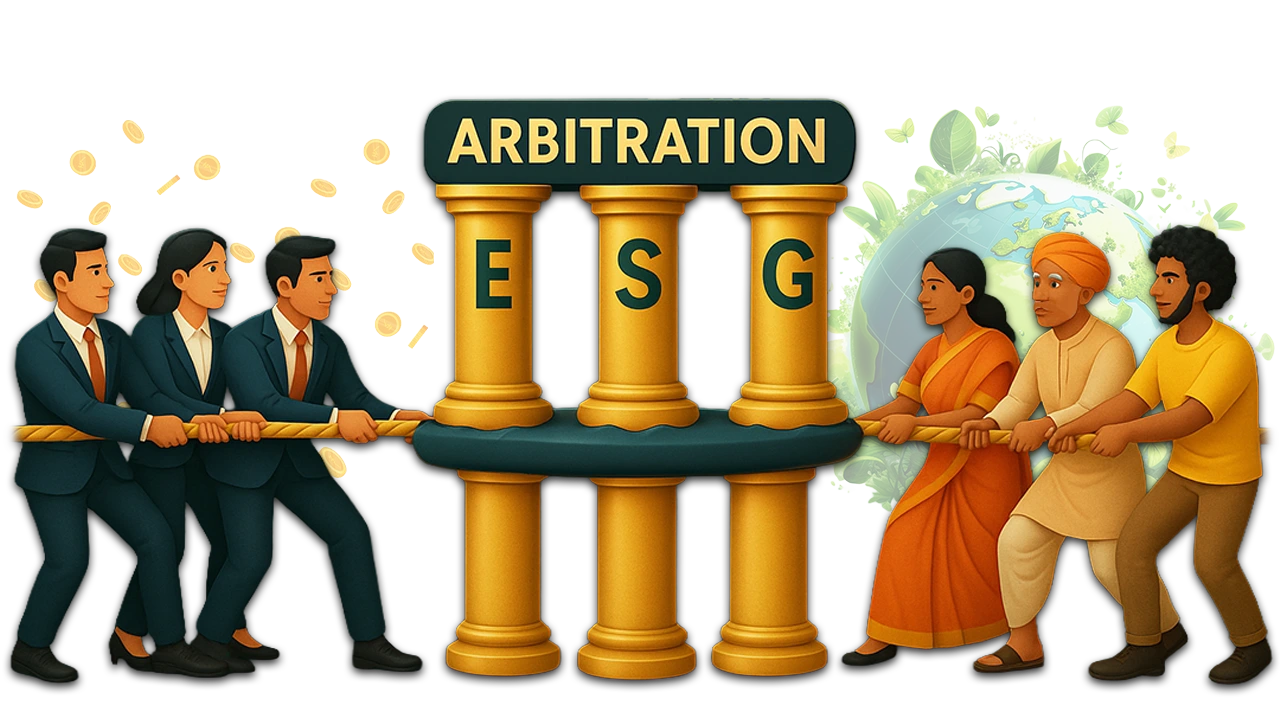
The burgeoning prominence of ESG1 concerns is undeniably reshaping the corporate landscape in India. What was once a niche interest has rapidly evolved into a critical lens through which investors, consumers, and stakeholders scrutinize businesses. This shift isn’t merely about good corporate citizenship; it’s about inherent value, long-term sustainability, and, increasingly, a fertile ground for disputes. And surprisingly, these disputes are finding an intriguing home in the seemingly private world of arbitration.
The Inexorable Rise of ESG Disputes
Gone are the days when a company’s financial sheet was its sole report card. Today, a firm’s impact on the planet, its treatment of people, and the integrity of its leadership are equally, if not more, vital. This heightened awareness has inevitably led to friction.
Consider the environmental front: a factory’s unchecked emissions, improper waste disposal, or even the devastating consequences of deforestation. These aren’t just regulatory infringements; they can be contractual breaches, sparking clashes over environmental compliance and remediation.
Then there’s the social dimension, a broad canvas encompassing everything from human rights and fair labor practices to workplace diversity and community engagement. Allegations of modern slavery in supply chains, unsafe working conditions, or adverse impacts on indigenous communities are no longer whispers but potentially actionable claims.
Finally, corporate governance acts as the crucial framework. Issues like executive overreach, lack of transparency, shareholder disenfranchisement, or instances of bribery and corruption can erode trust and trigger intense disagreements.
Historically, such battles might have played out in public courts or regulatory bodies. But with ESG clauses increasingly woven into commercial contracts, shareholder agreements, and even investment treaties, the stage is being set for these complex arguments to unfold in arbitral tribunals.
Navigating the Labyrinth: Challenges of ESG Claims in Arbitration
While arbitration offers a beacon of efficiency and expertise, ushering ESG claims into this forum is akin to steering a ship through uncharted waters. The challenges are distinctive and demand innovative solutions:
- The Tapestry of Facts: Unlike a standard contract breach, ESG disputes often involve an intricate web of scientific data—think climate models, pollution metrics, or biodiversity impact assessments. They demand an understanding of social impact studies, intricate supply chain mapping, and detailed financial analyses related to sustainable investments. Can arbitrators, typically legal eagles, truly grasp this multifaceted factual matrix without specialized training?
- Beyond Legal Textbooks: Imagine trying to resolve a dispute based not on black-letter law, but on evolving international norms, industry best practices, or voluntary sustainability guidelines. ESG claims frequently rely on these “soft laws” which, while morally compelling, lack the clear-cut enforceability of codified statutes. This ambiguity poses a significant hurdle for arbitrators tasked with determining liability.
- A Choir of Voices: ESG issues rarely involve just two disputing parties. Local communities, environmental NGOs, labor unions, and even future generations can have a profound stake in the outcome. How can a traditionally bilateral, confidential arbitration process adequately accommodate these diverse, often unrepresented, interests? Does it risk privatizing justice for matters of public good?
- The Intangible Price Tag: How does one quantify the damage of a polluted river, the loss of a unique ecosystem, or the reputational fallout from a human rights violation? Calculating damages in ESG claims is often an exercise in the abstract, given the lack of standardized methodologies for valuing such non-financial harms.
- The Public’s Eye: Many ESG issues, particularly those touching upon environmental degradation or social injustice, carry a significant public interest element. The inherent confidentiality of arbitration, while beneficial for corporate privacy, can clash with the public’s right to know and the need for accountability in matters of societal consequence.
India’s Arbitral Compass: Guiding ESG Disputes
Despite these formidable challenges, arbitration possesses inherent strengths that make it a compelling, and perhaps inevitable, choice for ESG disputes in India.
- The Power of the Expert: Perhaps the most compelling advantage is the ability to handpick arbitrators. For an environmental dispute, imagine appointing an arbitrator who understands ecological science or regulatory frameworks. For a social issue, a legal professional with expertise in human rights or labor law can bring unparalleled insight. This ensures a more informed, nuanced, and ultimately, more accurate resolution.
- A Shield of Confidentiality: For companies grappling with sensitive ESG allegations, the confidential nature of arbitration is a significant draw. It allows them to manage reputation and protect proprietary information, minimizing the public fallout that can accompany courtroom battles.
- Speed and Flexibility: Compared to the often-glacial pace of traditional litigation, arbitration offers a more agile and adaptable process. Parties can customize procedural rules, timelines, and discovery protocols, leading to quicker resolutions—a critical factor when urgent intervention, such as preventing further environmental damage, is required.
- Global Reach, Local Impact: India’s adherence to the New York Convention means that arbitral awards can be enforced across borders. Given the globalized nature of many ESG supply chains and investments, this international enforceability provides a distinct advantage over national court judgments.
- Tailored Solutions: Arbitration empowers parties to define their dispute resolution journey, from the substantive law governing their ESG obligations to the language of proceedings and the scope of evidence. This autonomy allows for creative, context-specific solutions to complex ESG challenges.
However, a crucial legal tightrope must be walked in India: the distinction between “right in rem” (disputes affecting the public at large) and “right in personam” (individual contractual rights). While the latter are generally arbitrable, Indian courts have historically deemed certain public interest matters non-arbitrable. The Arbitration Act2, remains silent on specific non-arbitrable subjects, leaving it to judicial interpretation. This means that an arbitration clause relating to an ESG matter must be meticulously drafted to ensure its subject matter falls squarely within the arbitrable domain. Past precedents, such as cases concerning labor disputes under the IDA3, and consumer disputes under the CP Act4, highlight this delicate balance.
Forging a Specialized Path: India’s Opportunity
India’s vibrant arbitration ecosystem, coupled with its growing commitment to sustainable development, presents a unique opportunity to cultivate specialized expertise in ESG arbitration.
The path forward requires deliberate steps:
- Educating the Arbitrators: We need dedicated training programs for arbitrators, focusing on ESG principles, relevant international standards, scientific methodologies for environmental impact assessments, and social audit techniques. This will empower them to confidently navigate the intricacies of ESG claims.
- Crafting ESG-Specific Rules: Indian arbitral institutions could learn from international efforts like the PCA Environmental Rules, 2001, and develop their own tailored rules for ESG disputes. These rules could address critical aspects such as multi-party involvement, allowing “amicus curiae” briefs from public interest groups, establishing clear expert witness protocols for scientific evidence, and developing innovative mechanisms for quantifying non-traditional damages.
- Building a Roster of Expertise: Creating and maintaining comprehensive rosters of legal, scientific, and social experts who can serve as arbitrators or provide expert opinions in ESG-related arbitrations is paramount. This ensures a readily available pool of qualified talent.
- Embracing Collaborative Solutions: Given the often sensitive and long-term nature of ESG issues, encouraging mediation and conciliation as primary or parallel dispute resolution methods is vital. These approaches foster collaboration and can help preserve crucial relationships.
- Balancing Confidentiality with Transparency: While arbitration’s confidentiality is a strength, a degree of transparency, especially in cases with significant public interest, could bolster its legitimacy. This might involve publishing anonymized awards or summary reports, with the consent of all parties.
Conclusion: The Unfolding Horizon of ESG Arbitration in India
The integration of ESG principles into the very fabric of corporate India is no longer an aspiration but a tangible reality. As this integration deepens, so too will the complexity and frequency of disputes arising from environmental stewardship, social responsibilities, and corporate governance. Arbitration, with its inherent flexibility, confidentiality, and potential for specialized expertise, stands poised to become a cornerstone in resolving these intricate disagreements. We’ve explored the unique challenges – the labyrinthine factual matrices, the reliance on evolving non-legal standards, the multi-party interests, and the profound difficulty in quantifying intangible damages. Yet, we’ve also highlighted arbitration’s inherent strengths: the ability to select expert arbitrators, its confidential nature, procedural efficiency, global enforceability, and the empowering autonomy it grants to parties.
The path forward for Indian arbitration in this critical domain is one of deliberate evolution. It demands a proactive investment in capacity building for arbitrators, the development of ESG-specific procedural rules, the creation of expert rosters, and a greater emphasis on collaborative dispute resolution mechanisms like mediation. However, this journey is not without its future ramifications and struggles. The tension between arbitration’s private nature and the public interest inherent in many ESG issues will continue to be a significant challenge. Furthermore, the constant evolution of ESG standards and scientific understanding will necessitate a highly adaptive arbitral framework. The judiciary’s continued interpretation of “arbitrability” for public interest matters will also shape the scope of ESG disputes amenable to this forum.
Ultimately, as corporations worldwide increasingly commit to more sustainable and ethical practices, the effectiveness of their dispute resolution mechanisms will become a direct reflection of their commitment. Imagine a scenario five years from now, where a major cross-border investment in a green energy project in India faces allegations of displacing indigenous communities and violating local environmental laws. The investment treaty contains a robust arbitration clause, but the affected communities are not direct parties. How would an Indian arbitral tribunal, balancing commercial interests with evolving human rights and environmental principles, navigate such a multifaceted dispute, and could its eventual award truly be seen as a just and holistic resolution by all stakeholders, both within the confines of the arbitration and in the broader public eye? This hypothetical underscores the profound questions and responsibilities that lie ahead for ESG arbitration in India.
Citations
- Environmental, Social, and Governance
- The Arbitration and Conciliation Act,1996
- Consumer Protection Act, 2019
- Industrial Disputes Act, 1947
Expositor(s): Adv. Anuja Pandit