Introduction
The efficacy of Arbitration as a specialized dispute resolution mechanism hinges upon the timely and precise invocation of a court’s power to refer parties to their chosen forum. However, this power is not self-executing. The central legal issue in this scenario is whether the mandatory requirement under Section 8 of the Arbitration Act for a party to apply for a reference to arbitration necessitates a formal, independent, and standalone application, or the Court possesses the authority to mould alternative reliefs, such as a prayer for the rejection of a plaint, to satisfy this statutory mandate.
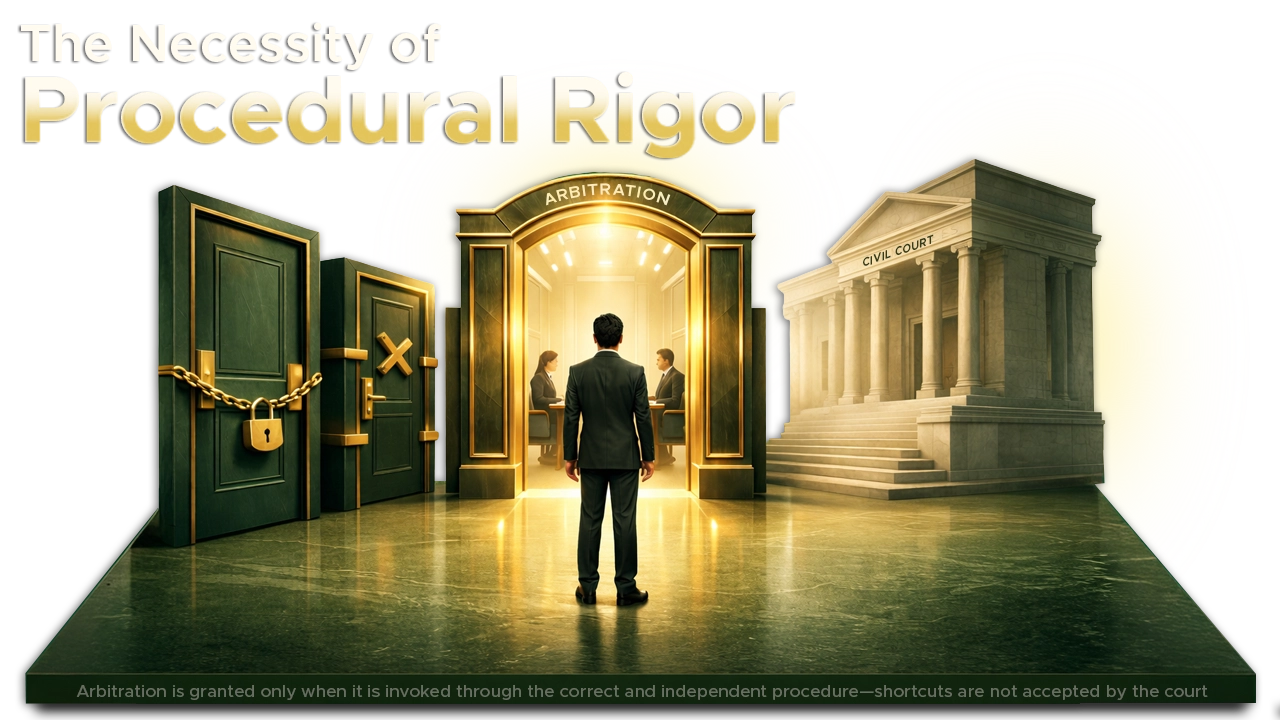
This fundamental question of procedural compliance was discussed in Jagannath Heights Pvt Ltd v. M/s Sammaan Capital Limited1, adjudicated by the High Court at Calcutta, Commercial Division, and presided over by Hon’ble Justice Aniruddha Roy. It was held that a defendant is barred from seeking an arbitral reference if their formal prayers only seek the dismissal or rejection of the suit under the CPC2. It was further emphasized that the essential of filing a standalone application is a mandatory precondition that cannot be bypassed by seeking collateral civil remedies.
The factual matrix originated from a suit filed by the plaintiff despite the existence of an arbitration clause in the underlying contract. The defendant, rather than filing a dedicated application under Section 8 of the Arbitration Act3, took out a Master’s Summons praying for the dismissal of the suit, the rejection or return of the Plaint under the CPC, or a stay of the proceedings. While the defendant’s supporting affidavit referenced Section 8 and the arbitration agreement, the formal prayers in the summons were directed towards the dismissal and rejection of the suit, rather than a specific reference to arbitration.
The Core Conflict: Procedural Technicality v. Arbitral Intent
The defendants, herein the Applicants, argued that because an arbitration agreement exists, the matter must be referred to arbitration as required by Section 8 of the Arbitration Act. They argued that the substance of the application shall be considered as a whole rather than focusing on the parts. It was asserted that even though the Master’s Summons asks for the rejection and return of the suit, the requested relief is broad enough to be adapted by the bench to meet the legal standards for an arbitration reference.
The Plaintiffs contended that the prayers for dismissal and rejection of the plaint are reliefs which cannot be granted under Section 8 of the Arbitration Act. It was further argued that the defendant’s application was fundamentally not filed under the Arbitration Act, and when a specific provision is laid down under a statute, a formal and specific application must be filed to invoke it.
The Applicants cited Madhu Sudan Sharma v. Omaxe Ltd4. and Naolin Infrastructure Private Limited v. Kalpana Industries5 to contend that a prayer for the rejection of a plaint could be moulded into a Section 8 reference if an arbitration agreement exists. The Court, however, rejected the liberal interpretation relying upon the precedent Smt. Gitarani Maity Vs. Mrs. Krishna Chakraborty6, wherein it was clarified that there is a “gulf of difference” between seeking the dismissal of a suit for lack of jurisdiction and seeking a reference to arbitration. In the case of Lindsay International Private Limited v. Laxmi Niwas Mittal7, it was established that an objection to a civil court’s jurisdiction is not synonymous with an application under Section 8, and that a formal, standalone application is a non-negotiable essential for triggering the same. Applying this logic to the present matter, it was observed that the defendant’s prayers for the rejection and return of the plaintiff under the Code of Civil Procedure operated at a different legal level than an Arbitration reference.
Adhering to the settled legal principle that when a statute prescribes a specific manner for an act, all other modes are expressly forbidden. On this basis, the defendant’s application was dismissed, ruling that it could not be construed or accepted as a valid request under Section 8 of the Arbitration Act. Because the defendant herein, the applicant, chose to seek the dismissal and rejection of the suit rather than a formal reference to arbitration, the filing failed to meet the mandatory statutory criteria.
Conclusion
The judgment in Jagannath Heights Pvt Ltd (Supra) reinforces the boundary between general civil procedure and the specialized requirements of the Arbitration Act. This ensures that once a suit is instituted, it proceeds without interruption unless a clear, unequivocal request for arbitration is made through a standalone application. By requiring a standalone application, it shall be ensured that the choice to arbitrate is made clearly and unequivocally.
It provides certainty to the legal process and ensures that the mandatory provisions of the Arbitration Act are applied only when the correct procedure has been followed. This serves as a firm reminder to practitioners that the judicial duty to refer a dispute is only triggered once a party fulfills the precise statutory criteria.
Ultimately, this reinforces the principle that procedural compliance is essential for the enforcement of arbitration agreements. By upholding these standards, it shall be ensured that the specialized framework of the Arbitration and Conciliation Act is preserved and respected. But as the courts continue to narrow the window for procedural deviations, one must ask whether this insistence on standalone applications streamlines the transition to arbitration, or will it inadvertently allow technicalities to trap parties in a civil litigation process they had expressly agreed to avoid?
Citations
Expositor(s): Adv. Shreya Mishra, Srijan Sahay (Intern)