Arbitration · Delhi High Court
Neutrality at the Soul of Arbitration: Delhi HC on a Bank’s Repeat Arbitrator Appointments
On this page
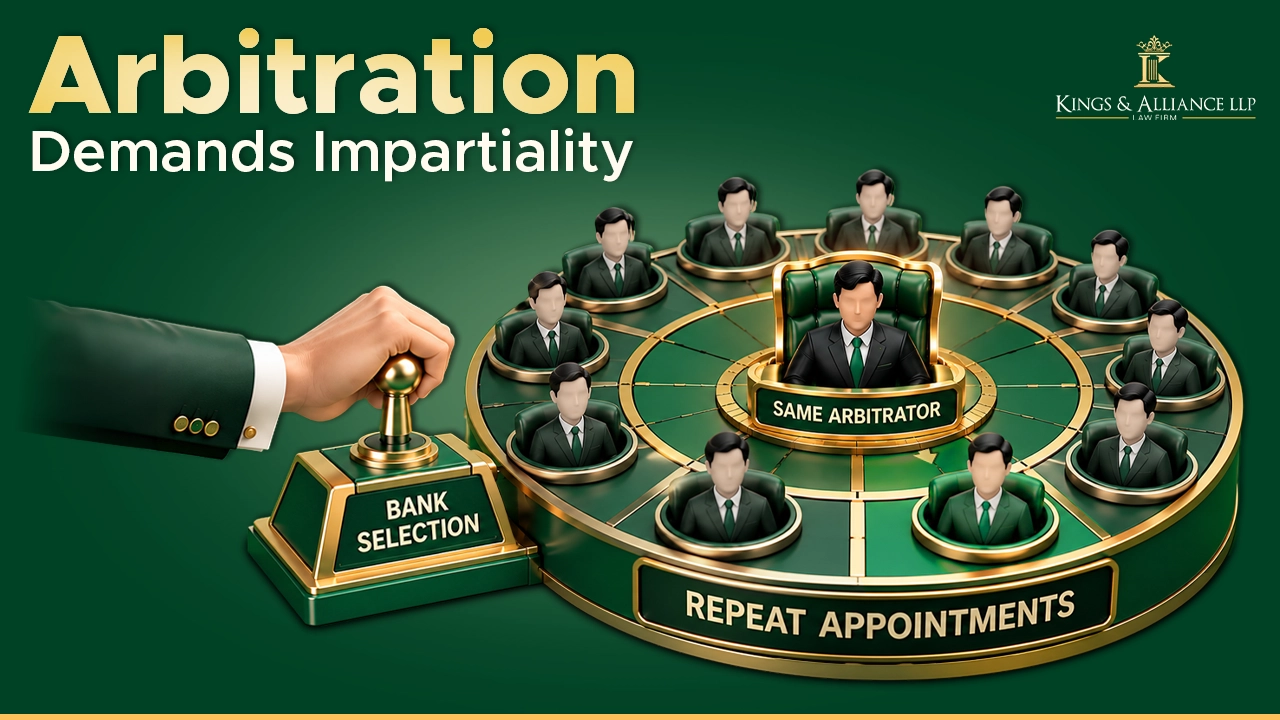
Can a bank keep sending thousands of loan disputes to an arbitrator it has chosen itself and still expect the resulting awards to be enforced? The Delhi High Court gave a pointed answer in Shikha Ghosh v. Axis Bank Ltd. & Anr.,1 hearing a borrower’s appeal in a Rs 16.66 lakh loan matter, a Division Bench consisting of Justice Prathiba M. Singh and Dinesh Bhatt found that a single sole arbitrator had handled 4,155 arbitrations concerning the Bank in four to five years, described this as “the most shocking aspect uncovered from the affidavit of the Respondent Bank,” and directed the Reserve Bank of India to caution all banks on unilateral appointments. For lawyers acting for borrowers or lenders in recovery arbitrations, the order is an early signal of how closely courts may now examine awards passed by arbitrators appointed by the lender alone. The matter remains part-heard, so this is not the Court’s last word.
Axis Bank disbursed a loan of Rs 16,66,795 to Shikha Ghosh in January 2019. Alleging default, the Bank initiated arbitration after communicating this to her on 18 January 2023, though she disputes receiving that communication. The sole arbitrator, Shri Vikrant Bhardwaj, is stated to have accepted the reference on 6 February 2023 and issued notice to her, which she also disputes receiving. He proceeded ex-parte on 16 May 2023 and passed an award on 26 May 2023, a copy of which reached her on 2 June 2023. Her Petition under section 34 of the Arbitration and Conciliation Act, 19962 was dismissed by the Commercial Court as time barred on 30 January 2025, and she appealed. On 3 September 2026, the High Court asked the Bank to file an affidavit of proof of service, the arbitrator’s connection to the bank, the number of arbitrators he had handled for it, and whether he had given the affidavit.
Revelations the Affidavit brought
The Bank answered that service was proved by the award’s own recital, that the arbitrator had no relationship with it of the kind contemplated under the Seventh Schedule,3 that he had conducted 4,155 arbitrations for it over four to five years, and that he had given the requisite declarations. The Court observed that, apart from the arbitrator’s own recital in the award, there was no proof of service, and that a Bank official present in Court said the arbitrator’s fees were paid through the Bank’s lawyer.
The Court then turned to the Fifth Schedule,4 which lists 34 circumstances giving rise to justifiable doubts about an arbitrator’s independence or impartiality. It noted that two of them concern arbitrators appointed on two or more occasions by one party within the past three years, or serving in another arbitration on a related issue involving a party. These amendments took effect on 23 October 2015, yet the Court was informed that unilateral appointments by the Bank continued until 2023. The Court observed that “the scale of conflict contemplated under the Fifth Schedule was of a far lower level than what has been unearthed here.”
The Bank’s Concession and the Wider Numbers
Senior Advocate Dayan Krishnan, for the Bank, conceded that awards arising from the Bank’s unilateral appointments are void ab initio, in view of the settled principle of neutrality at all stages of arbitration laid down by the Supreme Court in Perkins Eastman Architects DPC v. HSCC (India) Ltd.5 and Central Organisation for Railway Electrification v. ECI SPIC SMO MCML (JV).6 The Court noted that it had itself set aside awards on this ground in earlier cases. Counsel also disclosed that, of the 4,155 cases, about 2,700 (almost 65 percent) had been settled, and in about 1,264 no execution petition had been filed and no fresh appointment made. He stated that no unilateral appointment had been made since 2023, and that 76,000 awards had been passed pan-India by such sole arbitrators concerning the Bank.
Reacting to these figures, the Court said: “The clear impression that the Court gathers from the above is that this is nothing but the tip of an iceberg.” It held that arbitrators appointed in thousands of matters without filing proper declarations cannot be said to be independent and impartial, adding that “even judging by the unamended Section 12(1) of the ACA, 19967 handling thousands of the arbitrations by the very same arbitrator appointed by one single party would give rise to justifiable doubts as to independence and impartiality.” In its words, “repeated appointments of the same arbitrators in thousands of cases goes against the core of Neutrality which is at the soul of any arbitral process.”
A “Double Blow” for the Lender
The Court was equally direct about the consequences for the Bank. It observed that banks, as custodians of public money, “cannot avail remedies which are contrary to law to recover loans,” while also stating that defaulting borrowers “cannot be allowed to go scot free.” The route the Bank had taken, the Court said, had come as a “double blow”: awards from unilateral appointments are void and unenforceable, and the Bank cannot enforce them or recover the money. It added that “a solution would need to be carved at an institutional level in a centralised manner by the Respondent Bank,” failing which substantial public money would go unrecovered.
Directions and Outcome
The Bank must file a fresh affidavit explaining why thousands of cases went to the same arbitrator, and setting out its future course on awards passed by unilaterally appointed arbitrators, including enforcement and recovery. The RBI, as sector regulator, is to caution all banks so that remedial measures and guidance can be looked into, and must file its affidavit by 16 November 2026. The matter is listed on 17 November 2026 and remains part-heard.
On the borrower’s appeal, the Court noted that the Bank’s stand is that the award is void ab initio and, on that footing, declared the award dated 26 May 2023 unenforceable against Ghosh. The appeal succeeded, and the Bank is free to take fresh steps to recover the loan in accordance with law, if permissible. The declaration rests expressly on the Bank’s own stand, and the order does not decide the limitation question that had defeated her petition in the Commercial Court.
The order is notable less for its result in one borrower’s case than for the Court’s reasoning on scale. It treats repeated appointment of the same arbitrator by one party as a neutrality problem in itself, and it places the burden of explanation on the Bank. It also shows the commercial cost of the practice: an award that cannot be enforced, and a lender that may struggle to begin fresh arbitration. The order does not determine the status of a total of 76,000 awards mentioned by the Bank, and the directions to Axis Bank and the RBI are still to be followed up at the next listing.
Citations
- Shikha Ghosh v. Axis Bank Ltd. & Anr., FAO (COMM) 91/2025 & CM APPL. 20542/2025 ↩︎
- Arbitration and Conciliation Act, 1996, s. 34. ↩︎
- Arbitration and Conciliation Act, 1996, Seventh Schedule. ↩︎
- Arbitration and Conciliation Act, 1996, Fifth Schedule. ↩︎
- Perkins Eastman Architects DPC v. HSCC (India) Ltd., (2020) 20 SCC 760 ↩︎
- Central Organisation for Railway Electrification v. ECI SPIC SMO MCML (JV), (2025) 4 SCC 641 ↩︎
- Arbitration and Conciliation Act, 1996, s. 12(1) ↩︎
Expositor(s): Adv. Pratistha Dahiya
This article is for information only and is not legal advice. Read the disclaimer