Arbitration
No Transfer of Appellate Jurisdiction: Supreme Court Draws the Line Between Sections 17 and 37
On this page
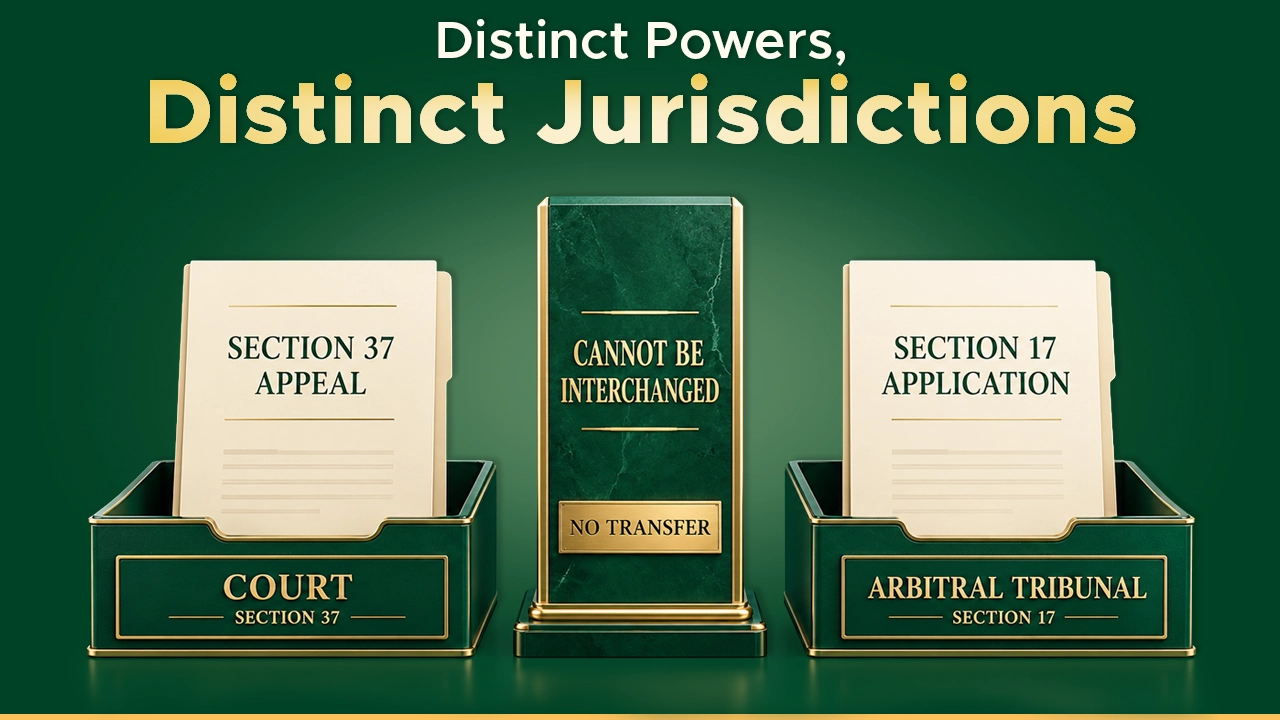
The interplay between court-ordered interim measures and arbitral interim relief raises important questions regarding the distinct jurisdictional boundaries of courts and arbitral tribunals under the Arbitration and Conciliation Act, 1996. In Union of India & Others v. Hariom Projects Pvt. Ltd. (2026),1 the Supreme Court made an important jurisdictional distinction between Sections 92, 173, and 374 of the Arbitration and Conciliation Act, 1996. While setting aside the Bombay High Court’s order, the Supreme Court held that proceedings under Section 37 challenging a Section 9 order cannot be transferred to an arbitral tribunal and treated as a Section 17 application, even with the parties’ consent.
Hariom Projects, the respondents, was awarded a contract for the construction of administrative and training infrastructure at NDA Khadakwasla. Disputes arose regarding payments, escalation, and design issues, following which the respondents invoked arbitration and sought interim relief under Section 9 of the Arbitration and Conciliation Act, 1996 before the District Judge, Pune, seeking an injunction restraining the Appellants from cancelling, terminating or repudiating the contract. The application was dismissed, leading the Respondent to prefer an appeal under Section 37 before the High Court, alongside a petition under Section 11 seeking appointment of an arbitrator. During the pendency of these proceedings, the Appellant terminated the contract on the ground of unsatisfactory performance. The High Court stayed the termination and directed the parties to maintain the existing status quo. Subsequently, with the parties reaching a consensus on the appointment of an arbitrator, the High Court appointed a sole arbitrator and directed that the pending Section 37 proceedings be remitted to the Arbitral Tribunal and treated as an application under Section 17. This direction ultimately became the central issue before the Supreme Court.
Contentions on the Remission of Section 37 Proceedings
The Appellants did not challenge the appointment of the Sole Arbitrator but challenged the High Court’s direction to remit the Section 37 proceedings to the Arbitral Tribunal and treat them as an application under Section 17. It was contended that an order under Section 9 could be challenged only through the statutory appeal under Section 37(1)(b), whose appellate jurisdiction vested exclusively in the Court. An Arbitral Tribunal, exercising powers under Section 17, could not assume such appellate or supervisory jurisdiction, even with the parties’ consent. It was further argued that allowing the Tribunal to reconsider issues already adjudicated under Section 9 amounted to an impermissible delegation of the High Court’s appellate function and was contrary to the statutory scheme of the Act. The Respondents fairly conceded that the direction to treat the pending Section 37 proceedings as a Section 17 application could not be sustained in law. However, it was also submitted that the direction for constitution of the Arbitral Tribunal to resolve the disputes between the parties may be sustained, as the Arbitral Tribunal, after its constitution, had already commenced proceedings.
Supreme Court Delineates the Jurisdictional Divide
The Supreme Court found no infirmity in the High Court’s order staying the effect and operation of the termination of the contract. However, it held that the direction remitting the proceedings pending before the High Court to the Arbitral Tribunal and requiring them to be treated as an application under Section 17 of the Act could not be sustained. The Court observed that appellate jurisdiction under Section 37 is vested exclusively in the “Court” as defined under Section 2(1)(e)5 of the Act. An Arbitral Tribunal exercising powers under Section 17 does not exercise appellate jurisdiction over an order passed by a competent Court under Section 9. Consequently, treating the Section 37 proceedings as a Section 17 application would require the Tribunal to examine the subject matter of a statutory appeal, which is beyond its jurisdiction. The Court further clarified that the nature and source of the powers exercised by an appellate Court under Section 37 are distinct from those conferred upon an Arbitral Tribunal under Section 17 and cannot be interchanged merely by transmitting or remitting the appellate proceedings to the Tribunal. At most, upon the constitution of the Arbitral Tribunal, the High Court could have granted liberty to the Respondent-Claimant to independently approach the Tribunal under Section 17 for such interim measures as may be available in law.
Maintaining the Statutory Divide Between Sections 9, 17 and 37
Accordingly, The Supreme Court set aside the Bombay High Court’s order to the limited extent that it treated the proceedings under Section 37 as proceedings before the Arbitral Tribunal and directed them to be treated as an application under Section 17 of the Act. The judgment reinforces that the different statutory remedies under Sections 9, 17 and 37 operate within distinct jurisdictional spheres. While Section 9 empowers the Court to grant interim measures before or during arbitral proceedings, Section 17 confers a corresponding power on the Arbitral Tribunal once constituted, whereas Section 37 provides a statutory appellate remedy against specified orders of the Court. The decision therefore makes clear that the availability of Section 17 does not extinguish or alter a pending Section 37 appeal. At the same time, the judgment preserves the autonomy of the arbitral process by allowing a party to independently seek appropriate interim relief under Section 17 after constitution of the Tribunal. Thus, the decision maintains the statutory separation between judicial appellate review and arbitral interim jurisdiction, while ensuring that parties retain access to interim protection through the appropriate forum.
Citations
- Union of India & Others v. Hariom Projects Pvt. Ltd., 2026 INSC 1044 ↩︎
- The Arbitration and Conciliation Act, 1996, s. 9. ↩︎
- The Arbitration and Conciliation Act, 1996, s. 17. ↩︎
- The Arbitration and Conciliation Act, 1996, s. 37. ↩︎
- The Arbitration and Conciliation Act, 1996, s. 2(1)(e). ↩︎
Expositor(s): Adv. Siddharath Shrivastava
This article is for information only and is not legal advice. Read the disclaimer