IBC · Supreme Court
Supreme Court Clarifies Limitation and Re-Filing Rules Under Section 62 of the IBC
On this page
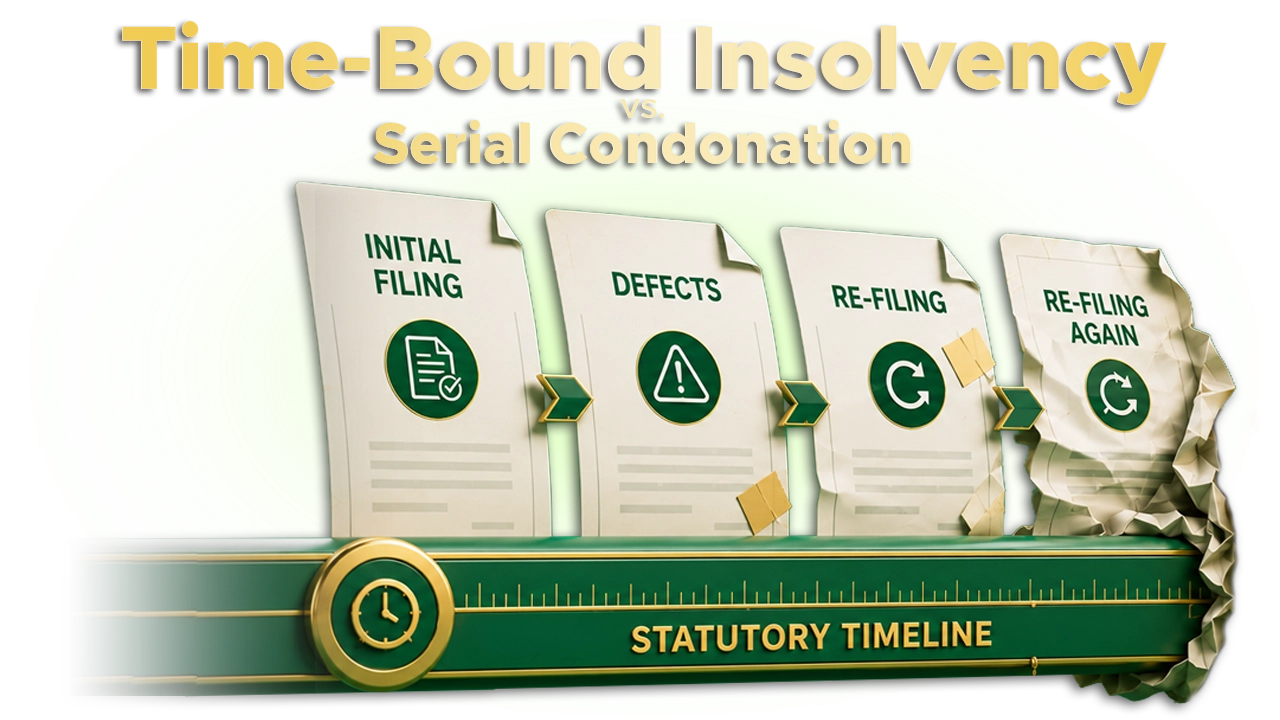
Can the statutory discipline of the Insolvency and Bankruptcy Code (IBC) be circumvented by the procedural flexibility of the Supreme Court Rules (SCR), and to what extent can a litigant rely on past judicial indulgence to overcome repeated lapses in filing? This question lies at the heart of the Supreme Court’s recent judgment in CA Ramchandra Dallaram Choudhary v. Adani Infrastructure and Developers Private Limited1, a decision that reinforces the uncompromising nature of limitation periods within the insolvency framework. The Court definitively held that the strict, time-bound scheme of the IBC operates as an insurmountable jurisdictional bar, rendering it impermissible for any litigant to use the re-filing of defective appeals as a mechanism to extend statutory timelines.
The factual matrix of the matter involves an appeal filed under Section 62 of the IBC against an order of the National Company Law Appellate Tribunal (NCLAT) dated December 8, 2025. The appeal was initially presented to the Supreme Court on January 29, 2026, which fell beyond the primary limitation period but within the statutorily permissible grace period. However, the appeal was marked defective by the Registry; the subsequent re-filing of the appeal after curing these defects was delayed by 82 days. Seeking to justify this, the appellant a liquidator argued that the delay stemmed from an internal administrative oversight and maintained that, given his role as a neutral officer of the Court, a liberal approach to condonation should be adopted. The appellant further pointed to a coordinate Bench decision in a previous round of the same litigation where an earlier re-filing delay had been condoned, asserting that “sufficient cause” should be interpreted liberally to serve the interests of justice.
The Supreme Court’s rationale rests on the foundational principle that the IBC is a self-contained code designed to ensure time-bound insolvency resolution, where the prevention of dilatory tactics is paramount. The Court clarified that while a defective appeal may be lodged within the limitation period, such filing cannot be used as a device to preserve limitation indefinitely. A litigant is required to cure defects within the period prescribed under the Supreme Court Rules, failing which the appeal cannot remain pending in perpetuity. By establishing a 28-day limit for curing defects under the Supreme Court Rules, the Court emphasized that this procedural window cannot be exploited to circumvent the IBC’s legislative intent. The Court rejected the argument that the SCR could override the IBC, noting that while standard civil proceedings might allow for more lenient treatment of re-filing delays, the IBC’s unique statutory structure demands stricter adherence. Crucially, the Court dismissed the appellant’s reliance on prior leniency, explicitly stating that a litigant cannot claim a “serial” right to condonation. It affirmed that the previous order granting indulgence was confined to its own peculiar facts and was never intended to serve as a perpetual precedent.
This judgment firmly establishes that the strict timelines prescribed under Section 62 of the IBC cannot be enlarged through delayed re-filing after expiry of the 28-day curing period under the Supreme Court Rules. By citing precedents such as Mobilox Innovations (P) Ltd. v. Kirusa Software (P) Ltd2. and Kalparaj Dharamshi v. Kotak Investment Advisors Limited3, the Court reaffirmed that the commercial wisdom and the integrity of insolvency timelines are shielded from unnecessary judicial intervention.
Notably, the Court observed that once the statutory bar operates, the adequacy of the explanation furnished for the delay becomes largely irrelevant because no amount of “sufficient cause” can confer jurisdiction where the statute expressly withholds it. Although the Court ultimately found the explanation offered by the appellant to be unsatisfactory on facts as well, it emphasized that the appeal was liable to fail primarily because the limitation framework itself foreclosed further indulgence.
Furthermore, the inclusion of Saturn Ventures and Advisors Pvt. Limited v. S. Gopalakrishnan4 served as a poignant reminder that even minor delays cannot be condoned when the Court lacks the statutory power to do so. Ultimately, the Court’s decision serves as a stern reminder to litigants that the “discipline of limitation” is not merely a procedural hurdle but a substantive requirement of the IBC, ensuring that the insolvency process remains efficient and final rather than progressively elastic at every stage of appellate challenge.
Citation
- CA Ramchandra Dallaram Choudhary v. Adani Infrastructure and Developers Private Limited ↩︎
- Mobilox Innovations Private Limited v. Kirusa Software Private Limited, (2018) 1 SCC 353 ↩︎
- Kalparaj Dharamshi & Anr. v. Kotak Investment Advisors Ltd. & Ors., (2021) 10 SCC 401 ↩︎
- Saturn Ventures and Advisors Pvt. Limited v. S. Gopalakrishnan ↩︎
Expositor(s): Adv. Jahnobi Paul
This article is for information only and is not legal advice. Read the disclaimer