Trending topic · Family Law
The Marriage That Survived a Divorce: Understanding the Gap Between Foreign Divorce Decrees and Indian Law
On this page
A marriage in one country, a divorce in another
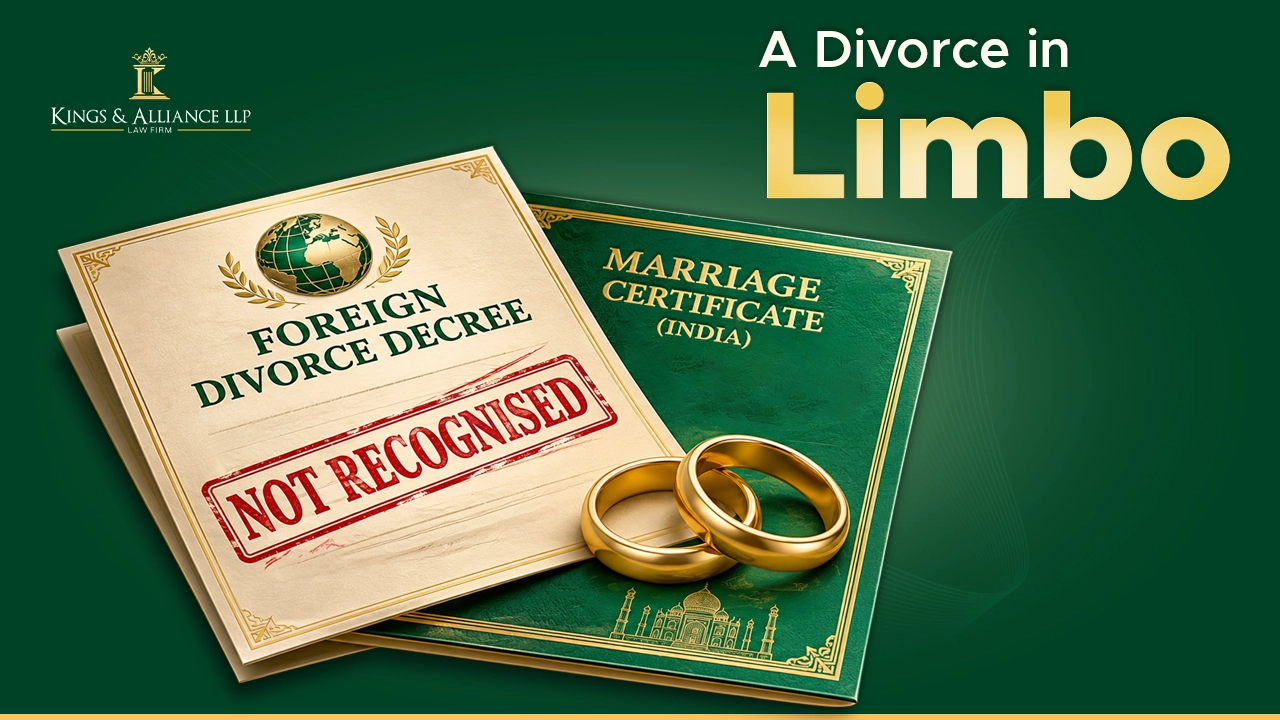
In India, a marriage can outlive its own divorce and for Indian couples who part ways abroad, that is not a figure of speech but a legal possibility and in today’ s times an unvarnished state of affairs for many NRI spouses who have their other-halves back home. The problem stems from India’s approach in recognising foreign matrimonial decrees. Irretrievable breakdown is a recognised ground for divorce in the United Kingdom, and a non-Muslim resident of the UAE can divorce without proving fault,1 but the Indian statutes that govern most marriages allow divorce only on listed grounds or by mutual consent. A foreign divorce granted solely on that basis may therefore go unrecognised in India as the two systems ask different questions, leaving the parties still legally married in India, despite them having attained a new marital status or citizenship. It falls to Indian courts to decide whether such a decree is valid, applying Section 13 of the Code of Civil Procedure2 and the Narasimha Rao 3 test rule,3 and in doing so they must weigh forum shopping, fraud and the consequences of refusing recognition.
Many non-resident Indians live in about 195 countries across the globe, and foreign matrimonial decrees now reach Indian courts routinely. The same pattern was observed in The Supreme Court’s decision in N. Sridhar Reddy v. State of Andhra Pradesh,4 where a husband who failed to obtain a divorce as per the India law, obtained one in England instead and remarried there but as a consequence of the same, now faces a bigamy trial in India.
The law in brief
India has no code on recognising foreign matrimonial decrees. Courts apply Section 13 of the Code of Civil Procedure, 1908 (CPC), as interpreted in Y. Narasimha Rao v. Y. Venkata Lakshmi (1991).5 The Supreme Court held there that a foreign decree is recognised only if the jurisdiction the foreign court assumed, and the ground on which it granted relief, accord with the matrimonial law under which the parties married. Three exceptions are recognised: the case was filed where the respondent is domiciled or habitually and permanently resides and relief was granted on a ground the governing law allows; the respondent voluntarily and effectively submitted to the foreign court and contested the claim on such a ground; or the respondent consented to the relief.
For a Hindu marriage the governing law is the Hindu Marriage Act, 1955 (HMA),6 which does not recognise irretrievable breakdown. A foreign decree on that ground therefore generally falls outside the rule and its exceptions. If a decree is not recognised, the marriage subsists in law: relief remains available under the HMA, maintenance continues, and remarriage may invite the law on void marriages and bigamy. Only the Supreme Court has dissolved marriages on breakdown, using Article 142 of the Constitution.
Lighter divorce, heavier consequences: how the problem arises
This pattern seems familiar when a marriage is solemnised in India under the HMA, where divorce is hard to get: a spouse must prove a fault ground or wait out the separation and cooling-off periods for mutual consent.7 One spouse, often the husband, then moves abroad, acquires residence or citizenship, and files in a forum that grants divorce on breakdown, sometimes within months and sometimes on a petition the other spouse never sees. The spouse in India may be served at an old address, may be unable to afford to appear, or may not know of the case. By the time the Indian court sees the decree, the husband has remarried.
Noticeably, several foreign jurisdictions fit the description. The United Kingdom grants divorce on breakdown, and a non-Muslim resident of the UAE can divorce without proving fault under Federal Decree-Law No. 41 of 2022, which also lets the court apply the parties’ home-country law.8 A Dubai court that applies the HMA, on a ground the Act recognises and with both spouses participating, produces a decree that stands on firmer ground. The Mexican “mail-order” and Nevada divorces discussed in Satya9 show that the problem is old. The Indian response does not turn on how lenient the foreign law is. It turns on whether the foreign decree can pass Section 13.
Where Foreign Decrees Break Down
Fraud on the court: Clause (e) of Section 1310 denies conclusiveness to a decree obtained by fraud. In Satya v. Teja Singh,11 the husband obtained a foreign decree by fraudulently claiming to be domiciled in the foreign forum, and the Supreme Court refused to recognise it, holding that comity does not require India to honour a foreign divorce law repugnant to its own law and public policy. The same logic reaches false claims of residence and suppressed facts about the marriage or about pending Indian proceedings.
Fraud on the spouse: Where the deception is aimed at the other spouse, such as service at a wrong or old address, service by publication despite a known address, or consent extracted by misinformation, the objection is usually framed under clauses (b) and (d): the decree was not decided on the merits and the proceedings were opposed to natural justice. In Kishorekumar Mohan Kale v. Kashmira Kale,12 the wife filed for divorce before the Circuit Court for the County of Oakland, Michigan. The husband sent a written statement by post solely to contest the US court’s jurisdiction and did not participate further. The Supreme Court held that this was neither voluntary and effective submission nor a meaningful opportunity to contest, so the decree was not conclusive.
The structural bar: Even without fraud, a lighter foreign ground gets nowhere. Narasimha Rao requires the ground to be one the law of the marriage allows. The first two exceptions still require such a ground, and only consent is framed around jurisdiction alone. The HMA has no breakdown ground, and the Supreme Court has held that adding it is for Parliament. The jurisdiction must also be one the law of the marriage recognises. Section 19 HMA13 looks to where the marriage was solemnised, the respondent’s residence and where the parties last lived together, and Section 1(2)14 carries the Act to Hindus domiciled in India wherever they live. In August 2025 the Gujarat High Court held that a Hindu marriage solemnised in India can be dissolved only under the HMA, whatever foreign citizenship or domicile the spouses acquire.15
Proof: Fraud must be pleaded with particulars (Order VI, Rule 4 CPC)16 and proved. A decree is not fraudulent merely because the spouse relying on it first failed in India, or because the foreign law is more lenient.
When it is forum shopping, not fraud
In N. Sridhar Reddy17 the Supreme Court described the case as one that “brings into sharp focus the limits of matrimonial forum shopping,” but its holding rested on Section 13 and Narasimha Rao and not on a finding of fraud, and it confined its findings to the scrutiny available on a petition to quash. A spouse who has been out-manoeuvred therefore need not prove deception. Showing that the decree fails the jurisdiction, ground or natural-justice tests is enough, and fraud is a further and harder route.
Policy points the same way. In Neerja Saraph v. Jayant Saraph18 (1994) the Supreme Court asked Parliament for safeguards such as compulsory registration of NRI marriages, as the Law Commission’s 287th Report (2024) later did.19
Personal law and state law: the Goa example
Because the test is run against the law of the marriage, the answer changes with that law. The HMA governs Hindus, Buddhists, Jains and Sikhs, while the Special Marriage Act, 1954, the Indian Divorce Act, 1869 , the Parsi Marriage and Divorce Act, 1936 and Muslim personal law governs other marriages, none offering irretrievable breakdown as a general ground. State law can add a layer. Goa still applies the Portuguese Civil Code of 186720 and the Law of Divorce of 1910 to Goans of every religion, with exceptions such as Catholics married in the Church. For a Goan couple the law of the marriage is the Goa Code and not the HMA, so a no-fault divorce obtained in Portugal by a Goan with Portuguese citizenship is tested against the grounds and forum the Goa Code allows.
The Supreme Court’s own exit: Article 142
Article 142(1)21 of the Constitution empowers the Supreme Court to make any order necessary to do “complete justice” in a matter before it. This is the only route by which an HMA marriage can be dissolved on irretrievable breakdown, a ground the Act does not recognise. The power is supplementary and cannot override a statutory provision that is plainly and expressly grounded in public policy. The Court has held that the fault-based scheme of the Act is not such a provision, and so does not bar dissolution of a marriage that has irreparably failed. The power remains discretionary. It is exercised with restraint, on a close reading of the length of the marriage and the separation, the nature of the allegations, any attempts at reconciliation, and the financial position of the wife and children. The consequence is an asymmetry: a ground that a foreign court cannot invoke and be recognised on is available to the Supreme Court, so the outcome turns on which forum decides rather than on the substance of the dispute, and only to couples able to reach the Court.
Conclusion
Indian law on foreign matrimonial decrees is settled in principle and unsettled in outcome. A marriage solemnised under the HMA ends only on the grounds the Act recognises, or through the Supreme Court’s own power under Article 142. A foreign decree on breakdown does not alter that position, whether it was obtained by a spouse who chose a lenient forum or passed over the other spouse’s objection or without meaningful participation. The marriage continues in India, and a spouse who relies on the decree to remarry takes on civil and criminal risk.
The same test produces different results across personal laws and state laws such as Goa’s, and one remedy, a decree on breakdown, lies only with a court that most couples cannot reach. Until Parliament decides whether to recognise breakdown as a ground and to codify recognition of foreign decrees, the safer course is to treat a foreign decree as incomplete. A couple whose lives span two legal systems should secure an Indian decree, by mutual consent or on a fault ground, before relying on the foreign one.
Citations
- UAE Federal Decree-Law No. 41 of 2022 on Civil Personal Status (2022) (UAE), in force from 1 February 2023 ↩︎
- Code of Civil Procedure, 1908, s. 13 ↩︎
- Y Narasimha Rao v Y Venkata Lakshmi, (1991) 3 SCC 451 ↩︎
- N. Sridhar Reddy v. State of Andhra Pradesh, 2026 INSC 1191 ↩︎
- ibid ↩︎
- Hindu Marriage Act, 1955 ↩︎
- Hindu Marriage Act, 1955, ss. 13, 13(1A), 13B. ↩︎
- Supra 3 ↩︎
- Satya v. Teja Singh, (1975) 1 SCC 120 ↩︎
- Code of Civil Procedure, 1908, s. 13(e) ↩︎
- Ibid ↩︎
- Kishorekumar Mohan Kale v. Kashmira Kale, CIVIL APPEAL NO.1342 OF 2013 ↩︎
- Hindu Marriage Act, 1955, s. 19 ↩︎
- Hindu Marriage Act, 1955, s. 1(2) ↩︎
- Smiti w/o Aakash Shah v. Aakash Kirankumar Shah, R/FIRST APPEAL NO. 2426 of 2023 ↩︎
- Code of Civil Procedure, 1908, Order VI, Rule 4 ↩︎
- Supra 5 ↩︎
- Neerja Saraph v. Jayant Saraph (1994) 6 SCC 461 ↩︎
- Law Commission of India, Report No. 287: Law on Matrimonial Issues Relating to Non-Resident Indians and Overseas Citizens of India ↩︎
- Hindu Marriage Act, 1955 ; Special Marriage Act, 1954 ; Indian Divorce Act, 1869 ; Parsi Marriage and Divorce Act, 1936 ; Portuguese Civil Code, 1867 (as applicable in Goa); Law of Divorce, 1910 (Goa) ↩︎
- Constitution of India, art. 142(1) ↩︎
Expositor(s): Adv. Pratistha Dahiya
Topics
This article is for information only and is not legal advice. Read the disclaimer