Introduction
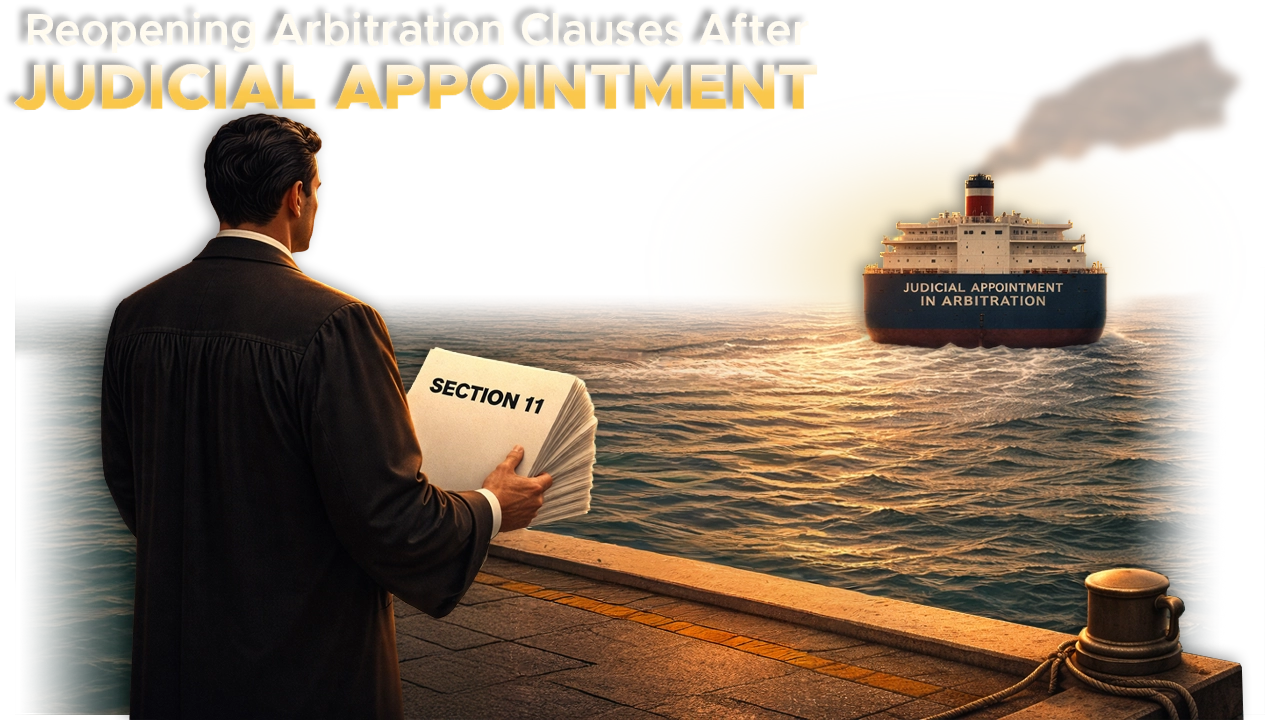
In the complex landscape of Indian arbitration law, can a court re-evaluate the very existence of an arbitration clause after a judicial authority has already appointed an arbitrator? This fundamental question lies at the heart of the Supreme Court of India’s decision in M/s Eminent Colonizers Private Limited v. Rajasthan Housing Board and Ors.1 The Court decisively answered that under the pre-2015 arbitration regime, an order appointing an arbitrator carries the weight of res judicata. When a court, acting under Section 11, interprets a contract and proceeds to appoint an arbitrator, that judicial determination creates a definitive legal seal. If the parties fail to challenge this appointment order at its inception, they are effectively estopped from later disputing the validity or existence of the arbitration clause. This prohibition extends throughout the entire lifecycle of the dispute, meaning the jurisdictional “gate” cannot be reopened before the arbitral tribunal itself, nor can it be used as a ground for reversal during subsequent set-aside proceedings under Section 34. Essentially, once the court validates the clause through the act of appointment, that finding becomes a settled legal fact that the parties must live with, regardless of any later second-guessing.
The dispute originated from construction contracts awarded to the appellant by the Rajasthan Housing Board in 2007 and 2009 for housing projects in Jaipur. In both instances, the appellant completed the work but encountered disputes regarding unpaid escalation bills for labor and material costs. When the respondents failed to settle these claims or properly constitute a “Standing Committee” as mandated by Clause 23 of the agreement, the appellant approached the High Court under Section 11 of the Arbitration and Conciliation Act, 1996. The High Court, acting prior to the 2015 legislative amendments, allowed the applications in 2014 and appointed retired judges as sole arbitrators, effectively treating Clause 23 as an arbitration agreement. Although the arbitrators subsequently passed awards in favor of the appellant, the Commercial Court and the Rajasthan High Court later set these awards aside, reasoning that Clause 23 was merely a departmental dispute resolution mechanism and did not actually constitute a valid arbitration agreement.
The Supreme Court’s “Res Judicata” Shield
The Supreme Court’s reversal centers on the “paradigm shift” between the pre-2015 SBP & Co.2 regime and current law. Justice K.V. Viswanathan noted that under the earlier rule, the power to appoint an arbitrator was a judicial function, not an administrative one. This required the presiding judge under section 11 to definitively confirm the existence of a valid arbitration agreement before granting the appointment, rendering their decision a final judicial act rather than a mere formality. By appointing the arbitrator, the court provided an “implied holding” on the clause’s validity that attained finality under Section 11(7) of the Act. The Court relied heavily on State of West Bengal v. Sarkar & Sarkar3, which established that such judicial orders are final and cannot be reopened by the Arbitral Tribunal under Section 16, as the tribunal cannot “go behind” the very order that gave it life.
Furthermore, the Court meticulously distinguished between precedent, which operates in rem, and res judicata, which operates in personam. While the respondents cited other High Court rulings like Mohammed Arif Contractor and M/s Marudhar Construction4 to argue that Clause 23 was not an arbitration clause, the Supreme Court clarified that these were merely legal precedents. In the specific litigation between these parties, the original 2014 Section 11 order right or wrong had attained finality. Under the principles summarised in Canara Bank v. N.G. Subbaraya Setty5, an erroneous decision on a question of law still binds the parties unless it involves a total lack of jurisdiction. Since the High Court clearly had the jurisdiction to interpret the contract under Section 11, its decision became the “law of the case” for these specific parties, regardless of how similar clauses were interpreted in unrelated disputes.
Conclusion
This judgment serves as a vital reminder of the finality required in arbitration proceedings and the necessity of challenging jurisdictional findings at the earliest possible stage. By setting aside the High Court’s order and remitting the case to the Commercial Court to hear the remaining objections on their merits, the Supreme Court protected the appellant from being dragged through years of arbitration only to have the entire process invalidated on a technicality that had already been judicially settled. Ultimately, the ruling reinforces that while the 2015 Amendment limited court intervention to a prima facie examination, those governed by the older regime must respect the conclusive judicial determinations made at the threshold of the arbitral journey, ensuring that the legal finality of a court order is not sacrificed for a second bite at the jurisdictional apple.
Citations
Expositor(s): Adv. Shreya Mishra, Aditi Singh (Intern), Riya Raksha (Intern)