Arbitration · bombay high court
Supreme Court Clarifies When a Non-Signatory Can Invoke an Arbitration Agreement: Elecon Engineering v. BRBCL
On this page
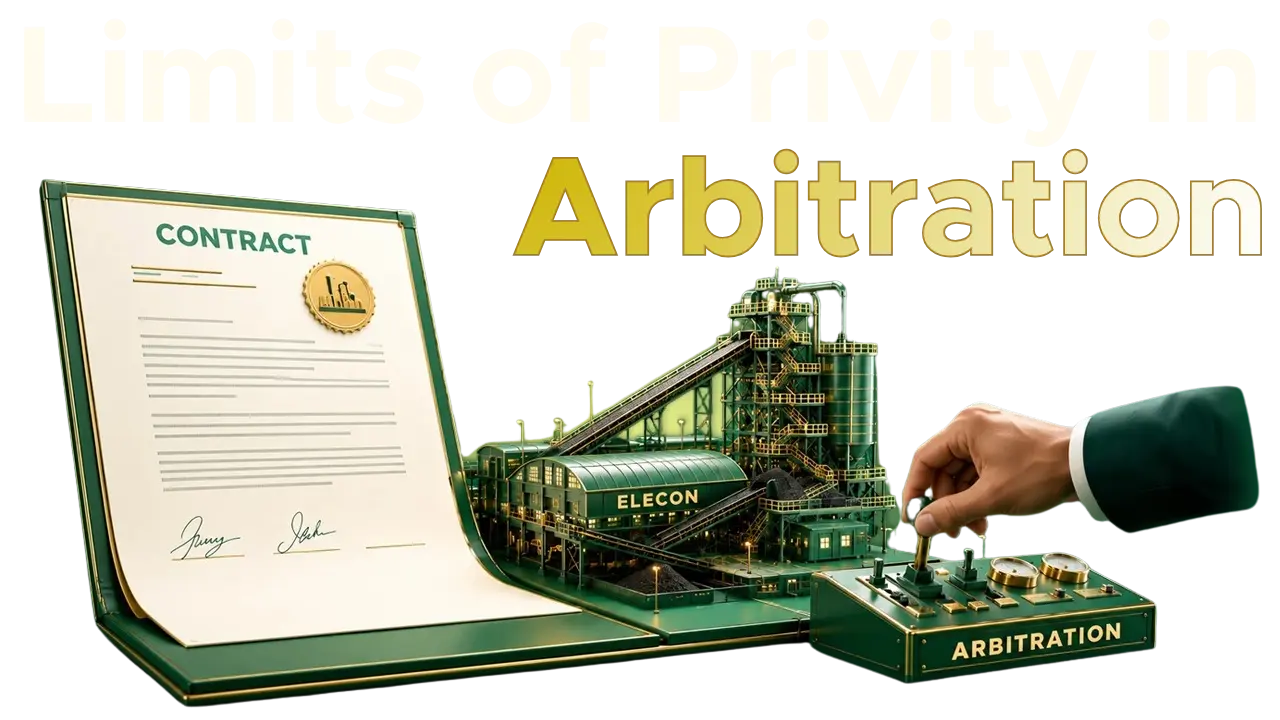
Can a party that never signed the principal contract nonetheless invoke the arbitration clause embedded within it? The question sits at the intersection of two competing ideas: the formal requirement of contractual privity and the commercial reality of complex projects that depend on participants who may not appear on the signature page. In its decision dated May 7, 2026 in Elecon Engineering Company Ltd. v. Bhartiya Rail Bijlee Company Ltd. and Anr.1, the Supreme Court reaffirmed that non-signatory status is not, by itself, determinative. Where the contractual framework itself makes a party’s participation integral to performance and obligations under the contract, such a party may qualify as a “veritable party” capable of invoking the arbitration agreement.
The Court, comprising Justice Sanjay Kumar and Justice K. Vinod Chandran, set aside the High Court’s dismissal of a petition under Section 11(6)2 of the Arbitration and Conciliation Act, 1996 filed by Elecon Engineering Company Ltd. (Elecon), holding that the Collaborator’s role under the contractual arrangement, the Deed of Joint Undertaking (DJU), and the parties’ subsequent conduct collectively established its status as a veritable party to the arbitration agreement.
The Coal Plant, the Collaboration, and the Collapse of the Contractor
The dispute arose from a contract for installing a Coal Handling Plant Package for the Nabinagar Thermal Power Project, awarded by Bhartiya Rail Bijlee Company Ltd. (the Employer) to a contractor who features in the proceedings as the second respondent. The bid documents contained stringent qualification thresholds specifically, experience in design and commissioning of an integrated bulk material handling plant with a rated capacity of 1,000 metric tonnes per hour or above for a minimum period of one year. The Contractor, unable to satisfy these requirements independently, collaborated with Elecon Engineering, which brought the requisite technical credentials. Crucially, the bid framework did not merely permit such a collaboration informally; it mandated that the bidder furnish a Deed of Joint Undertaking executed jointly by the collaborator and the contractor for successful performance, in the prescribed NTPC format. The DJU between Elecon and the Contractor, executed in favour of the Employer on February 22, 2010, expressly created joint and several liability for due completion of the project. In 2016, when execution encountered difficulties, the Employer, Contractor, and Collaborator entered into a tripartite agreement specifically authorising direct payment to Elecon for outstanding dues on earlier supplies and future ones. Then, on January 16, 2020, the Contractor was ordered to be wound up. Left without a counterpart, the Employer issued a communication on October 8, 2021, calling upon Elecon directly to fulfil its obligations under the DJU and threatening to execute the balance work at the Collaborator’s risk and cost. Elecon responded by issuing a notice under Section 213 of the Act on July 2, 2022, invoking arbitration; the Employer declined on July 29, 2022, asserting an absence of privity of contract. The High Court4 agreed with this position and dismissed the Section 11(6) petition, prompting the appeal to the Supreme Court.
Inextricability Over Formalism
The dispute reached the Supreme Court against the backdrop of a settled, though still evolving, body of jurisprudence on non-signatory participation in arbitration. Beginning with Chloro Controls India (P) Ltd. v. Severn Trent Water Purification Inc.5, and subsequently clarified by the Constitution Bench in Cox and Kings Ltd. v. SAP India6, Indian arbitration law has recognised that, in appropriate circumstances, entities that are not formal signatories may nonetheless be treated as parties to an arbitration agreement. The question before the Court was therefore not whether a non-signatory could ever invoke arbitration, but whether Elecon’s role under the contractual framework rendered it a veritable party to the arbitration agreement.
The Supreme Court’s reasoning cuts through the Employer’s reliance on privity by examining the contractual framework as a whole. The High Court had acknowledged the settled principle that a non-signatory who is a “veritable party” to an arbitration agreement may invoke it, but declined to apply that principle because the Section 21 notice appeared to seek the Employer’s consent to initiate arbitration. The Supreme Court rejected that interpretation. It held that the consent sought in the July 2022 communication was for reference of disputes to the Delhi International Arbitration Centre and not for arbitration as a dispute-resolution mechanism, which was already available under the contractual framework governing the parties.
The Court’s analysis proceeded from the structure of the bid documents themselves. The contract required a collaborator possessing the requisite technical experience and mandated execution of a DJU by both the Contractor and the Collaborator. The Court therefore treated the DJU not as a collateral arrangement but as an inextricable component of the contractual framework through which the project was awarded and performed. On that basis, it concluded that the Collaborator was a veritable party to the contract and the arbitration agreement embedded within it.
The Court then addressed the tripartite agreement of April 5, 2016, on which the Employer had heavily relied, arguing that it eclipsed earlier arrangements and, having no arbitration clause of its own, left the Collaborator without any right to demand arbitration. The Supreme Court was categorical in its rejection: the tripartite agreement was a practical measure to ensure direct payments to Elecon in the wake of the Contractor’s financial difficulties, and to reaffirm Elecon’s obligations to the project; it did not extinguish the original contractual framework, nor did it substitute a new governing contract. The employer-contractor agreement, with its arbitration clause7 and the DJU as an inextricable annexure, remained fully operative. In fact, the Employer’s own conduct invoking the DJU, convening tripartite meetings, and threatening Elecon with liability for incomplete works was treated by the Court as a reaffirmation of Elecon’s continuing obligations under the contractual arrangement. These circumstances reinforced the conclusion that Elecon could not simultaneously be treated as bound by the contractual obligations arising from the DJU while being denied access to the dispute-resolution mechanism governing those obligations.
The Court also noted that the contractual framework contemplated arbitration not merely in relation to the Contractor’s disputes with the Employer but within a broader structure governing the rights and obligations of the parties involved in the collaborative arrangement. Read together with the DJU and the subsequent course of dealings between the parties, the arbitration clause was therefore held to be available to the Collaborator as a veritable party to the contract.
The Court therefore set aside the High Court’s judgment, allowed the Section 11(6) petition, and appointed Justice (Retd.) Chakradhari Sharan Singh as sole arbitrator, with directions to make the declaration under Section 128 of the Act within fifteen days of receiving the judgment and to determine remuneration as per the Fourth Schedule9 to the Act.
Conclusion
Elecon Engineering is significant not because it expands the law governing non-signatories, but because it demonstrates the manner in which the “veritable party” principle operates in practice. The Court did not formulate a new test. Rather, it applied an established principle to a contractual structure in which the Collaborator’s participation was indispensable to qualification, performance, and completion of the project.
The ruling illustrates that courts will not examine signature pages in isolation when the contractual framework itself creates substantive rights and obligations for a participant whose involvement is essential to the transaction. Where a party is required for technical qualification, assumes joint and several liability through a mandatory undertaking, participates in arrangements governing project execution, and is repeatedly called upon to perform contractual obligations, the absence of a formal signature on the principal contract will not necessarily preclude access to the agreed dispute-resolution mechanism.
The decision ultimately reinforces a narrower but important proposition: a party that is treated throughout the life of a contract as an integral participant in its performance may also be entitled to invoke the arbitration clause that governs disputes arising from that performance. In that sense, the judgment strengthens the practical application of the “veritable party” doctrine by aligning arbitral access with the commercial realities reflected in the parties’ contractual arrangements and conduct.
Citations
- Elecon Engineering Company Ltd. v. Bhartiya Rail Bijlee Company Ltd. and Anr., Civil Appeal No. 7116/2026 ↩︎
- Section 11(6), Arbitration and Conciliation Act, 1996 — empowers the Supreme Court or a High Court to appoint an arbitrator where a party fails to act as required under the agreed appointment procedure, or where the parties or the two appointed arbitrators fail to reach agreement. ↩︎
- Section 21, Arbitration and Conciliation Act, 1996, stipulates that arbitral proceedings commence on the date on which a request for the dispute to be referred to arbitration is received by the respondent; the provision also governs the form and content of the notice invoking arbitration. ↩︎
- Elecon Engineering Company Ltd. v. Bhartiya Rail Bijlee Company Ltd., (2025) ibclaw.in 1126 HC ↩︎
- Chloro Controls India (P) Ltd. v. Severn Trent Water Purification Inc. and Ors., (2013) 1 SCC 641 ↩︎
- Cox and Kings Ltd. v. SAP India Pvt. Ltd. and Anr., 2023 SCC OnLine SC 1634 ↩︎
- The arbitration clause in question was contained in the employer-contractor agreement for the Coal Handling Plant Package for the Nabinagar Thermal Power Project (Bhartiya Rail Bijlee Company Ltd. v. the Contractor). The DJU executed on February 22, 2010 was held by the Court to be an inextricable part of this agreement, bringing Elecon within the scope of the arbitration clause as a veritable party. ↩︎
- Section 12, Arbitration and Conciliation Act, 1996. ↩︎
- Fourth Schedule, Arbitration and Conciliation Act, 1996 ↩︎
Expositor(s): Adv. Jahnobi Paul
This article is for information only and is not legal advice. Read the disclaimer