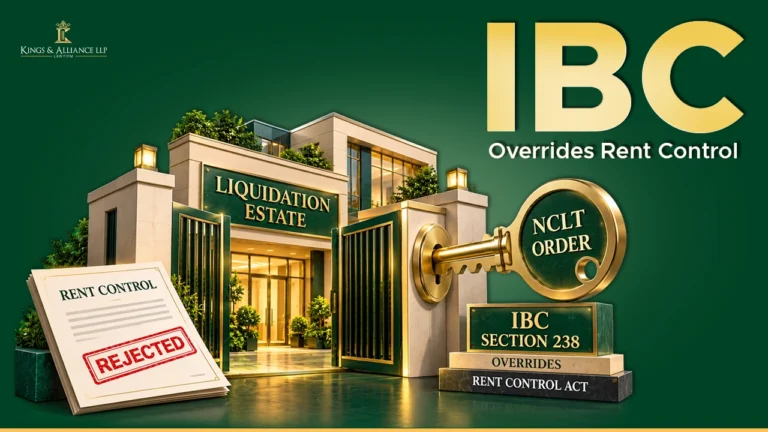
IBC
Clean Slate Principle Overrides Promoter Identity: Delhi High Court Rejects Revival of Pre-CIRP Claims Through Arbitration
On this page

Can a creditor revive a pre-CIRP claim through arbitration merely because the corporate debtor’s resolution plan was submitted and implemented by its existing promoter rather than an unrelated third party?
The Delhi High Court addressed this question in MBL Infrastructure Ltd. v. Pradeep Colonisers and Suppliers Pvt. Ltd.1, decided on 4 May 2026. The arbitral tribunal had held that Pradeep Colonisers’ counterclaims remained maintainable despite their exclusion from MBL Infrastructure’s approved resolution plan. Its reasoning was that the “clean slate” principle primarily protects an incoming third-party resolution applicant from unknown liabilities and should not automatically benefit the same promoter or management continuing after resolution.
The High Court rejected that distinction. It held that the extinguishment of claims under Section 31 of the Insolvency and Bankruptcy Code, 2016 attaches to the approved resolution plan and the corporate debtor, not to the identity of the resolution applicant. Once a plan is approved and attains finality, claims outside it cannot be revived through arbitration, litigation or any other collateral proceeding.
Factual Matrix, Arguments and the Court’s Decision
MBL Infrastructure had received a contract from the Water Resources Department, Government of Bihar, for restoration works relating to the Western Gandak Canal System. On 23 April 2015, it issued a work order to Pradeep Colonisers for execution of part of the project. Pradeep Colonisers claimed that it completed substantial work and raised running account bills, but received only partial payment after deductions. The parent contract was foreclosed in July 2016 and later terminated in January 2018.
Before the contractual dispute was resolved, CIRP commenced against MBL on 30 March 2017 on an application filed by RBL Bank Ltd. Pradeep Colonisers submitted a claim of approximately ₹7.29 crore. According to it, around ₹1.87 crore was partially verified and its name appeared in the list of creditors. However, its claim was not provided for in the resolution plan approved by the Committee of Creditors and the NCLT on 18 April 2018.
The plan had been submitted by MBL’s promoter, Mr. Anjani Kumar Lakhotia. Although the Supreme Court later found that the promoter attracted the ineligibility under Section 29A(h), it declined to disturb the plan in Bank of Baroda v. MBL Infrastructures Ltd.2 because the plan had already been implemented, funds had been infused and the company was operating as a going concern. Pradeep Colonisers had been impleaded in those proceedings, but no substantive relief preserving its claim was granted.
In 2022, an arbitral tribunal was constituted at MBL’s instance. MBL raised claims under the work order, while Pradeep Colonisers filed counterclaims for unpaid dues. MBL objected that those counterclaims had stood extinguished upon approval of the resolution plan.
The tribunal rejected the objection. It reasoned that the clean-slate doctrine was principally intended to protect an unrelated third-party resolution applicant. Since MBL’s existing promoter had continued after resolution, the tribunal treated the case as distinguishable from the Supreme Court’s clean-slate jurisprudence. It partly allowed Pradeep Colonisers’ counterclaim for approximately ₹6.52 crore and, after adjusting MBL’s allowed claims, directed a net payment of about ₹5.35 crore with post-award interest.
Both parties challenged different portions of the award under Section 34 of the Arbitration and Conciliation Act, 1996, while Pradeep Colonisers also sought enforcement. The High Court first considered whether the counterclaims were legally maintainable at all.
MBL argued that Section 31 conclusively binds the corporate debtor, creditors and all other stakeholders to the approved plan. Since Pradeep Colonisers’ claim did not form part of the plan, it stood extinguished. Its inclusion in the list of creditors, partial verification of the claim and impleadment before the Supreme Court did not preserve an independent right outside the plan. MBL further contended that any grievance regarding exclusion of the claim ought to have been pursued before the NCLT and NCLAT. Arbitration could not be used to reopen a plan that had attained finality, and Section 31 did not distinguish between a third-party applicant and an existing promoter.
Pradeep Colonisers responded that it had duly lodged its claim and that its omission from the plan was significant because the same promoter, who knew of the liability, had submitted the resolution plan. It relied on National Sewing Thread Co. Ltd. v. Superintending Engineer3, where the Madras High Court observed that the clean-slate doctrine should not protect substantially the same management from liabilities it had failed to disclose. It also relied on State Tax Officer v. Rainbow Papers Ltd.4 to argue that a plan becomes binding only if it satisfies Section 30(2). According to Pradeep Colonisers, the arbitration merely adjudicated contractual dues and did not challenge the resolution plan.
The High Court nevertheless held that the counterclaims were not maintainable. It first acknowledged the narrow scope of interference under Section 34. Referring to OPG Power Generation v. Enexio Power Cooling Solutions5, Renusagar Power v. General Electric6, ONGC v. Saw Pipes7, Associate Builders v. DDA8, Ssangyong Engineering v. NHAI9, State of Chhattisgarh v. SAL Udyog10, ONGC v. Western Geco11, Patel Engineering v. NEEPCO12, Delhi Metro Rail Corporation v. Delhi Airport Metro Express13 and Dyna Technologies v. Crompton Greaves14, the Court reiterated that an award cannot be set aside merely for an erroneous interpretation of law. However, interference is justified where the tribunal disregards binding statutory provisions and Supreme Court precedent and thereby assumes jurisdiction over a claim that no longer exists in law.
On the IBC issue, the Court relied principally on Committee of Creditors of Essar Steel v. Satish Kumar Gupta15 and Ghanshyam Mishra & Sons v. Edelweiss ARC16. These decisions establish that all claims must be dealt with within the CIRP and that claims outside an approved plan stand extinguished. Otherwise, unresolved “hydra-head” claims would undermine the financial certainty on which resolution applicants and the CoC proceed.
The Court also referred to CIT v. Monnet Ispat17 on the overriding effect of the IBC under Section 238, and to Ruchi Soya Industries v. Union of India18, Ajay Kumar Radheyshyam Goenka v. Tourism Finance Corporation19, RPS Infrastructure v. Mukul Kumar20 and JSW Steel v. Pratishtha Thakur Haritwal21, all reinforcing the finality of an approved resolution plan.
Particular reliance was placed on Electrosteel Steel v. Ispat Carrier22, where the Supreme Court held that lifting of the moratorium does not revive a claim extinguished under an approved plan and that an arbitral award on such a claim is incapable of enforcement. The High Court also followed JSW Ispat Special Products v. Bharat Petroresources23, which held that claims outside an approved plan cease to be arbitrable. It noted that the contrary approach in Standard Chartered Bank v. Satish Kumar Gupta24 had already been rejected in Essar Steel.
Crucially, the Court rejected the tribunal’s distinction based on the identity of the resolution applicant. Section 31 contains no separate rule for promoter-led resolutions. The corporate debtor remains the same juristic entity, and its liabilities are governed by the approved plan irrespective of who manages it afterward. The clean slate is therefore a structural consequence of the resolution process, not a personal protection reserved for an incoming outsider.
The Court also held that inclusion in the list of creditors did not preserve Pradeep Colonisers’ claim. Recognition during verification is different from entitlement under the final resolution plan. Once the claim was excluded, it could survive only through a successful challenge within the IBC framework.
Rainbow Papers was distinguished because the dispute there travelled through the statutory hierarchy under the IBC. It did not authorise a collateral challenge through arbitration after the plan had attained finality. The Court also declined to follow National Sewing Thread to the extent that it permitted concluded CIRP issues to be reopened merely because the same promoters remained in control. In any event, Pradeep Colonisers was not an undisclosed creditor; its claim had been submitted and considered during CIRP.
The Court consequently set aside the award insofar as it upheld and granted relief on Pradeep Colonisers’ counterclaims, including related interest. The enforcement petition was dismissed. Challenges concerning MBL’s own claims under the award were left for separate consideration.
Conclusion
The judgment establishes that the clean-slate principle does not depend on whether a company is revived by an independent third party or by its existing promoter. Its source is Section 31 and the finality of the approved resolution plan.
Any concern regarding promoter eligibility, omission or treatment of claims under the resolution plan or non-compliance with Section 30(2) must be raised within the statutory framework of the IBC. It cannot later be converted into an arbitral claim or counterclaim after the plan has become binding.
For creditors, the decision is a reminder that filing a claim during CIRP is only the beginning; its treatment in the resolution plan must be promptly examined and challenged. For resolution applicants, CoCs and insolvency professionals, the ruling reinforces the certainty at the heart of the Code: once the plan is approved, liabilities outside it cannot be revived through another forum.
Citations
- MBL Infrastructure Ltd. v. Pradeep Colonisers and Suppliers Pvt. Ltd. (4 May 2026) ↩︎
- Bank of Baroda v. MBL Infrastructures Ltd. (2022) ↩︎
- National Sewing Thread Co. Ltd. v. Superintending Engineer ↩︎
- State Tax Officer v. Rainbow Papers Ltd. (2022) ↩︎
- OPG Power Generation Private Limited v. Enexio Power Cooling Solutions India Private Limited, 2024 INSC 711 ↩︎
- Renusagar Power Co. Ltd. v. General Electric Co. (1994) ↩︎
- ONGC Ltd. v. Saw Pipes Ltd. (2003) ↩︎
- Associate Builders v. Delhi Development Authority (DDA) (2014) ↩︎
- Ssangyong Engineering & Construction Co. Ltd. v. NHAI (2019) ↩︎
- State of Chhattisgarh v. SAL Udyog Pvt. Ltd. (2021) ↩︎
- ONGC Ltd. v. Western Geco International Ltd. (2014) ↩︎
- Patel Engineering Ltd. v. North Eastern Electric Power Corporation (NEEPCO) (2020) ↩︎
- Delhi Metro Rail Corporation (DMRC) v. Delhi Airport Metro Express Pvt. Ltd. (2024) ↩︎
- Dyna Technologies Pvt. Ltd. v. Crompton Greaves Ltd. (2019) ↩︎
- Committee of Creditors of Essar Steel India Ltd. v. Satish Kumar Gupta & Ors. (2019) ↩︎
- Ghanshyam Mishra & Sons Pvt. Ltd. v. Edelweiss Asset Reconstruction Company Ltd. (2021) ↩︎
- Pr. Commissioner of Income Tax v. Monnet Ispat and Energy Ltd. (2018) 18 SCC 786 ↩︎
- Ruchi Soya Industries Ltd. v. Union of India (decided on February 17, 2022) is reported as (2022) 6 SCC 343 ↩︎
- Ajay Kumar Radheyshyam Goenka v. Tourism Finance Corporation of India Ltd. (2023) ↩︎
- RPS Infrastructure Ltd. v. Mukul Kumar & Ors. (2023) ↩︎
- M/S JSW Steel Limited v. Pratishtha Thakur Haritwal & Ors. 2025 INSC 401 or (2025) ibclaw.in 106 SC ↩︎
- Electrosteel Steels Ltd. v. Ispat Carrier (2021) ↩︎
- JSW Ispat Special Products Ltd. v. Bharat Petroresources Ltd (2025) ibclaw.in 2880 HC Case No.: O.M.P. (COMM) 533/2024 & I.As ↩︎
- Standard Chartered Bank v. Satish Kumar Gupta 2019 SCC OnLine NCLAT 388 ↩︎
Expositor(s): Adv. Jahnobi Paul,
This article is for information only and is not legal advice. Read the disclaimer