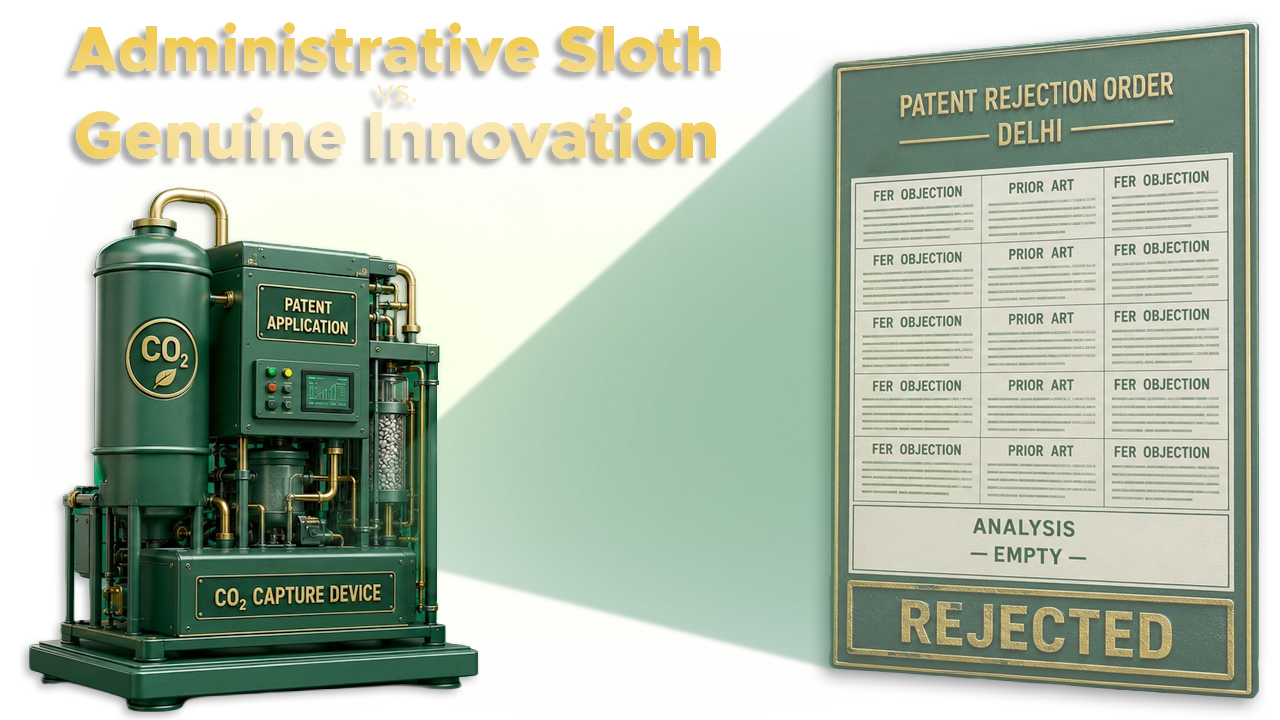
In an era where clean technology and green innovations are vital to combating climate change, patent offices worldwide are expected to rigorously and fairly evaluate complex technical applications. However, a widespread administrative shortcut has plagued Indian patent practice: the issuance of non-speaking, “copy-paste” rejection orders by Patent Controllers. In Enviro Ambient Corporation v. Assistant Controller of Patents1, the High Court of Delhi drew a firm line against this practice. The appellant, an entity with over 25 years of experience in green technologies, had filed an Indian national phase patent application for an invention titled “Carbon Dioxide Capture Device and Method.” The application disclosed an energy-efficient CO₂ capture system utilizing amine-free water droplets sized under 50 microns at subsonic speeds (less than Mach 1); a stark technical contrast to conventional, high-energy amine-based carbon absorption systems. Following a First Examination Report (FER), detailed written responses, and a formal hearing, the Assistant Controller of Patents rejected the application under Section 2(1)(j)2 for lack of novelty and Section 2(1)(ja)3 for lack of inventive step. However, while the impugned rejection order ran over 15 pages, roughly three-fourths of it merely reproduced verbatim the initial objections from the FER, extracted claim lines, and quoted prior art teachings, concluding with a single-line, unreasoned rejection that completely ignored the detailed comparative matrices and scientific proofs submitted by the applicant.
Core Legal Issue:
The High Court was confronted with critical questions of administrative and patent law: Whether a Patent Controller can satisfy the statutory mandate of a reasoned “speaking order” by mechanically reproducing FER objections and prior art text without independent technical analysis, and whether a rejection under Section 2(1)(ja) of the Patents Act can stand when the Controller fails to apply the established multi-step test for determining an inventive step. Counsel for the appellant contended that a non-speaking and unreasoned order is inherently untenable in law, as the Patent Office is obligated to deal with all relevant points and technical distinctions raised by an applicant. Conversely, counsel for the Patent Office argued that the prior art disclosed the essential features of the independent claims, maintaining that the rejection was justified. Justice Jyoti Singh ruled decisively in favor of the applicant, holding that mechanical reproduction of previous record contents does not equate to quasi-judicial reasoning. The Court emphasized that when assessing inventive step under Section 2(1)(ja), a Controller must strictly evaluate what was disclosed in prior art, what is claimed in the application, and how a Person Skilled in the Art (POSITA) would bridge that gap without hindsight bias; a statutory framework the Controller bypassed entirely through a one-line conclusion.
Conclusion:
The Delhi High Court’s decision in Enviro Ambient Corporation reinforces the necessity of procedural fairness and reasoned decision-making within administrative patent proceedings. By setting aside the Assistant Controller’s rejection order and remanding the matter back to the Patent Office for fresh consideration within three months, the Court established that patent controllers are legally precluded from utilizing copy-paste administrative templates paired with superficial conclusions. The ruling serves as a vital safeguard for green technology and authentic innovations, ensuring they are not discarded due to administrative carelessness. For patent practitioners and inventors, the judgment provides a formidable judicial precedent to challenge arbitrary rejections where the Patent Office fails to address specific technical comparative charts or written submissions, reinforcing India’s commitment to a robust, reasoned intellectual property ecosystem.
Citations
Expositor(s): Adv. Pratistha Dahiya