Trending topic · IPR Spectrum
The Business of Being “You”: The Realm of Personality Rights
On this page
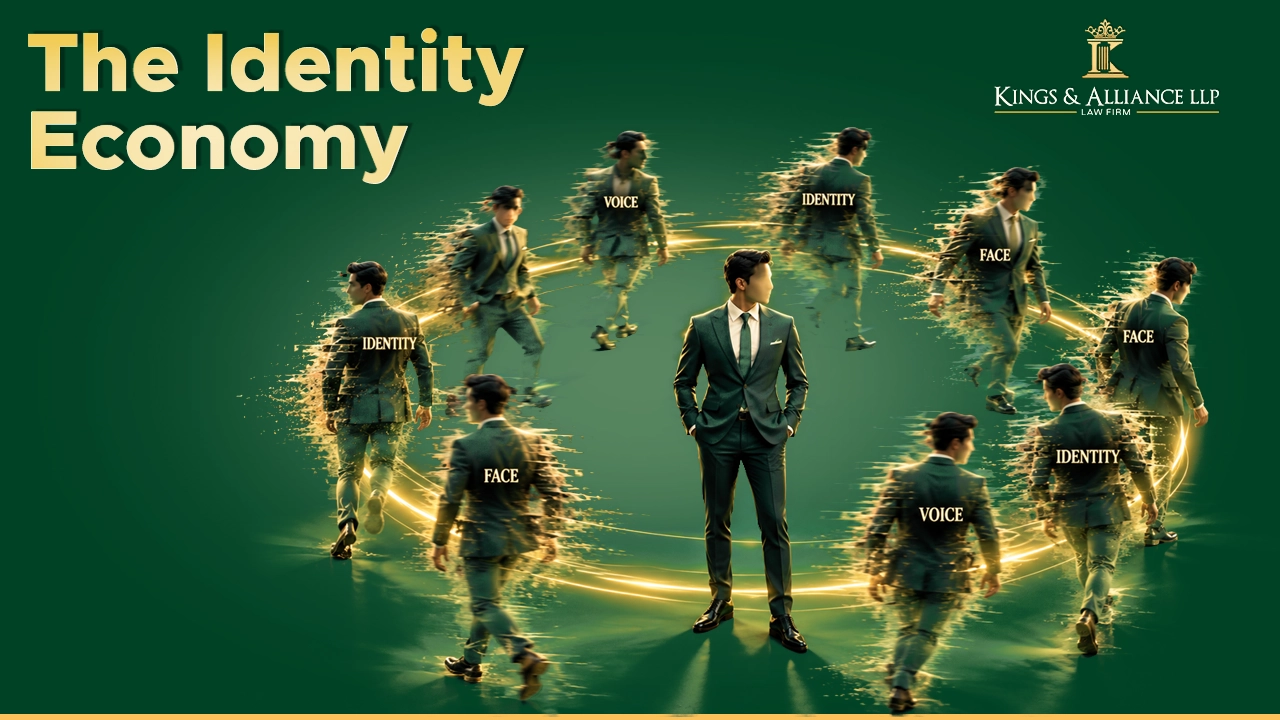
Somewhere on the internet, your face is working overtime. It is selling a cure, endorsing a betting app, starring in a video you never shot, yet you are not on the payroll. Indian courts are now being asked whether you should be. On 15 October 2026, Justice Purushaindra Kumar Kaurav said what many in this corner of law had been thinking: “we have to draw some line”.
That sentence is the story. Personality rights, the idea that you can control how your name, face, voice and manner are used, have gone from the occasional celebrity suit to the daily cause list. The orders keep coming, but the law is still unsettled.
A Right with No Statute and Too Many Parents
India does not have a specific statute dealing with protection personality rights law, however the Hon’ble Courts have stitched the protection together from privacy under Article 21,1 passing off, trade mark law, and a performer’s moral rights under Section 38-B of the Copyright Act.2 It works, but every suit arrives carrying several loosely framed claims at once. The Court orders are working fine for parties however, they do not lay any foundation test or principle which are to be applied as the matter of guidance while recognizing and protecting “personality right”
In Rakesh Bedi v. John Doe/Ashok Kumar & Ors.,3 a suit over merchandise and caricatures, Justice Kaurav framed three questions: what do personality rights protect, what are publicity rights, and who can claim them. Meta’s counsel offered a tidy split: publicity is a property right that can be assigned, privacy is personal and cannot, and reputation is protected by law of defamation.
In Janhvi Kapoor v. John Doe & Ors.,4 a similar point was raised: personality rights are a bundle of separate interests, and a court should decide which one is in play before blocking anything. Justice Anup Jairam Bhambhani likens the job of chipping at a block of wood until a shape appears. The courts are now organising themselves around the problem. The suits of Vivek Oberoi,5 Janhvi Kapoor6 and Aaradhya Bachchan7 are being heard together, so the principles that come out can be applied to the rest. This is how a doctrine gets built on purpose rather than by an accident.
The Circle Has Widened
The cases no longer belong only to the stereotypical celebrity doing endorsements for brands. In Dr Devi Prasad Shetty & Anr. v. Medicine Me & Ors.8 Justice Kaurav permanently restrained pages and channels that used the cardiac surgeon’s face and voice to push medicines he never endorsed. The court observed that the harm did not stop at his reputation: it reached ordinary viewers who might act on a cure he never offered.
The same logic covers educators and creators as well, in Dr Vikas Divyakirti v. Meta Platforms Inc. & Ors.,9 the Drishti IAS founder obtained takedowns of fake profiles, deepfake endorsements of betting platforms and straight reposts of his lectures. Journalist Sudhir Chaudhary10 and podcaster Raj Shamani11 have been protected too, as have Ankur Warikoo12 and Alakh Pandey,13 creators turned founders.
But now even being well known is not enough. In April 2026, the Delhi High Court, in Toprankers Edtech Solutions Private Limited & Ors. v. LPT Edtech Private Limited and Ors., 14refused to treat a single academic achievement as a source of personality rights and warned against over-expansive readings. It nevertheless restrained the use of a CLAT topper’s name and photographs, but on grounds of defamation and trade mark infringement. Protection can therefore extend to an ordinary person, though not necessarily through the doctrine of personality rights. We previously analysed this decision in detail “here.”15
One Right, Four Different Fights
The recent orders show four kinds of harm.
Money; In Vijay Sai Deverakonda v. Ashok Kumar John Doe & Ors.,16 the actor secured takedown of 94 links across merchandise, impersonation accounts and AI content. Yet the court would not stop use of his nickname “Rowdy” at the ex parte stage, because a plain word needs proof that it points to him alone, though an AI or morphed image of him carrying that word is covered.
Dignity; Sexual deepfakes and morphed images, where relief has been easiest to obtain. In Kangana Ranaut v. Meta Platforms Inc. & Ors17 The Delhi High Court ordered Meta to remove AI-generated explicit content about the actor and MP within 72 hours and had the listed sites blocked. In Samantha Ruth Prabhu v. John Doe (Ashok Kumar) & Ors.,18 the Bombay High Court protected the actor against deepfakes, morphed pornographic content and a chatbot built around her persona.
Loss of Truth; Words and endorsements the person never gave. Dr Shetty’s19 fake cures sit here, as do the two fabricated quotes in Ranaut’s20 case. When Divyakirti’s21 lawyers argued that captions attributing statements he never made were a separate wrong, the court reserved the question, since some of it may be commentary.
AI and Voice Cloning; Bombay’s order in Arijit Singh v. Codible Ventures LLP (2024)22 targeted tools that generate a singer’s voice on demand, and Delhi’s Anil Kapoor v. Simply Life India & Ors. (2023)23 first named AI morphing and deepfakes as a wrong in their own right.
At the interim stage, one test keeps coming back: is the damage to the person’s image a real and present risk? Justice Vikas Mahajan used the same words, and the same line about stature giving a proprietary right over one’s personality, in both Ranaut and Deverakonda.24 It leaves open who counts.
Fake Is Easy. Similar Is Hard.
The Courts have little trouble with an obviously fabricated video. The trouble starts with the thousands that look a bit like it.
Justice Bhambhani has been blunt with platforms. In Divyakirti’s case he told Meta’s counsel that handing powerful tools to anonymous users was worse than a gun, because the damage lands on reputation and the tool costs nothing. Yet he has also refused to let injunctions run open-ended. In Janhvi Kapoor v. John Doe & Ors.,25 with roughly 6,884 links on the list, he observed that it was “going out of hand.” In Dr Aniruddha Dhairyadhar Joshi v. John Does & Ors.26 He narrowed an earlier order: platforms must act on content identical to what the court listed, after technically verifying it, but remove merely similar content only if it breaks their own policies. The platforms’ argument is that Section 7927 a safe harbour does not require them to act on content no court has ordered removed.
Orders passed within days of each other treat later URLs differently. In Ranaut, new URLs she notified must be removed without a fresh suit. In Deverakonda, decided the same day, the actor may only notify intermediaries or seek legal remedy. In Samantha Ruth Prabhu,28 written notice triggers removal of similar content, but platforms may object, since genuine photographs might be caught.
The Rules and Laws Behind the Orders
As discussed above, Personality rights have no statute of their own, but the biggest recent change targets platforms. On 10 February 2026 the government notified the IT (Intermediary Guidelines and Digital Media Ethics Code) Amendment Rules, 2026, in force from 20 February.29 Rule 2(1)(wa) defines “synthetically generated information” as realistic audio-visual content made or altered by computer. Rule 3(3) requires platforms offering such tools to block unlawful synthetic content, including intimate imagery without consent and content that falsely shows a real person’s identity, voice or statements, and to label the rest. Rule 4(1A)30 makes large platforms ask users whether an upload is synthetic and verify the answer. Takedown orders must now be met within three hours instead of 36, and compliant removals do not cost a platform its Section 79 safe harbour.
Judges still mostly cite the older Rule 3(1)(b) list of barred content: in Ranaut, Justice Mahajan relied on Rule 3(1)(b)(ii) (obscene material) and (v)31 (false statements). Behind the Rules sit the statutes the suits are pleaded on:
| Law | Provision | How it appears in the orders |
| Constitution of India | Article 21 (privacy, dignity); Article 19(1)(a) (free speech); Article 300A (property) | Both courts ground the right in privacy and dignity, following Puttaswamy. Free speech is the limit in Galactus, but a source of the right in the Samantha Prabhu order. In Bedi, Meta’s counsel argued that publicity is a property right under Article 300A. |
| Information Technology Act, 2000 | Section 79 (safe harbour); rules made under Section 87 | Platforms keep safe harbour only if they meet their due diligence duties. Section 79 was the platforms’ main argument against broad takedowns. |
| Copyright Act, 1957 | Sections 38, 38-A, 38-B (performers’ rights, including moral rights); section 52 (fair dealing) | Samantha Prabhu’s suit rests partly on performer’s moral rights under section 38-B. Divyakirti’s lawyers argued that distorting captions breach it, and the court noted section 52 as a possible defence. |
| Trade Marks Act, 1999 | Section 29 (infringement); sections 2(1)(zg) and 11(6) (well-known marks); passing off | In Shetty, fake videos carried the hospital’s registered marks, which the court treated as infringement under section 29. It declined to declare the marks well known without the section 11(6) analysis. In Deverakonda, passing off over “Rowdy” needs proof of secondary meaning. |
| Criminal and related laws | Bharatiya Nyaya Sanhita, 2023; Representation of the People Act, 1951; Indecent Representation of Women (Prohibition) Act, 1986, among others | The 2026 Rules list these as laws whose breach through synthetic content can bring penalties, and swap the old Indian Penal Code reference for the BNS. |
While these Rules prescribe the obligations of platforms in dealing with fake or manipulated content, they do not address the underlying question of who, if anyone, owns a person’s face
Where the Right Has to Stop
In Digital Collectibles Pte Ltd v. Galactus Funware Technology Pvt Ltd.32 The Delhi High Court held that the publicity right gives way to free speech where facts about public figures are freely available and nobody is led to think they endorsed anything. In Alakh Pandey v. John Doe(s) & Ors.33 Justice Bhambhani warned on 5 August that the claim as framed could be over-broad: personality rights must not be used to stop information about wrongdoing, or to wipe out caricature, lampooning and parody that is not commercial exploitation. He limited relief to three violations: sexually vulgar portrayal, unlicensed monetisation and impersonation.
Fame raises a related puzzle. A big following helps prove goodwill, but it does not make every video, review or meme featuring a creator’s face an infringement. What tips the balance is commercial use, or a false suggestion of endorsement. Without either, commentary and parody generally stay outside the right.
Delhi and Bombay: A Tale of Two Approaches
Both courts anchor the right in Article 21 and both grant ex parte relief against AI misuse. The difference is emphasis.
Delhi set the template: the 2022 order in Amitabh Bachchan v. Rajat Nagi & Ors.34 made the blanket John Doe injunction routine, and Delhi has remained the main forum since. It is also the court now asking where the line is. It has appointed an amicus, batched three suits, refused Kapoor a blanket order, narrowed the similar-content direction and limited Pandey’s relief to three violations. Even the Bachchan35 suit is heading for settlement, with the actor told on 9 October to appear in person if it fails.
Bombay’s orders, from Arijit Singh36 in 2024 through Shilpa Shetty and Preity Zinta this year, follow a steadier pattern. In Samantha Ruth Prabhu, the court, relying on its earlier orders, found a very strong prima facie case under Articles 19(1)(a)37 and 21 and the performer’s moral rights, and granted the relief sought, including takedown of similar content on written notice. Two differences stand out. Bombay treats free speech as a source of the right, where Delhi’s Galactus38 line treats it as a limit. And Bombay leans on earlier orders where Delhi keeps stopping to examine the claim. If Delhi’s three questions get clear answers, Bombay will have to decide whether to follow them.
The Business of Being You
Being recognisable is now a business asset, and the courts have treated it like one. The next phase of personality rights litigation, however, will not be about establishing whether such a right exists, but about defining its boundaries: who can control that identity, and where the law must preserve space for expression, commentary and public conversation.
The Delhi cases may provide some of the first meaningful guidance on these unresolved questions. Until then, the emerging position appears to be this: the law is most willing to intervene when a person’s identity is appropriated to sell, mislead or cause reputational harm. The harder questions arise when the same identity is used not for exploitation, but for expression. It is in that space; between protecting personality and preserving speech, that the future of this right will be decided.
Citations
- The Constitution of India, art. 21 ↩︎
- The Copyright Act, 1957 (Act 14 of 1957), s. 38 ↩︎
- Rakesh Bedi v. John Doe/Ashok Kumar & Ors., CS(COMM) 1049/2026 ↩︎
- Janhvi Kapoor v. John Doe & Ors. CS (Comm) 868/2026 ↩︎
- Vivek Anand Oberoi v. Collector Bazar & Ors and connected matters, CS(COMM) 105/2026 ↩︎
- ibid ↩︎
- Ms. Aaradhya Bachchan and Anr. v. Bollywood Time & Ors CS(COMM) 230/2023 ↩︎
- Dr Devi Prasad Shetty & Anr. v. Medicine Me & Ors CS(COMM) 1053/2024 ↩︎
- Dr Vikas Divyakirti v. Meta Platforms Inc. & Ors., CS(COMM) 1015/2026 ↩︎
- Sudhir Chaudhary v. John Doe & Ors. CS(COMM) 1089/2025 ↩︎
- Raj Shamani & Anr. v. John Doe/Ashok Kumar & Ors. CS(COMM) 1233/2025 ↩︎
- Ankur Warikoo & Anr. v. John Doe & Ors.CS(COMM) 514/2025 ↩︎
- Alakh Pandey v. John Doe(s) & Ors., CS(COMM) 835/2026 ↩︎
- Toprankers Edtech Solutions Private Limited & Ors. v. LPT Edtech Private Limited and Ors CS(COMM) 344/2026 ↩︎
- “When Does Academic Success Become a Protectable Commercial Identity? Delhi High Court Clarifies Personality Rights Threshold,” Kings & Alliance LLP (2026) ↩︎
- Vijay Sai Deverakonda v. Ashok Kumar John Doe & Ors., CS(COMM) 1098/2026 ↩︎
- Kangana Ranaut v. Meta Platforms Inc. & Ors., CS(COMM) 1100/2026 ↩︎
- Samantha Ruth Prabhu v. John Doe (Ashok Kumar) & Ors., Commercial IP Suit 346 of 2026 ↩︎
- Supra Note 8 ↩︎
- Ibid ↩︎
- Supra Note 9 ↩︎
- Arijit Singh v. Codible Ventures LLP, 2024 SCC OnLine Bom 2445 ↩︎
- Anil Kapoor v. Simply Life India & Ors., CS(COMM) 652/2023 ↩︎
- Supra Note 16 ↩︎
- Supra Note 4 ↩︎
- Dr Aniruddha Dhairyadhar Joshi v. John Does & Ors., CS(COMM) 178/2026 ↩︎
- The Information Technology Act, 2000 (Act 21 of 2000), s. 79 ↩︎
- Supra Note 18 ↩︎
- The Information Technology (Intermediary Guidelines and Digital Media Ethics Code) Rules, 2021, Amendment Rules, 2026, G.S.R. 120(E), notified on 10 February 2026 ↩︎
- The Information Technology (Intermediary Guidelines and Digital Media Ethics Code) Amendment Rules, 2026, rr. 2(1)(wa), 3(3) and 4(1A) ↩︎
- Information Technology (Intermediary Guidelines and Digital Media Ethics Code) Rules, 2021, rr. 3(1)(b)(ii) and (v) ↩︎
- Digital Collectibles Pte Ltd v. Galactus Funware Technology Pvt Ltd., CS(COMM) 108/2023 ↩︎
- Supra Note 13 ↩︎
- Amitabh Bachchan v. Rajat Nagi & Ors., CS(COMM) 819/2022 ↩︎
- ibid ↩︎
- Supra Note 22 ↩︎
- The Constitution of India, arts. 19(1)(a) ↩︎
- Supra Note 32 ↩︎
Expositor(s): Adv. Pratistha Dahiya
This article is for information only and is not legal advice. Read the disclaimer