Shepardizing Law · IBC Insights
Clean Slate, Not So Clean: Set-Off After the Resolution Plan
On this page
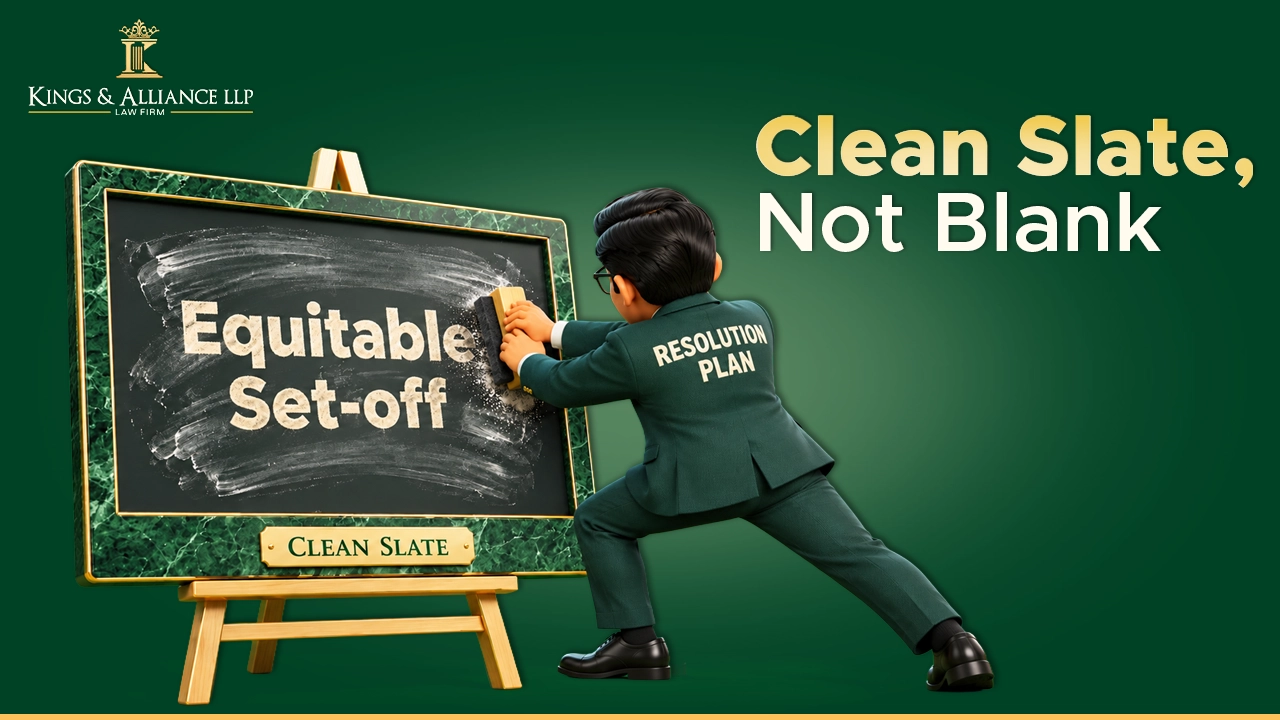
Section 31(1) of the Insolvency and Bankruptcy Code, 20161 (Code) makes an approved resolution plan binding on the corporate debtor (CD) and its stakeholders, including the Central Government, any State Government or any local authority to whom a debt in respect of the payment of dues arising under any law for the time being in force, such as authorities to whom statutory dues are owed, guarantors, and other stakeholders involved in the resolution plan. In Committee of Creditors of Essar Steel India Limited v. Satish Kumar Gupta2 (“Essar Steel”), and Ghanashyam Mishra and Sons Private Limited v. Edelweiss Asset Reconstruction Company Limited3 (“Ghanashyam Mishra”), the Supreme Court of India affirmed the clean slate principle, holding that a successful resolution applicant (SRA) cannot be burdened with claims that were not accounted for in the resolution plan or that survive outside the approved plan.
On 8 October 2026, in Modern Asset v. KNK Construction Pvt. Ltd.,4 the Supreme Court examined the limits of the clean slate principle. Modern Asset, the operational creditor (OC) had submitted a claim of Rs. 12.26 crore during the corporate insolvency resolution process (CIRP), but received only Rs. 8.83 lakh (0.72%) under a resolution plan submitted by the erstwhile promoters, who returned as the SRA by availing the exemption available to micro, small and medium enterprises under Section 240A(1)5 of the Code. The SRA subsequently invoked the arbitration clause in the construction contract, following which the Karnataka High Court appointed an arbitrator under Section 11 of the Arbitration and Conciliation Act, 1996.6 The High Court framed six issues but only decided on the appointment of the tribunal and left the rest of the issues, including the applicability of the clean slate principle, for the tribunal to decide. While upholding the appointment, the Supreme Court held that the “clean slate principle” was too firmly established in its decisions to be left to the arbitrator to determine or to be reconsidered by the Court, particularly in light of the introduction of Section 31(6). The arbitral tribunal, too, could not depart from this settled principle of law. The Arbitration Tribunal also cannot deviate from the established principle of law. Further, the Apex Court permitted the OC to raise a counterclaim solely for set-off, capped at the full Rs. 12.26 crore it lodged during the CIRP, while prohibiting any positive recovery. The Court’s direction raises questions about the scope of the clean slate principle and its application to claims extinguished under an approved resolution plan.
The Clean Slate Principle: Evolution and Scope.
Pre-amendment: The clean slate principle remained rooted in Section 31(1) of the Code. As originally enacted, the provision made an approved resolution plan binding on the corporate debtor, its employees, members, creditors, guarantors and other stakeholders involved in the resolution process. However, the position of government authorities remained a point of contention, as the government authorities would pursue claims even after approval of a resolution plan. The 2019 amendment to the Code expressly included the Central Government, State Governments and local authorities within the scope of Section 31(1). Simultaneously, in July 2019, the NCLAT, in Standard Chartered Bank v. Satish Kumar Gupta,7 held that claims that had not been decided on merits by the Adjudicating Authority or the Appellate Tribunal could be decided by an appropriate forum in terms of Section 60(6) of the Code.8
The NCLAT judgment was challenged before the Supreme Court in Essar Steel.9 The Supreme Court set aside the NCLAT’s judgment, holding that the rationale adopted by the NCLAT militated against the purpose of Section 31 of the Code. The Court observed that a successful resolution applicant could not suddenly be faced with “undecided” claims after the resolution plan had been accepted, as this would amount to a “hydra head popping up”, creating uncertainty regarding the amounts payable by a prospective resolution applicant seeking to take over and operate the corporate debtor’s business. Accordingly, all claims must be submitted to and decided by the resolution professional so that a prospective resolution applicant knows exactly what must be paid to take over and run the corporate debtor’s business. This approach forms the foundation of the clean slate principle under the Code, which seeks to ensure that, once a resolution plan is approved, the corporate debtor is free from claims that were not accounted for under the plan, thereby providing the successful resolution applicant with certainty regarding the liabilities it must assume and enabling the business to be revived without the uncertainty of future claims.
The principle was further solidified in Ghanashyam Mishra,10 wherein the Court held that claims not forming part of the approved resolution plan, including government dues, stood extinguished upon its approval. The Court held that the 2019 amendment was clarificatory and retrospective in nature. In Ebix Singapore Private Limited v. Committee of Creditors of Educomp Solutions Limited,11 the Supreme Court reinforced the finality of an approved resolution plan and held that Section 31(1) ensures an approved resolution plan binds the relevant stakeholders, including those who were not direct participants in the CIRP. In July 2026, the Supreme Court in Tata Steel v. Varsha12 again held that uncrystallised sub-judice claims of operational creditors stand extinguished on approval of a plan. The finality of the resolution plan allows the SRA to assess the corporate debtor’s assets and liabilities with greater certainty, without the risk of unforeseen claims arising after the resolution plan is approved. The principle is also one-directional: it extinguishes claims against the CD, while claims of the CD survive and may be pursued by the SRA. The Supreme Court’s decisions in Ujaas Energy13 (discussed later) and Modern Asset14 test the limits of this principle by permitting, in certain circumstances, the use of extinguished claims for set-off, raising questions about the scope and finality of the clean slate principle. The said cases appear to be among the first decisions of the Supreme Court to permit an extinguished claim to be used for “set-off” after approval of a plan
Equitable Set-off.
The principles governing set-off are well established. In the context of liquidation, set-off is statutorily permissible under Regulation 29 of the Insolvency and Bankruptcy Board of India (Liquidation Process) Regulations, 2016,15 which permits set-off where there are mutual dealings between the corporate debtor and another party. Regulation 29 operates in liquidation (Chapter III of Part II), not in the CIRP (Chapter II). Accordingly, in Bharti Airtel Ltd. v. Vijaykumar V. Iyer,16 the Supreme Court held that insolvency set-off does not apply in the CIRP, but carved out two exceptions. First, contractual set-off, where the entitlement arose before or on the date of commencement of the CIRP. Second, equitable set-off, where the claim and counterclaim are closely connected and arise from transactions that can be treated as a single transaction. It is important to note that these exceptions operate during the CIRP; after approval, the clean slate principle extinguishes the claim, so no subsisting mutual claim remains. However, the Supreme Court’s recent approach in effect extends the application of set-off to the post-CIRP period.
In Ujaas Energy Ltd. v. West Bengal Power Development Corporation Ltd.,17 the Supreme Court noted that although the respondent’s claim was considered extinguished for not having been raised before the Resolution Professional (RP), three factors were relevant. First, the counterclaim had been raised in arbitration before approval of the resolution plan. Second, the RP was aware of it, yet it was not incorporated into the plan. Third, the plan barred future payments or settlements concerning claims not raised before. Further, the plan did not prohibit a plea of set-off in pending arbitration, and the Court, as an equitable measure, permitted the counterclaim to be considered solely for set-off, without allowing any independent recovery. In Ujaas Energy, the Court also distinguished Bharti Airtel18 and held that it concerned set-off during CIRP, whereas the Ujaas case concerned set-off after approval of the resolution plan, with the claim having arisen before its approval by the CoC and the Adjudicating Authority.
Applying the same rationale in Modern Asset, the Court held that circumstances in Ujaas Energy that led to permitting set-off applied even more strongly to the present case. The Court observed that the Appellant’s claim of over Rs. 12 crore was settled at 0.72% under the resolution plan, while neither the RP nor the SRA accounted for the Corporate Debtor’s counterclaim. Therefore, the SRA was deemed to have accepted the Appellant’s entire claim, with payment limited to the amount provided under the plan. Further, the arbitration claim arose from the same contract, and the Court permitted the Appellant to raise a counterclaim solely for set-off, without any independent recovery. Accordingly, the Arbitral Tribunal was directed to allow set-off against any amount found payable to the SRA, to the extent of the Appellant’s entire claim submitted during CIRP. This approach raises concerns about the finality of approved resolution plans and the certainty of the assets available to the SRA.
Asset-Liability Distinction.
The clean slate principle operates on liabilities. Section 31(1) makes the approved plan binding on the corporate debtor, its creditors, employees and members. In Essar Steel (2020), the Supreme Court held that claims not provided for in the plan stand extinguished, so that the resolution applicant is not met with “hidden” claims. The CD’s recoveries stand on a different footing. The Code treats them as assets to be preserved and realized; this is also highlighted in Modern Asset, where the Court observes that as per the Clean slate principle, the OC’s claim stands extinguished as against the CD and the SRA, while the SRA could pursue dues owed to the Corporate Debtor. Thus, allowing an extinguished liability to reduce such a live asset (arbitration claim) through set-off defeats that distinction, as it effectively reduces the value of a claim that the SRA is otherwise entitled to recover.
Conclusion
The decision in Modern Asset risks undermining the finality that the clean slate principle seeks to secure. The Court reasoned that, without set-off, the erstwhile promoters could pay only 0.72% of the OC’s claim under the plan yet recover in full under the same contract. Adopting the description of arbitration as a “two-way street”, it found set-off equitable because the SRA, by offering 0.72%, was deemed to have accepted the OC’s entire claim, the RP and the SRA had not accounted for the CD’s claim, and the OC had suffered a 99.28% haircut.
This reasoning does not fully address the distinction between extinguished liabilities and subsisting assets: the CD’s claim is an asset, and although the OC cannot recover independently, set-off reduces that asset, with an effect similar to paying the extinguished claim. The judgment also does not say whether its reasoning is confined to these facts, or how it relates to Bharti Airtel, which considered equitable set-off in the CIRP context. Modern Asset also applies Ujaas without recording the terms of the plan, although Ujaas was confined to the plan’s specific terms. Since substantial haircuts and cross-claims are not unusual, the absence of clear limits may carry the exception beyond this case. The question is whether preventing one-sided recovery justifies set-off after approval, without weakening the commercial certainty the clean slate is meant to protect.
Citations
- Insolvency and Bankruptcy Code, 2016, s. 31(1). ↩︎
- Committee of Creditors of Essar Steel India Limited v. Satish Kumar Gupta, (2020) 8 SCC 531. ↩︎
- Ghanashyam Mishra and Sons Private Limited v. Edelweiss Asset Reconstruction Company Limited, 2021 SCC OnLine SC 313. ↩︎
- Modern Asset v. KNK Construction Private Limited, 2026 INSC 1103. ↩︎
- Insolvency and Bankruptcy Code, 2016, s. 240A(1). ↩︎
- Arbitration and Conciliation Act, 1996, s. 11. ↩︎
- Standard Chartered Bank v. Satish Kumar Gupta, 2019 SCC OnLine NCLAT 388, para 211. ↩︎
- Insolvency and Bankruptcy Code, 2016, s 60(6). ↩︎
- Supra Note 2 ↩︎
- Supra Note 3 ↩︎
- Ebix Singapore (P) Ltd. v. Committee of Creditors of Educomp Solutions Ltd., (2022) 2 SCC 401. ↩︎
- M/S Tata Steel Ltd. v. Varsha & Anr., 2026 INSC 717 ↩︎
- Ujaas Energy Ltd. v. W.B. PDC Ltd., 2026 SCC OnLine SC 453 ↩︎
- Supra Note 2 ↩︎
- Insolvency and Bankruptcy Board of India (Liquidation process) Regulations, 2016, reg. 29. ↩︎
- Bharti Airtel Ltd. v. Vijaykumar V. Iyer & Ors. (2024) SCC OnLine SC 4. ↩︎
- Supra Note 13 ↩︎
- Supra note 15 ↩︎
Expositor(s): Adv. on Record Mr. Mohit Chaudhary(Managing Partner) and Adv. Siddharath Shrivastava
This article is for information only and is not legal advice. Read the disclaimer