IBC
PUFE Transactions Under the IBC: Sections 43, 45, 49 and 50 After the 2026 Amendment
On this page
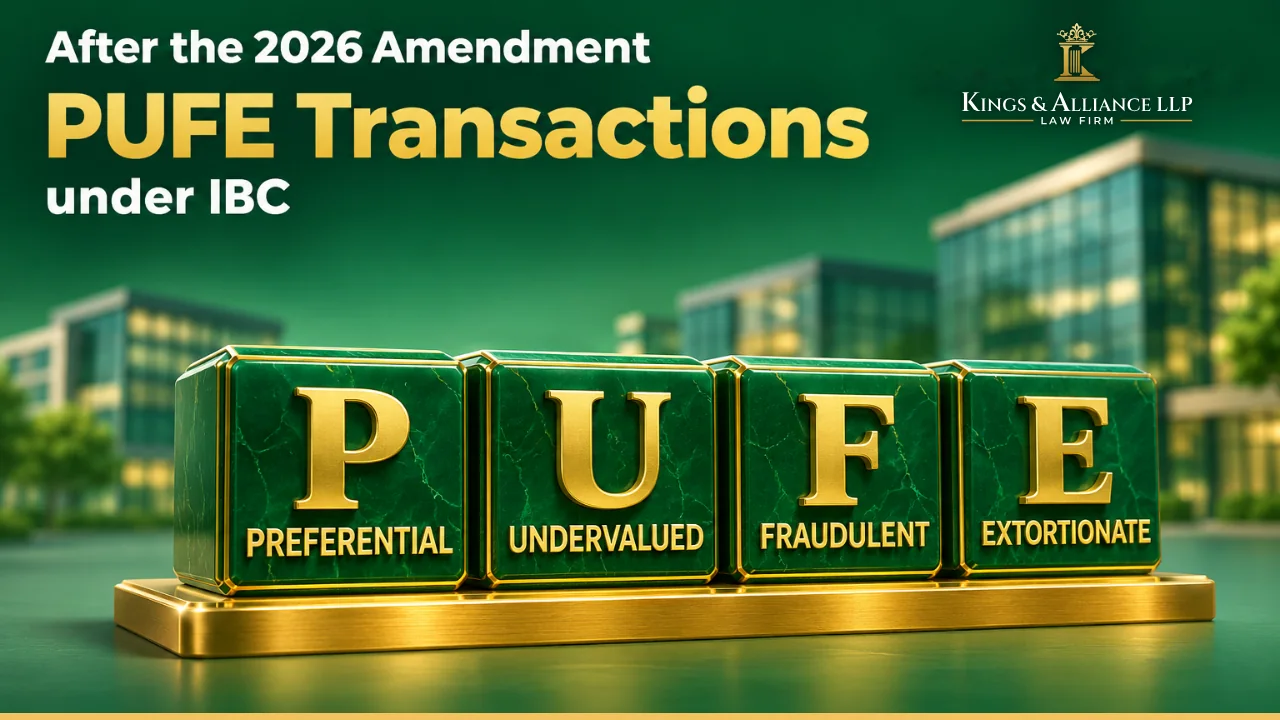
PUFE transactions are the four kinds of pre-insolvency dealing the Insolvency and Bankruptcy Code, 2016 (IBC) lets the Adjudicating Authority reverse: preferential (Section 43),1 undervalued (Section 45),2 defrauding creditors (Section 49)3 and extortionate credit (Section 50).4 Since 26 May 2026, the Insolvency and Bankruptcy Code (Amendment) Act, 20265 calls them “avoidance transactions”, dates the look-back from filing and lets cases outlive the process.6 After the amendment, Section 5(2A) of the Code7 defines them by reference to Sections 43, 45, 49 and 50, and Section 5(9A)8 separately defines fraudulent or wrongful trading.
All four shrink or skew the pool available to creditors.
When is a payment a preferential transaction under Section 43?
Section 43(2) requires “a transfer of property or an interest thereof of the corporate debtor for the benefit of a creditor or a surety or a guarantor”. It must be made “for or on account of an antecedent financial debt or operational debt or other liabilities” and leave the beneficiary better off than a Section 539 distribution would.
Section 43(3) excludes a “transfer made in the ordinary course of the business or financial affairs of the corporate debtor or the transferee”, and security for “new value” used to buy the property, registered within thirty days. A professional of the opinion that a preference was given “shall apply” under Section 43(1).
Under the amended Section 43(4),10 the relevant period opens two years before the insolvency application was filed for a related party (other than one related only as an employee), or one year before filing for others. It closes on admission, so a transfer made while the application is pending is caught. Where several applications were pending on admission, the new proviso to Section 5(11) of the Code11 makes the initiation date “the date on which the first such application was made”.
In Anuj Jain, IRP for Jaypee Infratech Ltd v. Axis Bank Ltd, decided on 26 February 2020, the Supreme Court read Sections 43(2) and 43(4) as the “charging parts” of the section, met when “the twin requirements of clauses (a) and (b) of sub-section (2)” are satisfied within the period in sub-section (4).12 They create “legal fictions” under which a preference “is deemed to have been given; and is deemed to have been given at a relevant time, if the stated requirements are satisfied”.
Once the ingredients are shown, the transaction attracts “the attendant consequences as per Section 44 of the Code, irrespective whether the transaction was in fact intended or even anticipated to be so”. As the Court later put it, “the question of intent is not involved in Section 43”, so a deemed preference escapes only through the exclusions in Section 43(3). On the first of them, the Court held that “or” between “corporate debtor” and “transferee” “ought to be read as ‘and’”, so the exclusion needs the ordinary course of both parties.
The Court also held that the look-back does not make Section 43 retrospective: “merely because look-back period is envisaged, for the purpose of finding ‘relevant time’, it cannot be said that the provision itself is retrospective in operation”. Once in force, it does not “remain in hibernation” while that period runs. In the case before it, the window ran from 10 August 2015, although Sections 33 to 54 of the Code came into force only on 15 December 2016, so it reached transactions made before Section 43 itself was in force.
When is a transaction undervalued under Section 45?
An undervalued transaction is one in which the corporate debtor gives an asset away, or parts with it for far less than it is worth, in the period before insolvency. A debtor under financial strain may do this to move value to a promoter, a related party or a friendly buyer before creditors can reach it, which leaves less in the estate to distribute.
Section 45(1) requires the liquidator or resolution professional who finds undervalued transactions within the relevant period to “make an application” to have them declared void. Under Section 45(2), a transaction is undervalued where the corporate debtor “makes a gift to a person”, or transfers assets “for a consideration the value of which is significantly less than the value of the consideration provided by the corporate debtor”, in a transaction that “has not taken place in the ordinary course of business of the corporate debtor”.
The exception looks only to the corporate debtor’s ordinary course and, unlike Section 43(3)(a) as read in Anuj Jain, says nothing of the transferee.
After the amendment, Section 46 of the Code,13 renamed “Relevant period for undervalued transactions”, requires the liquidator or resolution professional to “demonstrate” that the transaction falls within the same one-year or two-year window. Section 48 orders include payment of “such consideration for the transaction as may be determined by an independent expert”.14 In Anuj Jain the Court left that charge undecided, but said it “requires a different enquiry as per Sections 45 and 46” and added: “Specific material facts are required to be pleaded”.15
In Gloster Ltd v. Gloster Cables Ltd, decided on 22 January 2026, the Supreme Court tied that pleading requirement to natural justice, after the NCLT, with no avoidance application before it, had held a trademark assignment deed hit by Section 43 and Section 45(2)(b).16 The moving party, it said, “should cogently set out the basis on which the claim is made”, and the other side “should be clearly put on notice as to the basis for claiming that the transaction is preferential or undervalued. Otherwise serious breach of principles of natural justice would ensue.” The NCLT’s finding had been recorded “by a sidewind as it were”, and the Court held it “perverse and in gross violation of the principles of natural justice”, leaving title to the trademark open.
What makes a transaction one defrauding creditors under Section 49?
Section 49 applies to a Section 45(2) undervalue that the Adjudicating Authority is satisfied was “deliberately entered into” by the corporate debtor. Its purpose must be “keeping assets of the corporate debtor beyond the reach of any person who is entitled to make a claim against the corporate debtor”, or harming such a claim. It names no applicant, though since 26 May 2026 the professionals’ duties in Sections 25(2)(j)17 and 35(1)(l)18 cover it.
Nor does Section 49 state a look-back. In Aditya Kumar Tibrewal v. Om Prakash Pandey, decided on 6 April 2022, the NCLAT held that “the timeline prescribed for transactions under Section 46 does not cover the transactions covered by Section 49 and 66 of the Code”.19 It revived a challenge to a 29-year lease of the debtor’s land and plant to Imax Infrastructure Private Limited without deciding whether Imax was a related party.
When is a credit transaction extortionate under Section 50?
A credit transaction is extortionate when the debtor received financial or operational debt on terms that “required exorbitant payments to be made by the corporate debtor”. Unlike Sections 43 and 45, Section 50(1)20 says only that the professional “may make an application”. Debt from “any person providing financial services” that complies with the governing law “shall in no event be considered as an extortionate credit transaction”.
Comparison of PUFE transactions under Sections 43, 45, 49 and 50
| Transaction | What must be shown | Look-back from 26 May 2026 | Main exclusion |
|---|---|---|---|
| Preferential (Section 43) | Transfer to a creditor, surety or guarantor for an old debt that beats Section 53; no intent needed | Two years (related party) or one year before filing, to admission | Ordinary course of both parties; new-value security |
| Undervalued (Section 45) | Gift, or transfer for significantly less value, outside the debtor’s ordinary course; no intent needed | Same, under Section 46 | Ordinary course of the debtor |
| Defrauding creditors (Section 49) | A Section 45(2) undervalue made deliberately to defeat creditors | None (Aditya Kumar Tibrewal) | Good-faith buyer for value without notice, not from the debtor or (since 2026) its related party21 |
| Extortionate credit (Section 50) | Credit terms requiring exorbitant payments | Two years before filing, to admission | Lawful debt from a financial service provider |
Since 26 May 2026, the new Section 4722 also lets a creditor, member or partner apply under Sections 43, 45 and 50 where the professional “has not reported it”.
Where does fraudulent or wrongful trading under Section 66 fit?
Section 6623 sits in Chapter VI, outside the definition of avoidance transaction, and has two limbs. Section 66(1) applies where “any business of the corporate debtor has been carried on with intent to defraud creditors of the corporate debtor or for any fraudulent purpose”. It makes “any persons who were knowingly parties” to that business liable to contribute. Section 66(2) reaches only a director or partner who “knew or ought to have known” before admission that there was “no reasonable prospect of avoiding the commencement” of the process. That person must also have failed to “exercise due diligence in minimising the potential loss to the creditors”. Due diligence is what “was reasonably expected of a person carrying out the same functions”, and neither limb states a look-back.
In Piramal Capital & Housing Finance Ltd v. 63 Moons Technologies Ltd, decided on 1 April 2025, the Supreme Court held that the legislature “has consciously kept” fraudulent and wrongful trading applications under Chapter VI “outside the purview of Section 25(2)”.24 That clause required the professional to file avoidance applications under Chapter III. The two kinds of application “operate in different situations”, and the Adjudicating Authority’s powers over each “have also been separately circumscribed”. Under Section 66, “the properties and the persons involved may or may not be ascertainable”, so the Authority cannot set transactions aside but orders those knowingly party to the business to contribute. Whether the business was carried on with intent to defraud is “a matter of inquiry” for the Authority.
Section 66 applications therefore “could not be termed as ‘Avoidance Applications’”, a term the Court kept for Sections 43, 45 and 50. Where common applications are filed, the Authority must distinguish them and decide which provision applies to each. On the facts, the NCLAT had exceeded its jurisdiction in interfering with the DHFL plan clause giving Section 66 recoveries to Piramal.
What standard of proof applies under Section 66?
In Nalinesh Kumar Paurush v. Arvind Mittal, decided on 25 September 2025, the NCLAT held that the standard “would be of preponderance of probability but the same is subjected to the heavy proof to the applicant”.25 It reasoned that “each and every commercial transaction which has resulted in ‘loss’ may not be labelled as fraudulent”. Section 66(2) joins its two conditions with “and”, so clauses (a) and (b) “are required to be read together”, and “non-exercise of due diligence alone may perhaps be not sufficient”. The NCLAT set aside the NCLT’s contribution order against the suspended directors, which rested on a transactional audit report that “may not be termed as a conclusive piece of evidence”.
In Swapan Kumar Saha v. Ashok Kumar Agarwal, decided on 6 November 2025, the NCLAT rejected the argument that Sections 66(1) and 66(2) must be read together.26 Both, it held, “have self-contained provisions, with clear mechanisms for their invocation during a CIRP”, and the “or” in the opening words of Section 67(1) and (2)27 makes them “independent sub-sections”. It relied on the Supreme Court’s statement in Hussain Ahmed Choudhury v. Habibur Rahman that “The disjunctive ‘or’ cannot be read as a conjunctive ‘and’”.28 “Fraudulent transactions cannot be shielded by the lapse of time”, it held. Nor can fraud be condoned “merely because of procedural technicalities”, because “fraud vitiates all transactions”, and “even a single instance of fraud once proven is sufficient to establish the intent to deceive creditors”. Quoting the Section 66(2) passages of Nalinesh Kumar Paurush, it said that discussion “refers to the ingredients for invocation of Sec 66(2) of the IBC only and can in no manner be inferred to deal with Sec 66(1)”.
Fraudulent or wrongful trading thus leads to an order to contribute, made against anyone knowingly party to fraudulent business under Section 66(1) or against a director or partner who meets the conjunctive test of Section 66(2). The applicant proves its case on a preponderance of probability with a heavy burden, under limbs that stand independently and that lapse of time does not bar. Since 26 May 2026 the liquidator may also apply, and under Section 47 so may a creditor, member or partner where the professional has not reported it.
Conclusion
Anuj Jain makes a preference turn on the ingredients and the dates, whatever the intent, and Gloster requires any preference or undervalue claim to be cogently pleaded and put to the other side. Section 49 adds deliberate intent to defeat creditors but, after Aditya Kumar Tibrewal, no look-back, while Section 50 turns on exorbitant terms. The 2026 Act writes into the Code, through the Explanation to Section 26 as substituted,29 the rule in Tata Steel BSL Ltd v. Venus Recruiter Pvt Ltd (Delhi High Court, Division Bench, 13 January 2023) that an avoidance application “is independent of the resolution of the corporate debtor and can survive CIRP”.30 Piramal reasoned from the old Section 25(2)(j); the substituted clause brings both kinds of application within the professional’s duty but names an avoidance transaction and fraudulent or wrongful trading as distinct heads, as Piramal had treated them. The Amendment Act has no transitional rule for the amended look-back, and no ruling on whether it reaches processes initiated before 26 May 2026 was found.
Further reading on PUFE and avoidance transactions
- Evolving Landscape of Avoidance Transactions under IBC in Light of July 2025 Amendment
- Unmasking Corporate Fraud: NCLAT Clarifies the Independent Scope of Section 66 under the IBC
- Can the Jurisprudential Developments from the Supreme Court’s DHFL Ruling Reshape India’s Insolvency Law?
- The Flimsy Proof of Fraud: Why a Transactional Audit Report is Not the IBC’s Final Word
The law is stated as on 6 November 2026.
Citations
- The Insolvency and Bankruptcy Code, 2016 (Act 31 of 2016), s. 43 (as amended up to Aug. 12, 2021). ↩︎
- The Insolvency and Bankruptcy Code, 2016 (Act 31 of 2016), s. 45 (as amended up to Aug. 12, 2021). ↩︎
- The Insolvency and Bankruptcy Code, 2016 (Act 31 of 2016), s. 49 (as amended up to Aug. 12, 2021). ↩︎
- The Insolvency and Bankruptcy Code, 2016 (Act 31 of 2016), s. 50 (as amended up to Aug. 12, 2021). ↩︎
- The Insolvency and Bankruptcy Code (Amendment) Act, 2026 (Act 6 of 2026) (assented to on Apr. 6, 2026), published in The Gazette of India, Extraordinary, Part II, s. 1, No. 11 (Apr. 6, 2026). ↩︎
- Ministry of Corporate Affairs, Notification S.O. 2625(E) (May 22, 2026), The Gazette of India, Extraordinary, Part II, s. 3(ii), No. 2533 (May 25, 2026), appointing May 26, 2026 for the listed provisions of the Insolvency and Bankruptcy Code (Amendment) Act, 2026 (Act 6 of 2026). ↩︎
- The Insolvency and Bankruptcy Code, 2016 (Act 31 of 2016), s. 5(2A), as inserted by the Insolvency and Bankruptcy Code (Amendment) Act, 2026 (Act 6 of 2026), s. 3(a). ↩︎
- The Insolvency and Bankruptcy Code, 2016 (Act 31 of 2016), s. 5(9A), as inserted by the Insolvency and Bankruptcy Code (Amendment) Act, 2026 (Act 6 of 2026), s. 3(b). ↩︎
- The Insolvency and Bankruptcy Code, 2016 (Act 31 of 2016), s. 53 (as amended up to Aug. 12, 2021). ↩︎
- The Insolvency and Bankruptcy Code, 2016 (Act 31 of 2016), s. 43(4), as amended by the Insolvency and Bankruptcy Code (Amendment) Act, 2026 (Act 6 of 2026), s. 26. ↩︎
- The Insolvency and Bankruptcy Code, 2016 (Act 31 of 2016), s. 5(11), proviso inserted by the Insolvency and Bankruptcy Code (Amendment) Act, 2026 (Act 6 of 2026), s. 3(c). ↩︎
- Anuj Jain, Interim Resolution Professional for Jaypee Infratech Limited v. Axis Bank Limited, 2020 SCC OnLine SC 237. ↩︎
- The Insolvency and Bankruptcy Code, 2016 (Act 31 of 2016), s. 46, as amended by the Insolvency and Bankruptcy Code (Amendment) Act, 2026 (Act 6 of 2026), s. 27. ↩︎
- The Insolvency and Bankruptcy Code, 2016 (Act 31 of 2016), s. 48 (as amended up to Aug. 12, 2021). ↩︎
- Supra note 12. ↩︎
- Gloster Ltd. v. Gloster Cables Ltd., 2026 INSC 81. ↩︎
- The Insolvency and Bankruptcy Code, 2016 (Act 31 of 2016), s. 25(2)(j), as substituted by the Insolvency and Bankruptcy Code (Amendment) Act, 2026 (Act 6 of 2026), s. 15. ↩︎
- The Insolvency and Bankruptcy Code, 2016 (Act 31 of 2016), s. 35(1)(l), as substituted by the Insolvency and Bankruptcy Code (Amendment) Act, 2026 (Act 6 of 2026), s. 23(a)(iii). ↩︎
- Aditya Kumar Tibrewal v. Om Prakash Pandey, 2022 SCC OnLine NCLAT 142. ↩︎
- The Insolvency and Bankruptcy Code, 2016 (Act 31 of 2016), s. 50(1), as amended by the Insolvency and Bankruptcy Code (Amendment) Act, 2026 (Act 6 of 2026), s. 30. ↩︎
- The Insolvency and Bankruptcy Code, 2016 (Act 31 of 2016), s. 49, proviso, cl. (a), as amended by the Insolvency and Bankruptcy Code (Amendment) Act, 2026 (Act 6 of 2026), s. 29. ↩︎
- The Insolvency and Bankruptcy Code, 2016 (Act 31 of 2016), s. 47, as substituted by the Insolvency and Bankruptcy Code (Amendment) Act, 2026 (Act 6 of 2026), s. 28. ↩︎
- The Insolvency and Bankruptcy Code, 2016 (Act 31 of 2016), s. 66, as amended by the Insolvency and Bankruptcy Code (Amendment) Act, 2026 (Act 6 of 2026), s. 46. ↩︎
- Piramal Capital & Housing Finance Ltd. v. 63 Moons Technologies Ltd., 2025 INSC 421. ↩︎
- Nalinesh Kumar Paurush v. Arvind Mittal, 2025 SCC OnLine NCLAT 1537. ↩︎
- Swapan Kumar Saha v. Ashok Kumar Agarwal, 2025 SCC OnLine NCLAT 1756. ↩︎
- The Insolvency and Bankruptcy Code, 2016 (Act 31 of 2016), s. 67 (as amended up to Aug. 12, 2021). ↩︎
- Hussain Ahmed Choudhury v. Habibur Rahman, 2025 SCC OnLine SC 892, as recorded in Supra note 26. ↩︎
- The Insolvency and Bankruptcy Code, 2016 (Act 31 of 2016), s. 26, as substituted by the Insolvency and Bankruptcy Code (Amendment) Act, 2026 (Act 6 of 2026), s. 16. ↩︎
- Tata Steel BSL Ltd. v. Venus Recruiter, 2023 SCC OnLine Del 155. ↩︎
Expositor(s): Adv. Siddharath Shrivastava
Topics
This article is for information only and is not legal advice. Read the disclaimer