Case Docket · Consumer Protection
Last-Minute Flight Cancellation Lands IndiGo with ₹2.5 Lakh Compensation
On this page
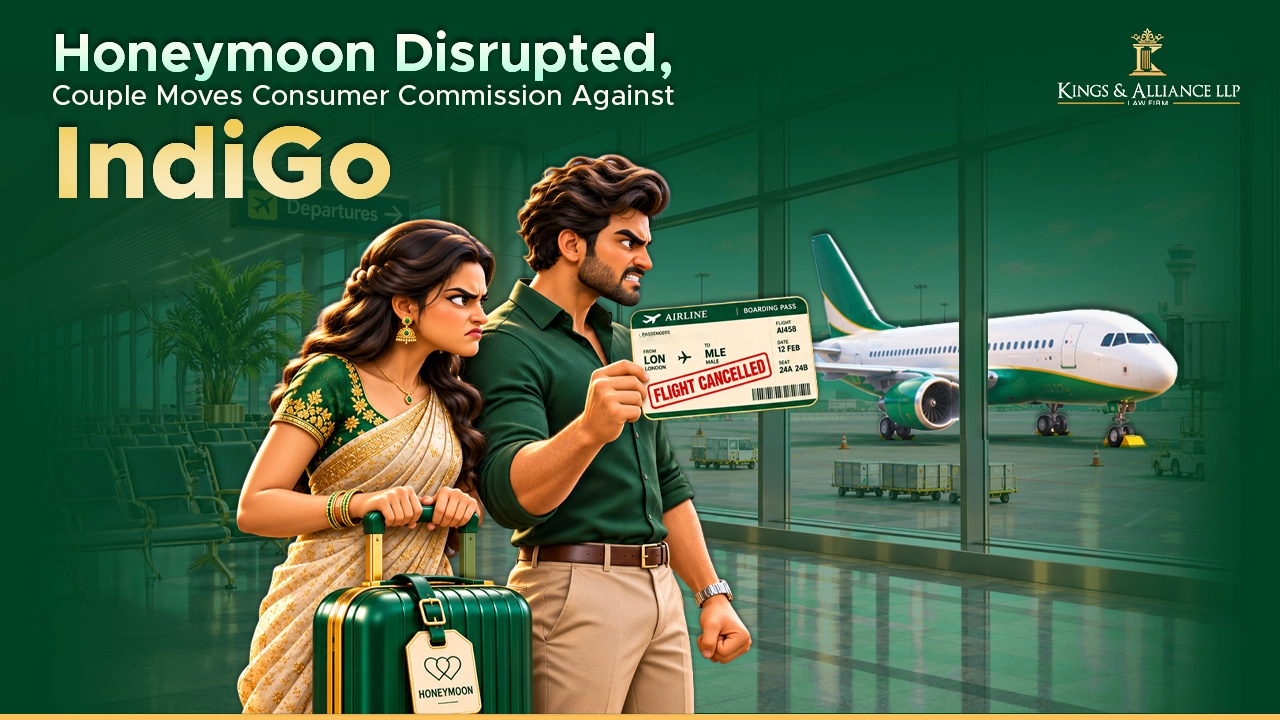
What happens when a long-awaited honeymoon is disrupted just hours before departure? For a couple travelling to Geneva via Istanbul, their plans took an unexpected turn when IndiGo cancelled their flight scheduled for the following morning. With no suitable alternative offered under the airline’s Plan B, the couple was left to arrange last-minute tickets with another airline at a considerably higher cost. What was meant to be the beginning of a memorable journey soon became a consumer dispute over the airline’s responsibility for the cancellation and the resulting financial and mental distress.
The question before the District Consumer Disputes Redressal Commission-VI, New Delhi, was not simply whether an airline could cancel a flight. It was whether citing operational reasons, without establishing the circumstances behind the cancellation, was enough to escape liability.
In Rishabh Maheshwari & Ms. Anisha Mangleek v. Inter Globe Aviation Ltd. (IndiGo Airlines),1 decided on 27 August 2026, the Commission held IndiGo held liable to pay compensation for inconvenience, harassment and mental agony and directed it to pay ₹2.5 lakh towards compensation and litigation expenses.
The Journey That Never Took Off
The complainants, Rishabh Maheshwari and Anisha Mangleek, had booked tickets with IndiGo for their honeymoon to Geneva via Istanbul, scheduled for 17 May 2024. Their itinerary comprised Flight No. 6E11 from New Delhi to Istanbul, followed by Flight No. 6E4099 from Istanbul to Geneva. The total cost of the original tickets was ₹54,428. However, on 16 May 2024, at approximately 8:54 PM, just hours before the scheduled departure, IndiGo informed them that Flight No. 6E11 had been cancelled.
IndiGo offered the couple two options through its Plan B facility: book an alternative flight or cancel the booking and receive a full refund. The complainants contended that no suitable alternative arrangement to Geneva was available under the facility. Left with little time, they booked replacement tickets with Etihad Airways for ₹1,24,202, incurring an additional expenditure of ₹69,774.
The cancellation also put their advance hotel bookings and tour reservations at risk.The complainants stated that IndiGo refunded ₹54,428, being the original ticket amount, and offered an additional ₹20,000 as compensation. However, IndiGo recorded the refund amount as ₹54,427 in its written statement.
Despite repeated follow-ups with IndiGo Airlines over the telephone and through email, the airline declined to increase the compensation offered. The complainants then approached the Directorate General of Civil Aviation (DGCA), but their efforts to resolve the dispute remained unsuccessful. Consequently, they issued a legal notice dated 10 October 2024 before approaching the Consumer Commission.
IndiGo’s Submissions
IndiGo, in its written statement, denied the allegations of deficiency in service and unfair trade practice. It contended that the flight had been cancelled due to operational reasons beyond its control, constituting a force majeure event under the applicable DGCA Civil Aviation Requirements.
The airline maintained that the complainants had been informed about the cancellation through SMS and email and had been offered the option of booking an alternative flight through its Plan B facility or obtaining a full refund. It further submitted that the refund had been duly processed and denied liability for the additional expenditure incurred by the complainants in arranging alternative travel.
Operational Reasons: A Defence, Not a Free Pass
IndiGo denied any deficiency in service or unfair trade practice. Its defence was that the cancellation had occurred due to operational reasons beyond its control and constituted a force majeure event under the applicable DGCA Civil Aviation Requirements. It also maintained that the passengers had been informed through SMS and email and had been offered a refund or alternative booking through Plan B. IndiGo further relied on Clause 3.3.2 of the DGCA Civil Aviation Requirements (CAR) Section 3,2 contending that its liability in the event of flight cancellation was limited to a full refund along with compensation of up to ₹10,000, subject to the applicable conditions. The Commission examined whether the airline had actually established the circumstances that necessitated the cancellation.
It observed that merely describing an event as a force majeure situation or referring generally to operational reasons does not automatically absolve a service provider of liability. The airline was required to place sufficient material on record to demonstrate that the circumstances were beyond its reasonable control. In the present case, the Commission found that IndiGo had failed to produce adequate evidence establishing the specific operational circumstances responsible for the cancellation. A general explanation, without supporting material, was insufficient to justify its defence.
The Commission observed that the passengers entitlement to compensation had to be examined in accordance with the applicable DGCA provisions. Accordingly, it considered the airline’s liability in light of the circumstances surrounding the flight cancellation and the material placed on record.
The Commission also made an important distinction that the flight cancellation does not automatically amount to deficiency in service in every case. The circumstances surrounding the cancellation, the notice provided to passengers, the alternative arrangements offered and the applicable regulatory requirements must be examined on the available evidence.
Here, the notification came only a few hours before departure, leaving the complainants to arrange alternative international travel at short notice. The resulting disruption to their honeymoon plans and inconvenience warranted compensation.
₹69,774 in Additional Airfare: Why the Entire Claim Was Rejected
The interesting part of the decision lies in what the Commission did not award. Although the couple had spent an additional ₹69,774 on replacement tickets, the Commission declined to direct IndiGo to reimburse this amount. The fact that alternative tickets cost more than the original booking was not sufficient to establish an entitlement to recover the entire difference.
The complainants were required to establish that the additional expenditure was reasonably necessary and foreseeable as a consequence of the airline’s deficiency and was recoverable under the applicable legal and regulatory framework.
Thus, the Commission distinguished between compensation for the inconvenience and mental agony suffered by passengers and reimbursement of a specific financial expenditure. Establishing the former did not automatically establish the latter.
The Consumer Protection Law Behind the Dispute
The complaint was instituted under Section 35 read with Section 34 of the Consumer Protection Act, 20193 Act along with Section 2(6), 2(7), 2(11), 2(47) against the Opposite Party alleging deficiency of service.
The Commission’s approach demonstrates that an airline’s contractual and operational explanations cannot be accepted at face value when a consumer alleges deficient service. The service provider must substantiate the defence it relies upon, particularly when it seeks to attribute the disruption to circumstances beyond its control.
At the same time, a consumer seeking reimbursement of additional expenditure must establish the legal basis for recovering that particular loss. Compensation and reimbursement are not interchangeable remedies.
Commission Awards ₹2.5 Lakh for Honeymoon Disruption
The District Consumer Disputes Redressal Commission-VI, New Delhi, comprising President Poonam Chaudhry and Members Bariq Ahmad and Shekhar Chandra, partly allowed the complaint on 27 August 2026.
IndiGo was directed to pay:
- ₹2,00,000 towards mental agony, harassment and inconvenience.
- ₹50,000 towards litigation expenses.
The amounts were directed to be paid within 45 days of receipt of a copy of the order. In the event of non-compliance, interest at 9% per annum would be payable from the date of the order until realisation. The claim for reimbursement of the additional airfare of ₹69,774 was rejected.
The decision leaves behind a practical reminder for the aviation sector: operational explanations must be supported by evidence, and a refund alone does not necessarily address the consequences of a last-minute cancellation. For passengers, however, proving inconvenience and establishing a recoverable financial loss remain two distinct exercises. Accordingly, although the Commission declined to reimburse the additional airfare, it held the airline liable for the inconvenience and mental agony suffered by the complainants and awarded a total of ₹2.5 lakh.
Conclusion
The decision reinforces the principle that airlines must substantiate claims of force majeure with evidence rather than rely on general references to operational difficulties. While a last-minute cancellation may amount to deficiency in service depending on the circumstances, the recovery of consequential financial losses requires separate justification. By awarding ₹2.5 lakh for mental agony, harassment and litigation expenses while rejecting the additional airfare claim, the Commission distinguished between compensation for deficient service and reimbursement of specific monetary losses. The ruling serves as a reminder that airlines must remain accountable for the services they provide, while consumers must establish the basis of the financial losses for which they seek reimbursement.
Citations
- Rishabh Maheshwari & Ms. Anisha Mangleek v. Inter Globe Aviation Ltd. (IndiGo Airlines) ↩︎
- Directorate General of Civil Aviation, Civil Aviation Requirements, Section 3 (Air Transport), cl. 3.3.2 ↩︎
- Consumer Protection Act, 2019, ss. 34, 35 ↩︎
Expositor(s): Adv. Gaurangi Tandon
This article is for information only and is not legal advice. Read the disclaimer