Case Docket · Family Law
No Retroactive Birthright: The Supreme Court Denies a Grandson’s Coparcenary Claim in J. Rajesh v. M. Kumaran
On this page
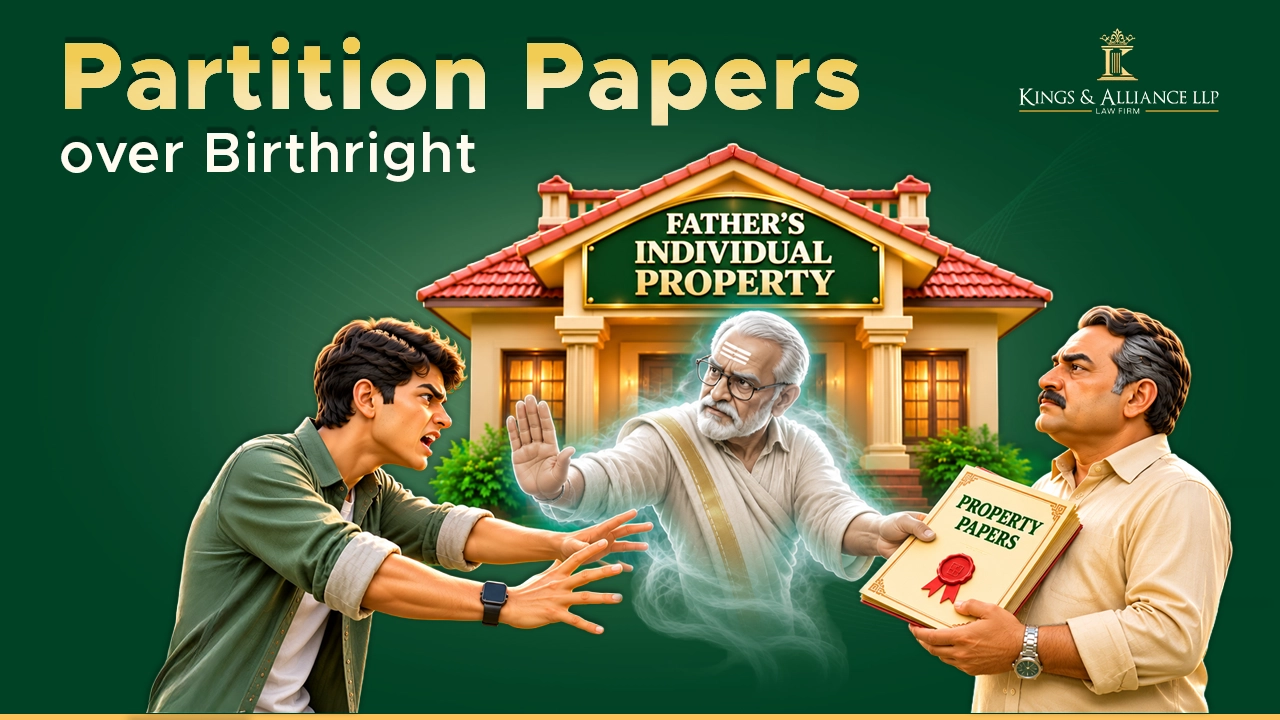
Does a grandson acquire a coparcenary right by birth in property inherited by his living father under Section 8 of the Hindu Succession Act, 1956? In J. Rajesh (Minor) v. M. Kumaran, the Supreme Court answered in the negative, reaffirming that property partitioned among Class I heirs vests as the allottee’s exclusive individual estate.
J. Rajesh, represented by his mother J. Gomathi, sued his father R. Jayagopal for half of a 1,811 sq. ft. joint family property inherited from his grandfather, N. Ramakrishnan.1 Previously, Jayagopal’s sister, G. Lalitha, had filed a partition suit in 1993 that ended in a compromise decree on 03/02/1994, allotting the 1,811 sq. ft. share to Jayagopal.2 Jayagopal later sold the land to M. Kumaran and K. Santhi via sale deeds dated 03/04/1997 and 17/04/1997. While Rajesh alleged the sales were meant to deprive him of his share, Kumaran and Santhi argued that Jayagopal held absolute title under the 1994 decree and that they had taken possession after paying consideration. On 30/01/2003, the II Additional Judge, City Civil Court, Chennai, ruled in Rajesh’s favour and passed a preliminary partition decree.
On appeal by Kumaran and Santhi, the Madras High Court reversed the trial court’s decision.3 The High Court observed that Rajesh was born on 06/01/1994, after Lalitha filed the 1993 partition suit, and had never challenged either the 1994 compromise decree or the 1997 sale deeds. Examining Section 8 of the Hindu Succession Act, 19564 (HSA), the Court held that upon Ramakrishnan’s intestate death and subsequent partition, Jayagopal took his divided share per capita as an absolute owner, barring Rajesh from acquiring any right by birth.
Aggrieved by the High Court’s judgement, an appeal was filed before the Hon’ble Supreme Court by J. Rajesh, challenging the same. Thus, the primary question of law before the Supreme Court was “whether J. Rajesh (appellant) would be entitled to half share in the property of his father who is still alive and can seek a decree of partition on the premise of the property in question being ancestral/joint family property?”
To answer this question, the Supreme Court first analysed the Section 8 and Section 65 of the HSA. Under Section 6, a male Hindu’s intestate interest in Mitakshara coparcenary property devolves by survivorship upon the surviving coparceners; however, if he leaves behind a Class I female heir, the proviso diverts devolution to intestate succession under the Act.6 Section 8 sets out the general rules of intestate succession for a male Hindu, devolving property in order of priority first to Class I heirs,7 then Class II heirs,8 then agnates, and finally cognates.
To examine the interplay between Sections 4,9 6, and 8, the Supreme Court relied on Commissioner of Wealth Tax, Kanpur & Ors. v. Chander Sen & Ors.,10 which addressed whether property inherited by a partitioned son from his father is taxed as his individual income or his HUF’s income. While a son’s coparcenary right traditionally arises at birth, making property inherited from a grandfather part of the Hindu Joint Family, Section 8(a)11 alters this rule by devolving property upon Class I heirs. Crucially, the HSA Schedule includes sons of predeceased sons as Class I heirs but excludes sons of living sons, raising the question of whether a son inherits in his individual capacity or as the Karta of his own undivided family.
Looking to the HSA’s Preamble,12 which states that the Act was enacted to amend and codify the law of intestate succession, the Court in Chander Sen agreed with precedents set by the majority of High Courts that property under Section 8 devolves in an heir’s individual capacity rather than as Karta. It rejected the Gujarat High Court’s contrarian view, noting that allowing a grandson to inherit under old Hindu law would defeat Section 8’s deliberate exclusion. Endorsing the Andhra Pradesh High Court’s position, the Court emphasised that Section 4 gives the Act overriding effect over pre-existing Hindu law, meaning the express language of Section 8 must prevail.
Applying Chander Sen to the present dispute, the Supreme Court held that because a son’s son is omitted from Class I, he acquires no right in his grandfather’s property during his father’s lifetime; pre-existing uncodified Hindu law was explicitly not saved, and Section 8 operates as a self-contained scheme of devolution. Consequently, upon N. Ramakrishnan’s death, his surviving children each took an individual share under Section 8 rather than HUF property. When partition opened with the 1993 suit and concluded in a compromise decree, each heir became the exclusive owner of their share. Citing Bhanwar Singh v. Puran & Ors.13 and Section 19 of the HSA,14 the Court concluded that the property ceased to be joint family property, with the heirs succeeding as tenants-in-common and ending any joint coparcenary. Because succession opened and partition proceedings began in 1993, before the appellant was born in 1994, no interest in the suit property devolved upon him.
In the present case, the Court reinforced the decision of Chander Sen, stating treating property devolved under Section 8 as HUF property would impermissibly create two distinct classes among Class I heirs: male heirs, who would hold the property as joint family assets vis-à-vis their sons, and female heirs, such as a widow, mother, or daughter, to whom no such concept could apply.
Next, addressing whether the appellant acquired a coparcenary share in his grandfather’s property by birth, the Court turned to the unamended Section 6, which governs the devolution of Mitakshara coparcenary interest by survivorship at the time of the male Hindu intestate’s death. N. Ramakrishnan evidently died in or before 1993, making his death occur at least a year before the appellant was born, and hence, Section 6 had no application to the case.
Similarly, the Court rejected the appellant’s reliance on Section 29-A of the Hindu Succession (Tamil Nadu Amendment) Act, 1989.15 The appellant had contended that Section 29-A, while conferring equal coparcenary rights by birth on daughters, left a son’s birthright intact and, under Clause (iii),16 preserved the coparcenary incidents of the property allotted under the 1994 compromise decree. However, the Supreme Court held that Section 29-A, much like Section 6, operates only where a Mitakshara coparcenary subsists at the time of the intestate’s death. Since N. Ramakrishnan had passed away and the partition suit among Class I heirs had commenced in 1993 prior to the appellant’s birth, the appellant was not a “surviving coparcener” at the time of death, rendering Section 29-A wholly inapplicable.
In its conclusion, the Court underscored this chronological sequence – by the time the appellant was born, the property had already devolved upon the Class I heirs and a partition suit had been initiated, culminating in a decree that rendered each divided share the exclusive property of its respective heir. Consequently, R. Jayagopal held his share in his exclusive, individual capacity rather than as coparcenary property, precluding any further devolution once the partition was complete.
The Supreme Court finally decided that there was no infirmity in the judgement passed by the High Court, and thus dismissed the appeal, and disposed of all pending applications, with no order as to costs.
Through this judgment, the Hon’ble Supreme Court reaffirms a settled principle of Hindu succession law – property inherited by a son from his intestate father under Section 8 of the Hindu Succession Act, 1956 (HSA) is held in his exclusive individual capacity rather than as HUF or coparcenary property, thereby excluding his living son from acquiring an interest by birth. Interpreting the statutory object of the HSA in light of C.W.T. v. Chander Sen, the Court held that since succession had already opened upon the grandfather’s death and partition proceedings had commenced before the appellant was born, his father acquired absolute individual title under the subsequent compromise decree.
Citations
- J. Rajesh (Minor) v. R. Jayagopal & Ors., O.S. No. 1698/1997 (II Additional Civil Judge, City Civil Courts, Chennai). ↩︎
- C.S. No. 1728/1993. ↩︎
- M. Kumaran & Anr. v. J. Rajesh (Minor) & Anr., A.S. No. 609/2003 (Madras High Court). ↩︎
- Hindu Succession Act, 1956 (Act 30 of 1956), § 8. ↩︎
- Hindu Succession Act, 1956 (Act 30 of 1956), § 6 (Pre-2005Act). ↩︎
- Hindu Succession Act, 1956 (Act 30 of 1956), § 6, Proviso (Pre-2005Act). ↩︎
- Hindu Succession Act, 1956 (Act 30 of 1956), Schedule. ↩︎
- ibid. ↩︎
- Hindu Succession Act, 1956 (Act 30 of 1956), § 4. ↩︎
- Commissioner of Wealth Tax, Kanpur & Ors. v. Chander Sen & Ors., (1986) 3 SCC 567 (SC). ↩︎
- Hindu Succession Act, 1956 (Act 30 of 1956), § 8(a). ↩︎
- Hindu Succession Act, 1956 (Act 30 of 1956), Preamble. ↩︎
- Bhanwar Singh v. Puran & Ors., (2008) 3 SCC 87 (SC). ↩︎
- Hindu Succession Act, 1956 (Act 30 of 1956), § 19. ↩︎
- Hindu Succession (Tamil Nadu Amendment) Act, 1989 (Tamil Nadu Act No. 1 of 1989), § 29-A. ↩︎
- Hindu Succession (Tamil Nadu Amendment) Act, 1989 (Tamil Nadu Act No. 1 of 1989), § 29-A(iii). ↩︎
Expositor(s): (Intern.) Priyangshu Bishayee
Topics
This article is for information only and is not legal advice. Read the disclaimer