Trending topic · WCC
Legal Mind Required: Supreme Court Reads Down Section 6 of the PMLA
On this page
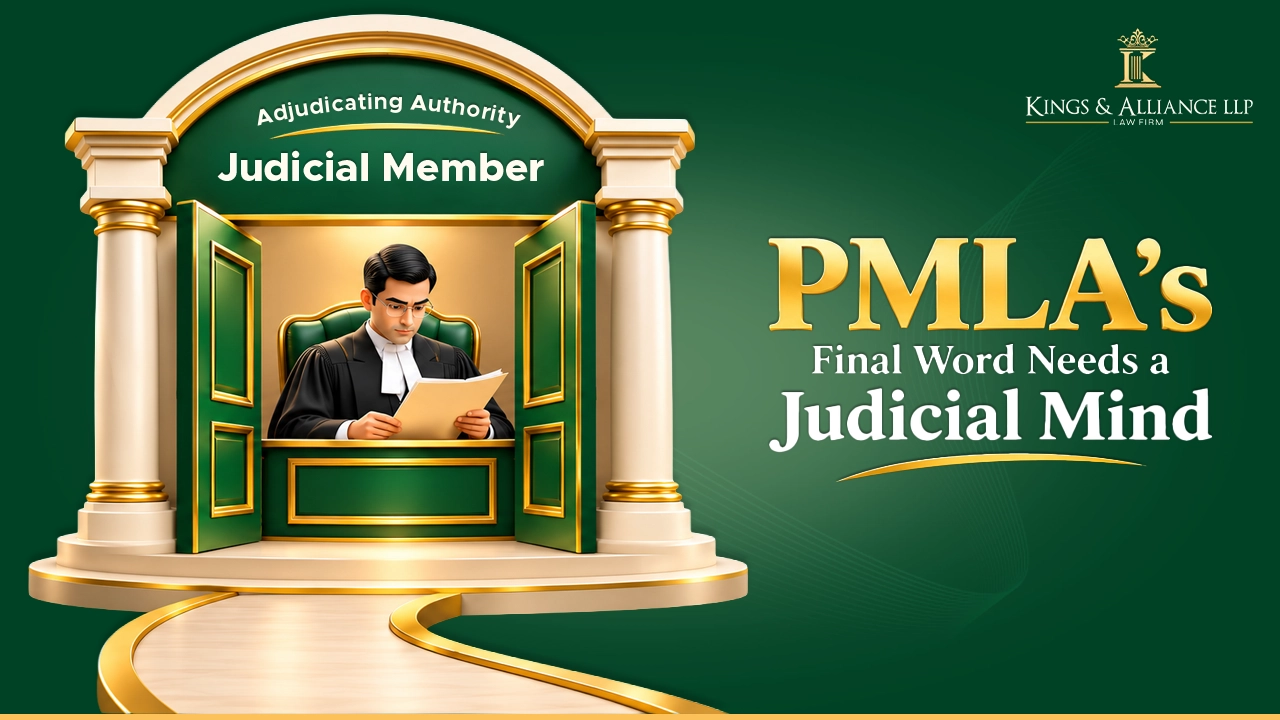
On 26 November 2026, in Union of India v. J. Sekar,1 a Bench of CJI Surya Kant, Justice Joymalya Bagchi and Justice V. Mohana held that adjudication under Sections 8(2)2 and 8(3)3 of the PMLA involves interpreting key statutory provisions and appreciating evidentiary material. It must therefore be undertaken by a Bench of the Adjudicating Authority (AA) that consists of, or includes, the Judicial Member. The Court upheld Sections 6(5)(b)4 and 6(7),5 allowing single-Member Benches, and held that a show-cause notice under Section 8(1) does not need a Judicial Member. It also held that the Judicial Member need not be the Chairperson.
Three High Courts, One View
The present case arose from judgments of the Delhi, Calcutta and Telangana High Courts. In J. Sekar v. Union of India6 the Delhi High Court held that the ED may provisionally attach property under the second proviso to Section 5(1)7 of the PMLA, provided its reasons for believing that non-attachment may frustrate proceedings are included in the AA’s show-cause notice. It also held that a sole Member may discharge the AA’s functions and that a Judicial Member need not form part of the AA or its Bench. The Delhi High Court held that the writ petitions were maintainable before it, since the AA sits in New Delhi, even though the underlying proceedings arose outside its territorial jurisdiction. Similarly, in R.P. Infosystems Ltd. v. Adjudicating Authority, PMLA,8 the Calcutta High Court rejected the contention that the AA could not adjudicate through a single Member, particularly one who was not a Judicial Member.
Following these decisions, the Telangana High Court in Enforcement Directorate v. Karvy India Realty Ltd9 refused to interfere with the show-cause notice under Section 8(1) and rejected the proposition that the powers under Section 8(1) of the PMLA could be exercised only by an Adjudicating Authority comprising a member with a legal background. The Telangana High Court reaffirmed this view in B. Sreenivasa Gandhi v. Adjudicating Authority10 The Union of India appealed against J. Sekar, challenging the Delhi High Court’s findings on its territorial jurisdiction and on communicating the “reasons to believe”. On those two aspects, the Supreme Court expressed no opinion, as neither side argued them. Private parties challenged the other High Court rulings, and a writ petition under Article 32 was also filed, in which the vires of Sections 6(5)(b) and 6(7) were challenged.
Three Members, One Authority
Originally, the PMLA provided for multiple AAs. The 2009 amendment replaced references to multiple AAs with references to a single AA. Section 6 provides for the AA’s appointment, powers and composition. Under Section 6(1), the Central Government appoints the AA to exercise the jurisdiction, powers and authority conferred by or under the Act. The AA comprises a Chairperson and two other Members, one each from the fields of law, administration, and finance or accountancy.
Rules 411 and 512 of the Prevention of Money-Laundering (Appointment and Conditions of Service of Chairperson and Members of Adjudicating Authorities) Rules, 2007 set out the appointment process. Rule 4 provides for a Selection Committee comprising the Revenue Secretary as Chairperson, the Secretary of the Department of Legal Affairs, and either the Chairman of the Central Board of Direct Taxes or the Chairman of the Central Board of Excise and Customs, as nominated by the Revenue Secretary. Under Rule 5, the Chairperson is appointed from among the AA’s Members on the Committee’s recommendation.
Under Section 6(5), the AA exercises its jurisdiction through Benches, and a Bench may be constituted by the Chairperson with “one or two Members” as the Chairperson may deem fit (Section 6(5)(b)). The Supreme Court in Sekar13 (SC) rejected the private appellants’ argument that “one or two Members” excludes the Chairperson. Reading Sections 6(2), 6(4) and 6(7) with Rule 5, it held that the Chairperson is also a Member, so a Bench may consist of one Member, the Chairperson or another, or of two Members, with or without the Chairperson. Excluding the Chairperson would make the AA sit en bloc and render Section 6(5) redundant.
Two Hats of the Adjudicating Authority
The Supreme Court divided the AA’s functions into two categories: in the first it is the “keeper of the sealed cover”, in the second it “holds the scales”. The Court held that the need for a Judicial Member differs between them.
The custodial functions arise where ED officers attach property, conduct a survey, search, seize, freeze, arrest or retain property and records (Sections 5, 16 to 21). Each provision requires the officer to forward the recorded reasons and supporting material to the AA in a sealed envelope. The AA takes no active step and simply holds them, so the ED must commit its reasons to an independent body at the moment it acts, creating a record against which its conduct can later be tested. The Court held this role to be essentially administrative, involving no assessment of competing submissions and no interpretation of statutes, so the absence of a Judicial Member does not impair it.
The adjudicatory functions arise under Section 8, which the Court treated as a three-stage process of notice, hearing and final order. The Section 8(1) notice rests only on the ED’s material, is prima facie, and carries no consequence for the noticee, so it needs no Judicial Member. The hearing and final order under Sections 8(2) and 8(3) are different. Section 8(2) requires a full opportunity to be heard, and Section 6(15)14 makes the AA subject to the principles of natural justice. At this stage the AA must weigh evidence, apply the standards of proof and statutory presumptions, identify the source of the income used to acquire the property and construe terms such as “property” and “money-laundering” in light of precedent. The stakes are high, because once an attachment is confirmed, Section 8(4) requires the Director to take possession, and the person may remain dispossessed until the trial ends.
The Court observed that this function is not unlike that of a regular court. The Special Court makes a similar determination at the confiscation stage, on evidence led in the trial, while for the interim the PMLA entrusts the question to the AA and bars civil courts under Section 41.15 Relying on Union of India v. Madras Bar Association16 and State of Gujarat v. Utility Users’ Welfare Association,17 the Court held that a person is entitled to have their rights decided by a forum that follows the recognized principles of adjudication. It rejected the argument that the availability of appeals dispenses with this need, since an appellate forum can correct errors but cannot supply what the original forum lacked. It also rejected the comparison with the NDPS Act, SAFEMA, the Benami Act and the Customs Act, because those statutes do not require a member with legal experience, whereas Section 6(2) and (3) of the PMLA expressly do, and attachment under the PMLA is more far-reaching. The Court therefore held that a person with a judicial or legal background must be part of the Bench making the final determination under Sections 8(2) and 8(3)
Bridging the Gap Between Text and Safeguard
The Court recognised a dissonance. Parliament had deliberately refrained from requiring the Judicial Member to sit on particular Benches or to be Chairperson, yet the Court found that legally sound adjudication under Section 8(3) needs that Member. The private appellants used this gap to challenge the vires of Sections 6(5)(b) and 6(7). The Supreme Court observed that when a law is challenged on constitutional grounds, courts should first try to interpret it in a way that harmonises its text with constitutional rights and safeguards. A provision should be struck down only if that approach cannot resolve the defect. Applying this principle, the Court read Section 6 of the PMLA to accommodate the participation of a Judicial Member in the AA’s final adjudication under Section 8.
The Court relied on L. Chandra Kumar v. Union of India,18 in which a Constitution Bench interpreted the Administrative Tribunals Act to require that cases involving statutory interpretation be heard by a Bench of at least two Members, including a Judicial Member. The PMLA similarly empowers the AA’s Chairperson under Sections 6(6) and 6(7) to transfer Members between Benches and assign cases to them. The Court held that these powers can be used to ensure judicial participation in final adjudication. Accordingly, a Judicial Member need not participate in issuing a show-cause notice under Section 8(1), but must sit on the Bench that hears the parties and makes the final determination under Sections 8(2) and 8(3). The Chairperson must issue an administrative circular ensuring that every Bench passing an order under Section 8(3) includes a Judicial Member.
The same requirement applies to the ancillary determinations under the first proviso to Section 919 (whether an encumbrance or leasehold interest was created to defeat the Act) and under Sections 20(4)20 and 21(4)21 (whether property or records may be retained beyond 180 days). These are bound up with the Section 8 adjudication and must be decided by the same Bench. The Court clarified that it was not requiring Section 8 adjudication to be done only by a Bench of two or more Members: the Chairperson may list such matters before a single-Member Bench, provided that Member is the Judicial Member.
The Court also declined to require the Judicial Member to be the Chairperson. Relying on State of Gujarat v. Utility Users’ Welfare Association,22 where the Court read “may” in Section 84(2)23 of the Electricity Act, 2003 as directory and held that the Chairperson of a body with executive and quasi-judicial functions need not come from a legal background, it reasoned that a Judicial Member on the adjudicating Bench ensures an independent judicial mind, and the Chairperson’s role is administrative.
What Comes Next
The Court’s directions in Union of India v. J. Sekar are narrow but consequential. Sections 6(5)(b) and 6(7) stand and single-Member Benches remain valid, but final adjudication under Sections 8(2) and 8(3) now requires the Judicial Member. The Court limited the ruling’s reach backwards: the judgment is not a ground to question the jurisdiction of an AA Bench in respect of any order passed before 26 November 2026, though such orders can still be challenged on merits in the statutory appeal. All interim relief, including stays of proceedings before the AA, stands vacated, and pending matters must be decided in line with the judgment.
The Court also flagged the strain on a single AA, noting that provisional attachment orders rose from 130 up to March 2012 to 712 in 2025-26, against a 180-day adjudication window. It held back from directing additional AAs because the 2009 Amendment, which replaced multiple AAs with one, was not under challenge, but recommended that the Union consider repealing it and returning to multiple AAs. Its closing thought sums up the ruling: independence from the attaching agency is only half the assurance, and where the authority must weigh evidence and construe the law, the assurance is fully honoured only when the decision-maker is trained in law.
Citations
- Union of India v. J. Sekar, 2026 INSC 1277. ↩︎
- Prevention of Money-Laundering Act, 2002, s. 8(2). ↩︎
- Prevention of Money-Laundering Act, 2002, s. 8(3). ↩︎
- Prevention of Money-Laundering Act, 2002, s. 6(5)(b). ↩︎
- Prevention of Money-Laundering Act, 2002, s. 6(7). ↩︎
- J. Sekar v. Union of India (2018 SCC OnLine Del 6523) ↩︎
- Prevention of Money-Laundering Act, 2002, s. 5(1). ↩︎
- R.P. Infosystems Ltd. v. Adjudicating Authority, PMLA, (2023) 2 HCC (Cal) 251. ↩︎
- Enforcement Directorate v. Karvy India Realty Ltd., 2024 SCC OnLine TS 18. ↩︎
- B. Sreenivasa Gandhi v. Adjudicating Authority, 2026:TSHC:3414-DB. ↩︎
- r. 4, Prevention of Money-Laundering (Appointment and Conditions of Service of Chairperson and Members of Adjudicating Authorities) Rules, 2007. ↩︎
- r. 5, Prevention of Money-Laundering (Appointment and Conditions of Service of Chairperson and Members of Adjudicating Authorities) Rules, 2007. ↩︎
- Ibid 1 ↩︎
- Prevention of Money-Laundering Act, 2002, s. 6(15). ↩︎
- Prevention of Money-Laundering Act, 2002, s. 41. ↩︎
- Union of India v. Madras Bar Assn., (2010) 11 SCC 1 ↩︎
- State of Gujarat v. Utility Users’ Welfare Assn., (2018) 6 SCC 21 ↩︎
- L. Chandra Kumar v. Union of India, (1997) 3 SCC 261 ↩︎
- Prevention of Money-Laundering Act, 2002, s. 9. ↩︎
- Prevention of Money-Laundering Act, 2002, s. 20(4). ↩︎
- Prevention of Money-Laundering Act, 2002, s. 21(4). ↩︎
- Ibid 17
↩︎ - Electricity Act, 2003, s. 84(2). ↩︎
Expositor(s): Adv. Siddharath Shrivastava
Topics
This article is for information only and is not legal advice. Read the disclaimer