Delhi High Court · Intellectual Property Rights
Author on Record: Why India’s Copyright Office Rejected the DABUS Application
On this page
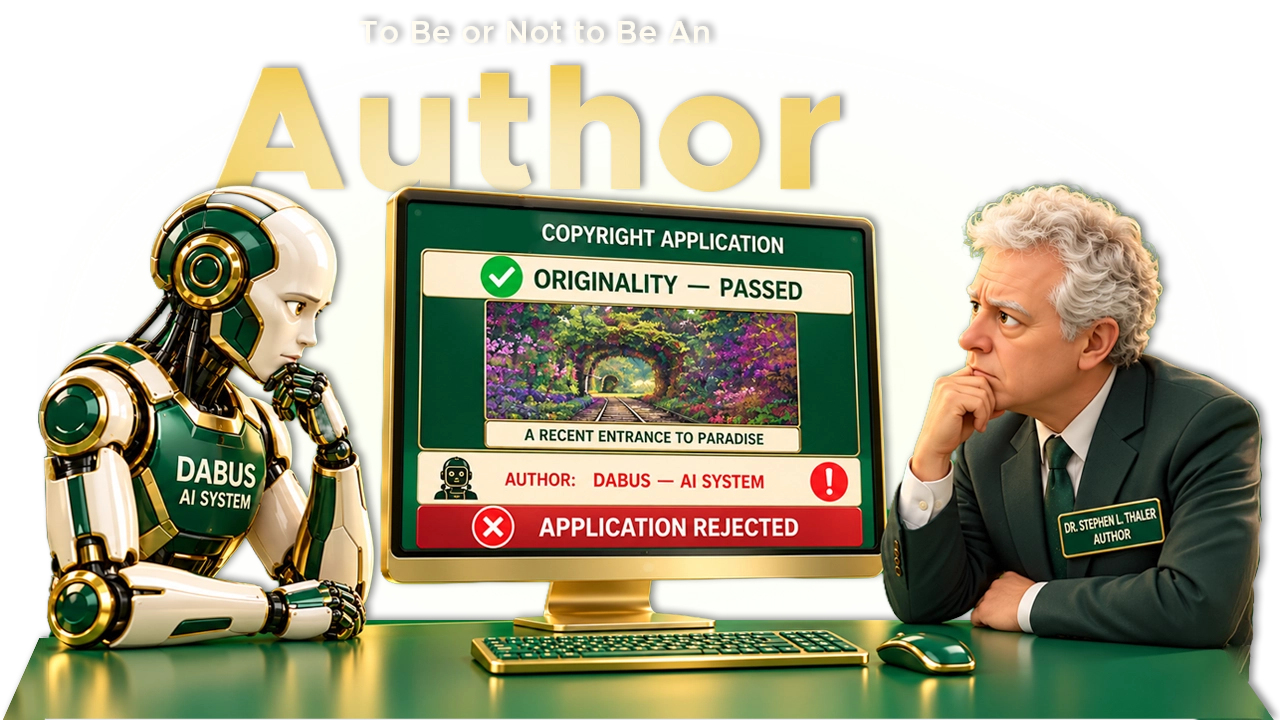
If an AI system generates an artwork based on a human prompt, without any human intervention in its final generated output, who by law can technically be considered the creator ? The Registrar of Copyrights rejected Dr. Stephen L. Thaler’s application to register the artwork “A Recent Entrance to Paradise” with his AI system, Device for the Autonomous Bootstrapping of Unified Sentience (AI-DABUS), named as author. The Registrar held that DABUS cannot be an author under section 2(d)(iv)1 of the Copyright Act, 1957,2 since it is neither a natural nor a juristic person, but separately found the artwork itself cleared the originality threshold under section 133 and that the Applicant, on his own account of how the work was made, was the person who could have been named its statutory author. The application failed not because AI-generated works are categorically unprotected, but because the Applicant even when directly invited to amend the application and name himself as author, declined to do so.
The Applicant filed the application in May 2022, naming DABUS, an AI-System as author, and himself as owner. The copyright issued a discrepancy letter in 2023, questioning whether DABUS could legally be recognised as an author at all, and after the Applicant response failed to resolve the objections, the matter proceeded to a formal hearing process. An amicus curiae, Senior Advocate Rajeshwari Hariharan was appointed to assist the Registrar given the novelty of the questions involved. Across three hearings, the Applicants’ side argued that DABUS operated through interconnected neural network modules, trained on photographs Thaler had taken and curated thesaurus entries, and that once activated, DABUS generated the final artwork autonomously, without any real-time human intervention or text prompt. On this basis, Thaler contended that his own role was merely “antecedent” and “upstream,” while DABUS was the “immediate and operative cause” of the artwork, and should accordingly be named its author.
Crossing the Originality Bar Was Never the Issue
The Registrar first addressed whether the work could be original at all if no human consciously shaped its final expressive form. Applying the standard from Eastern Book Company v. D.B. Modak,4 which requires independent creation and a minimal, non-trivial degree of creativity rather than novelty or artistic merit, the Registrar held that the work’s particular arrangement of colours, tonal variations and compositional elements was not shown to reproduce any pre-existing work, and was not the predetermined or inevitable output of a purely mechanical process. The order states plainly that “the fact that the work was generated through algorithmic or computational processes cannot, by itself, render the resulting expression unoriginal,” and concluded that the work “satisfies the requirement of originality under Section 13 of the Copyright Act, 1957.” This finding was confined to the material on record in this proceeding and treated as analytically separate from the question of who, if anyone, could be named the work’s author.
Section 2(d)(vi): The Person, Not the Machine
A major question was who under section 2(d)(iv), “causes the work to be created” ? The Applicant argued that this phrase required an inquiry into the actual process, and since DABUS performed the act of generating, DABUS should be named author regardless of whether it holds legal personality or not. The Registrar rejected this reading, holding that section 2(d)5 as a whole is “a self-contained scheme of statutory attribution” that allocates authorship, for every category of work, to a specific legally recognised person rather than to whichever actor last touches the output. Drawing an analogy to a book passing through editors, typists and publishers before reaching print, none of whom become its legal author, the order holds that “the Legislature did not identify the computer, software or generative system as the author. It identified the author as the ‘person’ who causes the work to be created”. Persuasive support was drawn from the “mastermind” or “effective cause”” test in the US case Aalmuhammed v. Lee,6 applied here to find that Thaler, who conceived and configured DABUS, personally supplied and curated its inputs, and initiated the generative process, was the one whose acts bore a sufficiently direct relationship to the work’s creation. The order states directly that “Dr. Thaler is the person who caused this particular work to be created within Section 2(d)(vi), although DABUS performed the immediate computational generation of its final visual form.”
The Registrar also rejected the Applicant’s argument, built on section 2(d)(iv)’s recognition of a company as a film’s author-producer, that “person” in the above mentioned section should likewise stretch to cover DABUS. This was held to conflate two different legislative choices: a producing company already holds recognised legal personality before section 2(d)(iv) ever applies to it, whereas DABUS holds no such status to begin with, so the same word cannot be read to import personality where none exists.
Why did the Application still failed
Because DABUS cannot hold or assign copyright, the application’s own structure, naming DABUS as author and Thaler merely as owner, created what the order calls “a legally impossible separation for which no statutory route of vesting or transfer has been shown.
Critically, the Registrar was explicit that this defect was curable: had Thaler been correctly identified as author, Section 177 would ordinarily have made him first owner directly, with no assignment from DABUS needed at all. At the final hearing, Thaler was expressly offered the chance to amend the application accordingly. He declined, and the alternative he proposed, naming himself as author only if DABUS also received formal recognition as “generator”, was never put forward as an unconditional correction. The Registrar held it could not treat a conditional proposal as an amendment, and that entering Thaler as author on its own initiative “would amount to the Registrar making and allowing a materially different application on the Applicant’s behalf.” The application was rejected on that basis alone, with the order noting this “does not preclude Dr. Stephen L. Thaler from pursuing such remedy as may be available in law” on corrected particulars.
Citations
- Copyright Act, 1957, s. 2(d)(iv) ↩︎
- A recent entrance in paradise, Diary No. 9356/2022-CO/A ↩︎
- Copyright Act, 1957, s. 13 ↩︎
- Eastern Book Company v. D.B. Modak, (2008) 1 SCC 1 ↩︎
- Copyright Act, 1957, s. 2(d) ↩︎
- Aalmuhammed v. Lee, 202 F.3d 1227 (9th Cir. 2000) ↩︎
- Copyright Act, 1957, s. 17 ↩︎
Expositor(s): Adv. Pratistha Dahiya
This article is for information only and is not legal advice. Read the disclaimer