Introduction
Can a single, distinctive word, protected and nurtured over decades, be adopted by another entity without sparking a protracted legal war? This is the central question at the heart of the contentious dispute between a venerable German chemical company and a relatively newer Indian entity, a legal battle that unfolded in the hallowed halls of the High Court of Judicature at Bombay, highlighting the fierce protection afforded to intellectual property.
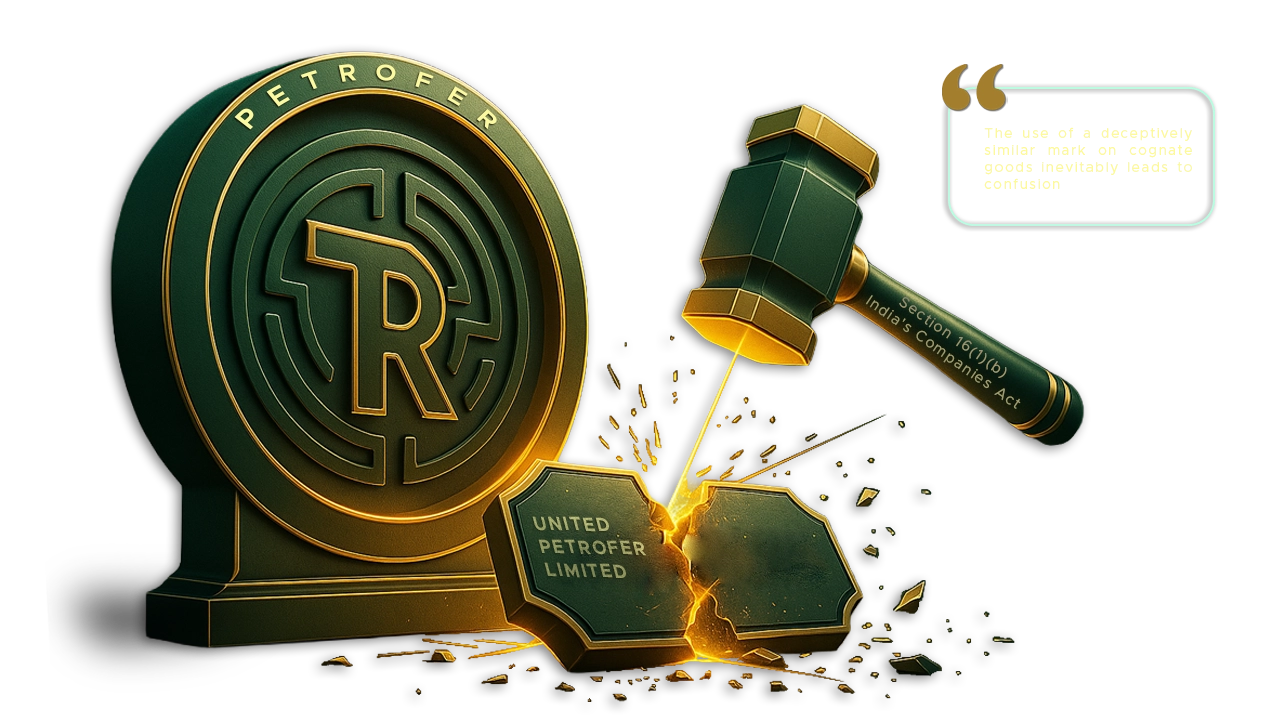
The contentious legal dispute, Petrofer Chemie H.R. Fischer GMBH & Co. KG. & Anr. v. United Petrofer Limited1, centers on the infringement and passing off of the Plaintiffs’ established and registered trademark, ‘PETROFER’, by the Defendant. The Plaintiffs, a venerable German chemical company and its Indian licensee, built global goodwill under ‘PETROFER’, which they asserted is a coined and invented word, affording it the highest level of distinctiveness and protection since its Indian registration in 1997. The conflict arose when the Defendant incorporated as ‘UNITED PETROFER LIMITED’ and began using ‘UNITED PETROFER’ for identical or cognate goods—industrial chemicals and lubricants—creating an “imminent likelihood of confusion.” The Plaintiffs’ case was exceptionally strong, not only grounded in their long-standing trademark rights and statutory infringement claims but also bolstered by their successful, prior action under the Companies Act, which legally mandated the Defendant to change its corporate name. Consequently, the Interim Application sought an immediate temporary injunction to restrain the Defendant from using any name or mark containing ‘PETROFER’, arguing that a registered, distinctive mark, representing years of investment, must be swiftly and fully protected against such a conspicuous near-imitation.
The Plaintiffs’ action was not a knee-jerk reaction. Prior to filing the suit, they successfully moved the Regional Director MCA under Section 16(1)(b) of the Companies Act, 2013, seeking a direction for the Defendant to change its corporate name. This statutory provision is key, allowing a registered proprietor of a trademark to compel a company to change its name if it “is identical with or too nearly resembles” their registered trademark. The Regional Director, noting the resemblance, ordered the Defendant to change its name in September 2019. The Defendant’s subsequent attempts to challenge this order at the Gujarat High Court and to cancel the Plaintiffs’ trademark registrations via Rectification Applications were part of the ensuing legal maneuvers, though the rectification efforts were ultimately dismissed for want of prosecution in January 2025.
Legal Precedents and Rationale
The Plaintiffs’ arguments for granting an injunction to restrain the Defendant from using the word ‘PETROFER’—were heavily anchored in established trademark jurisprudence. The underlying rationale is the protection of the Plaintiffs’ statutory rights and goodwill, and crucially, the safeguarding of the public from being misled. In support of their contention that the use of a deceptively similar mark on cognate goods inevitably leads to confusion, the Plaintiffs placed reliance on several foundational judgments:
Corn Products Refining Co. v. Shangrila Food Products Ltd2.: The Hon’ble Supreme Court’s decision here sets a crucial benchmark for determining deceptive similarity, establishing that if the marks are similar and the goods are of the same description, or cognate, the likelihood of confusion is high. The Plaintiffs argued that the use of ‘UNITED PETROFER’ on identical industrial goods was a direct parallel to this principle.
Neon Laboratories Ltd. v. Themis Medicare Ltd3.: This case from the same High Court supports the principle that using a deceptively similar mark in respect of cognate goods constitutes infringement.
Furthermore, the Plaintiffs addressed a potential counter-argument related to laches by clarifying that their minor raw material purchases from the Defendant in 2017-2018 were of “insignificant quantity” and were made without the knowledge of their key managerial personnel. Citing the judgment of the Delhi High Court in Makemy Trip (India) Private Limited vs M/S Make My Happy Journey4, they asserted that such inconsequential, compartmentalised transactions should not prejudice their statutory entitlement to an injunction.
Conclusion
The Interim Application sought a temporary injunction to restrain the Defendant from utilizing the impugned mark, corporate name, and domain name containing the word ‘PETROFER’ pending the final disposal of the suit. The Plaintiffs built an “overwhelmingly strong case” on the bedrock of their extensive reputation, global sales, promotional expenditure, and, most importantly, their valid and subsisting trademark registrations. The judgment in this case, pronounced by Arif S. Doctor, J., in November 2025, was to decide whether the statutory rights of a registered trademark holder could be immediately vindicated when faced with a near-identical corporate name and mark dealing in the same category of goods. The core message of this dispute remains a clear warning in the commercial world: a coined and registered mark, representing years of investment and goodwill, is a closely guarded asset, and any imitation—even when slightly modified—will be met with the full force of trademark law.
Citations
- Petrofer Chemie H.R. Fischer GMBH & Co. KG. & Anr. v. United Petrofer Limited 2025:BHC-OS:20475
- Corn Products Refining Co. v. Shangrila Food Products Ltd. AIR1960SC142
- Neon Laboratories Ltd. v. Themis Medicare Ltd 2014 (60) PTC 621 (Bom)
- Makemy Trip (India) Private Limited vs M/S Make My Happy Journey AIRONLINE 2019 DEL 261
Expositor(s): Adv. Archana Shukla