GST Litigation
Bombay High Court Rules GST Proceedings Against Amalgamated Entity Are Void Ab Initio
On this page
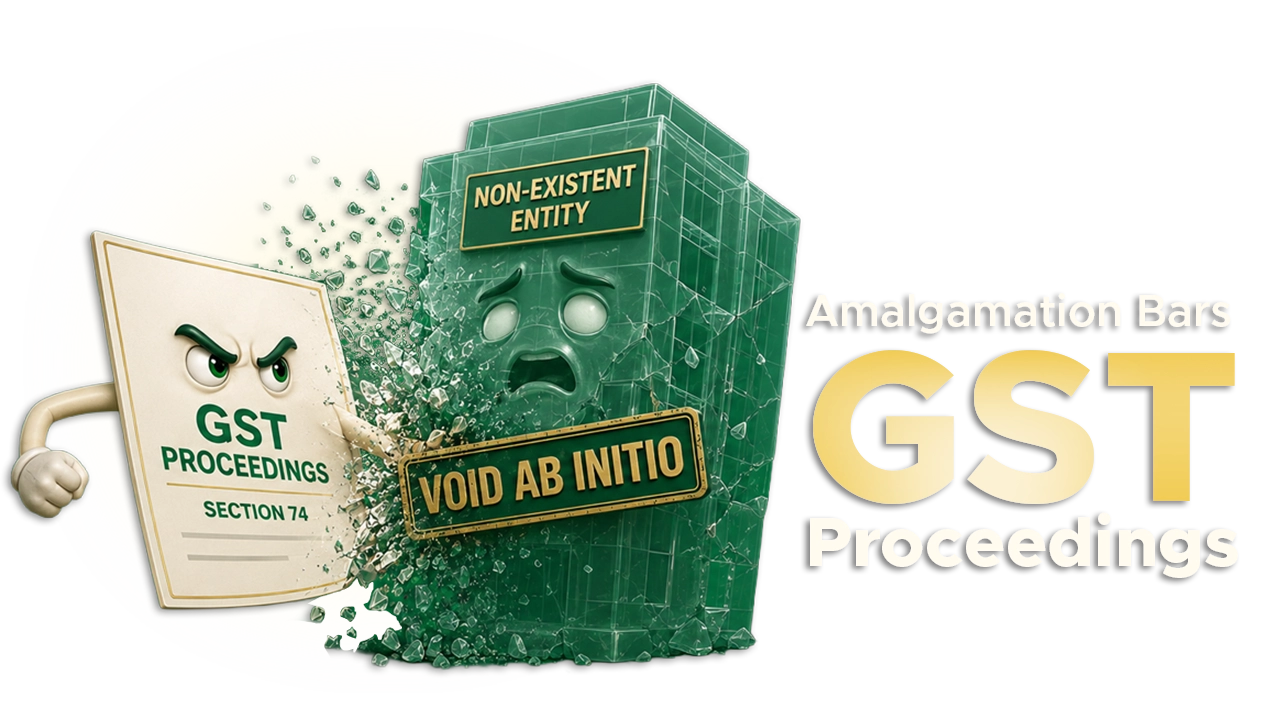
Can tax authorities continue legal proceedings against a company that has already ceased to exist after a merger? More importantly, can statutory recovery provisions under the GST framework cure proceedings initiated against an entity that no longer exists in the eyes of law?
These questions formed the foundation of the recent decision delivered by the Bombay High Court in Kanakia Spaces Realty Private Limited v. Union of India & Ors.1, a dispute involving GST proceedings initiated against a company that had already merged into another entity years earlier. The ruling revisits an increasingly litigated issue in tax jurisprudence: whether proceedings initiated against a non-existent entity can survive merely because the underlying tax liability may continue against the successor company.
In setting aside the impugned GST proceedings, the Bombay High Court reiterated a settled but critical principle of law once an amalgamating company ceases to exist pursuant to a sanctioned merger scheme, any proceedings initiated against such entity are void ab initio, particularly where the Department had prior knowledge of the merger.
Amalgamation and GST Proceedings Against a Dissolved Entity
The dispute arose pursuant to a scheme of amalgamation sanctioned by the Bombay High Court on 29 November 2016 involving Kanakia Supremo Construction Private Limited (KSCPL) and Kanakia King Style Construction Private Limited, both of which merged into the petitioner company, Kanakia Spaces Realty Private Limited (KSRPL), with retrospective effect from 1 April 2015. Following the amalgamation, the names of the transferor companies were ultimately struck off from the records of the Registrar of Companies, resulting in their corporate existence formally coming to an end.
An important factual aspect noted by the Court was that upon introduction of the GST regime in 2017, KSCPL’s earlier Service Tax registration was automatically migrated into the GST framework under Section 139 of the CGST Act2, resulting in generation of a GST registration in the name of a company that had already ceased to exist. This automated migration later became one of the underlying reasons for the Department continuing proceedings in the old entity’s name.
Despite the merger, the GST Department subsequently initiated proceedings against KSCPL itself. A Show Cause Notice dated 25 June 2025 was issued under Section 74 of the CGST Act3 alleging non-payment of GST dues amounting to ₹44.78 crore . The petitioner specifically informed the Department that KSCPL had already dissolved pursuant to amalgamation and that proceedings against a non-existent entity were legally unsustainable.
Notwithstanding these objections, the Department proceeded to pass an Order-in-Original dated 31 December 2025 confirming GST demands of ₹42.65 crore along with interest and penalty, after dropping a component of ₹2.13 crore attributable to land value. This led the petitioner to challenge the proceedings before the Bombay High Court.
Rival Contentions Before the Court
Before the Court, the petitioner argued that the entire proceedings stood vitiated because they had been initiated against a company that no longer existed in the eyes of law. According to the petitioner, once the Department had knowledge of the amalgamation, continuation of proceedings against KSCPL became fundamentally without jurisdiction.
To support its case, the petitioner relied heavily upon the Supreme Court’s decision in Principal Commissioner of Income Tax v. Maruti Suzuki India Ltd.4, an Income Tax Act ruling where proceedings initiated against a non-existent amalgamating company were held void ab initio. The petitioner argued that the same foundational corporate law principle applies equally under the CGST Act. Reliance was also placed on the Bombay High Court’s rulings in Reliance Industries Ltd. v. P. L. Roongta5 and Vodafone Idea Ltd. v. Union of India6, both of which extended similar reasoning in the GST context.
The Department, on the other hand, argued that the tax liabilities of KSCPL survived the merger and could still be recovered under Sections 74 and 85 of the CGST Act. During the course of adjudication, the Court also examined Section 87 of the CGST Act7 dealing with amalgamation and merger of companies, since it formed a central issue in determining whether the statutory framework permitted continuation of proceedings despite the merger.
Court’s Analysis and Findings
The Bombay High Court ultimately rejected the Department’s position. Relying extensively upon Maruti Suzuki, Reliance Industries and Vodafone Idea, the Court held that once a company ceases to exist pursuant to amalgamation, any notice issued in its name becomes jurisdictionally defective and void from inception.
The Court emphasized that the Department had already been informed about the amalgamation and yet consciously proceeded against the dissolved entity. The Bench clarified that the central issue before it was not whether GST dues could legally survive against a successor entity, but whether proceedings themselves could validly continue against a company that had ceased to exist.
A particularly significant aspect of the ruling concerned the Court’s interpretation of Section 87 of the CGST Act. The Court clarified that Section 87 applies only to the intervening period between the effective date of amalgamation and the formal sanction of the merger scheme, specifically in situations where the amalgamating companies supply or receive goods or services to or from each other during that period. The provision does not authorize issuance of notices against a company that has already ceased to exist following amalgamation.
The Court therefore concluded that the Show Cause Notice and the consequent Order-in-Original were unsustainable in law and liable to be quashed. At the same time, the Court clarified that its decision would not prevent the Department from initiating fresh proceedings against the surviving entity in accordance with law, if otherwise permissible.
Conclusion
The Bombay High Court’s ruling strengthens the fundamental jurisdictional principle that legal proceedings cannot continue against a non-existent entity merely because tax liabilities may survive a merger. The judgment draws a clear distinction between the substantive survival of tax dues and the procedural validity of proceedings initiated under taxing statutes.
The decision also highlights the importance of promptly notifying authorities about amalgamations, maintaining complete merger documentation and carefully scrutinizing whether proceedings have been initiated in the correct legal name. Equally importantly, the ruling demonstrates that statutory recovery provisions under the CGST Act cannot override foundational principles governing corporate existence and jurisdiction.
The judgment further reflects the growing consistency across Indian tax jurisprudence that proceedings initiated against dissolved or amalgamated entities are vulnerable to challenge, particularly where the authorities had prior knowledge of the corporate restructuring.
Citation
- Kanakia Spaces Realty Private Limited v. Union of India & Ors., Writ Petition No. 2586 of 2026 ↩︎
- Section 139 of the CGST Act, 2017 ↩︎
- Section 74 of the CGST Act, 2017 ↩︎
- Principal Commissioner of Income Tax v. Maruti Suzuki India Ltd., (2019) 416 ITR 613 (SC) ↩︎
- Reliance Industries Ltd. v. P. L. Roongta, [2025] 479 ITR 770 (Bom HC) ↩︎
- Vodafone Idea Ltd. v. Union of India, 2026 (5) TMI 162 (Bom HC) ↩︎
- Section 87 of the CGST Act, 2017
↩︎
Expositor(s): Adv. Aparna Shukla
This article is for information only and is not legal advice. Read the disclaimer