Shepardizing Law · Constitutional Law
Complete Justice, Incomplete Hierarchy: “First-Resort Syndrome”
On this page
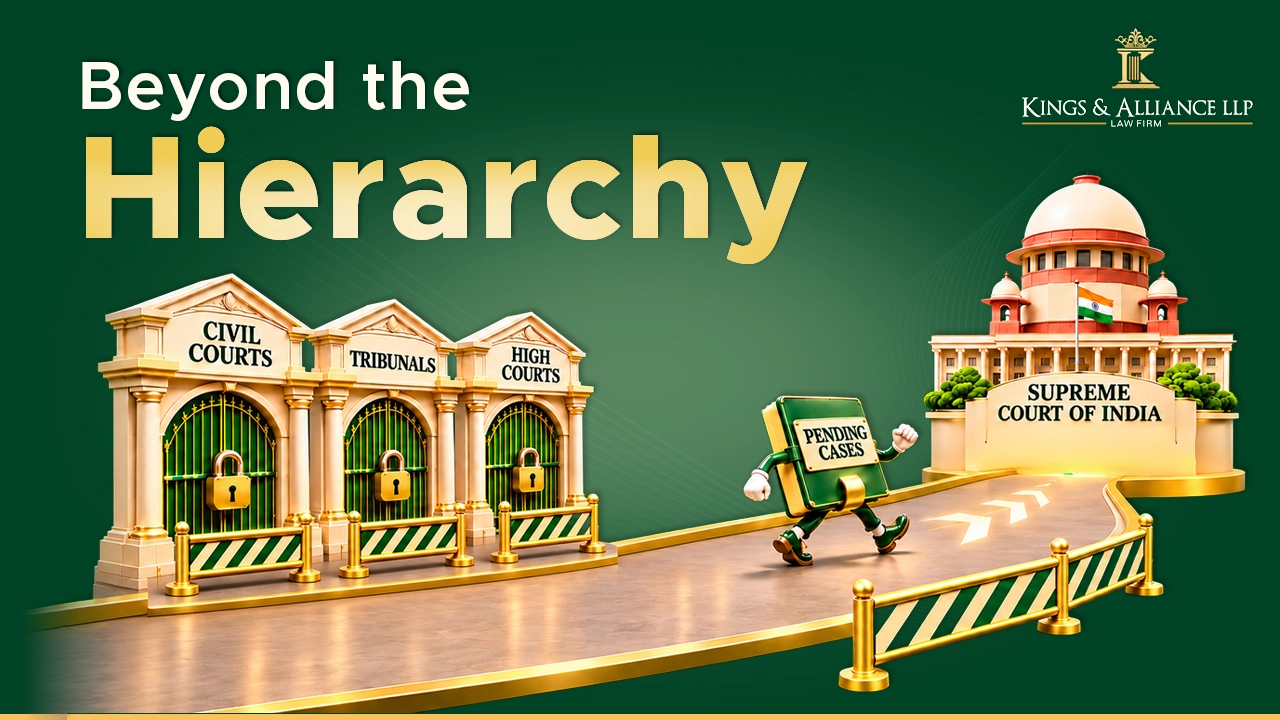
Article 142(1) of the Constitution1 empowers the Supreme Court, “in the exercise of its jurisdiction”, to pass such decree or make such order as is necessary for doing “complete justice in any cause or matter pending before it”. The power presupposes a jurisdiction the Court already has, and it operates on a matter already pending. Article 1422 therefore moulds the relief the Court may give and it’s not a free-standing source of forum.
Article 323 guarantees the right to approach the Supreme Court for the enforcement of Fundamental Rights. Described by Dr B.R. Ambedkar as the “heart and soul” of the Constitution, it provides a direct constitutional remedy against their violation. Under Article 32(2), the Supreme Court is empowered to issue directions, orders and five constitutional writs: Habeas Corpus, Mandamus, Prohibition, Certiorari and Quo Warranto, Article 32 provides the jurisdictional basis for approaching the Supreme Court to enforce Fundamental Rights.
Once a matter is properly before the Supreme Court, how long may it be kept, which connected disputes may be drawn into it, and will other forums be closed ?
Over the past three decades, The Supreme Court has built a practice of keeping certain matters open before it for years. This established principle is called the Continuing Mandamus, in which the Supreme Court keeps a case pending on its docket for months or years, issuing periodic directives and monitoring implementation, rather than issuing a single final judgment. In the Amrapali litigation, a remedy designed to cure a systemic failure left the Supreme Court as the first port of call for disputes that tribunals, consumer commissions and civil courts would ordinarily decide. Direct access to the Court under Article 32 is a constitutional guarantee, and the Court’s supervision has delivered relief where statutory machinery had stalled. This unintentionally institutionalized a “first-resort syndrome”.
The criticism is that the Court’s own practice has not settled when supervision must end or which collateral disputes stay with ordinary forums, and that the absence of settled limits carries institutional costs. The Justice Loya case, Tehseen Poonawalla v. Union of India4 serves as a benchmark, the Court sat as a court of first instance under Article 32, decided the petitions and closed the file.
Article 142 & 32: Text, Origin and Source of Jurisdiction
To understand the constitutional foundation of this evolving role, it is necessary to revisit the origins of Article 142. An important antecedent to its enforcement framework can be found in Section 210 of the Government of India Act, 1935.5 Section 210(1)6 required civil and judicial authorities throughout the Federation to act in aid of the Federal Court, while Section 210(2)7 empowered it to secure the attendance of witnesses, order the discovery or production of documents, and investigate or punish contempt of court. These provisions subsequently found their constitutional counterparts in Articles 1448 and 142(2),9 respectively. However, under Section 204(2) of the 1935 Act,10 the Federal Court, while exercising its original jurisdiction, could pronounce only declaratory judgments. The 1948 Draft Constitution introduced a broader remedial power through Draft Article 118(1),11 empowering the Supreme Court to pass decrees or orders necessary for doing “complete justice” in any cause or matter pending before it, with such decrees and orders enforceable throughout India in the prescribed manner. Adopted on 27 May 1949 without substantive debate, the provision marked a departure from the Federal Court’s restricted remedial jurisdiction. Yet, neither the text nor the Constituent Assembly proceedings expressly delineated the outer limits of the expression “complete justice”. Its scope was consequently left to judicial interpretation, developing through the Supreme Court’s decisions over the decades that followed on a case by case basis.
Article 32 has its own, separate lineage: it is not an antecedent of Article 142 but a parallel guarantee that the article draws on for jurisdiction. It traces to Article 25 of the 1948 Draft Constitution, debated in the Constituent Assembly on 9 December 1948 and adopted the same day, with minor amendments. What the Assembly adopted was a right of a different character from the remedial power later placed at Article 142, Article 32(1) itself guarantees the individual a right to move the Supreme Court for the enforcement of Fundamental Rights, and Article 32(4) bars suspension of the right except as the Constitution itself provides, that is, during an Article 359 emergency. Article 32 is therefore a fundamental right in itself, not merely a grant of power to a court, and that is what distinguishes direct access to the Supreme Court from access to a High Court under Article 226, which carries no equivalent constitutional guarantee. It is this guaranteed, unsuspendable route of entry, rather than Article 142 itself, that first brings a matter before the Court and makes Article 142 available to it at all.
It carefully operates in the exercise of the Court’s jurisdiction and in a cause or matter that is pending. The jurisdiction arises from Article 32 (the guaranteed right to move the Court for the enforcement of fundamental rights), Article 13612 (special leave to appeal) and the powers of withdrawal and transfer in Article 139A.13 In the case Shilpa Sailesh v. Varun Sreenivasan,14 the Constitutional Bench held that a party cannot invoke Article 32 directly to obtain a divorce, while accepting that, in a proceeding properly before it, the Court may dissolve a marriage under Article 142(1). In simple language Article 142 cannot, by itself, make the Supreme Court a court of first instance. The difficulty lies in what follows once a matter is pending, because the Court has read “cause or matter”15 widely enough to draw connected proceedings into it.
From a Supplementary Power to a Broad Remedial Jurisdiction
In its early jurisprudence, Article 142 was a narrowly delineated boundary, and we can interpret this through a series of cases that fall under the same principle. In Prem Chand Garg v. Excise Commissioner, U.P.,16 a Constitutional Bench held that an order for complete justice must be consistent with the fundamental rights and cannot even be inconsistent with the substantive provisions of the relevant statute. It held that a Supreme Court rule requiring security from Article 32 petitioners infringed the guaranteed right, and that Article 142 could not be used to sustain what that right forbade. In A.R. Antulay v. R.S. Nayak,17 a seven-judge Bench set aside the Court’s own 1984 direction moving a trial from the Special Judge to a High Court judge. It held that a court cannot, by its own direction, create or enlarge jurisdiction, or take away a person’s statutory rights of revision and appeal. That is the closest the Court has come to the concern of this article, and the Court directed it at its own order. The expansive turn came in the early 1990s. Delhi Judicial Service Association v. State of Gujarat,18 described the power as “entirely of different level and of a different quality”19 from ordinary powers, and held that restrictions in ordinary law cannot limit it. In Union Carbide Corporation v. Union of India,20 the Court recorded in February 1989, after directly recording a $470 million mass-tort settlement while appeals from an interim compensation order were pending, a Constitution Bench in its 1991 review judgment formally invoked Article 142 to uphold the civil settlement even as it conceded that Article 142 could not justify the 1989 quashing of criminal prosecutions and restored those charges to the regular trial court. By using Article 142 to finalise the entire civil mass-tort claim at the appellate stage without a trial on merits, the Court demonstrated that its ‘complete justice‘ power could entirely bypass the conventional trial-court hierarchy.
A Constitution Bench in review (1991) held that the Court had power, under Article 142 read with its other jurisdiction, to withdraw and dispose of the connected suits and criminal cases. It upheld the civil settlement and set aside the quashing of the criminal proceedings on the facts. It also treated the remarks in Prem Chand Garg and Antulay about inconsistency with statute as unnecessary to those decisions, and held that a statutory provision restrains Article 142 only where it reflects a fundamental and general issue of public policy. The mass-tort claim was closed by consent at the appellate stage, without a trial on the merits. A pending appeal was enough for the Court to dispose of the whole litigation.
The reach of the power met a limit in In re Vinay Chandra Mishra, where a three-judge Bench, combining Articles 129 and 142, suspended an advocate from practice for three years for contempt thus directly suspending license to practice by bypassing the statutory authority of the Bar Council entirely. Later a five-judge Bench in Supreme Court Bar Association v. Union of India overruled the decision to the extent of the suspension. Article 142, it held, cannot be used to build “a new edifice where none existed earlier” by ignoring express statutory provisions, and disciplinary jurisdiction over advocates belongs to the Bar Councils under the Advocates Act, 1961. In simple terms, it ruled that while Article 142 gives the Supreme Court great power to “fill in the gaps” (supplement the law) to do justice, it cannot override clear laws or take over the job of other bodies (like the Bar Council) that have the legal right to handle those matters.
The position is therefore mixed, The Court has said that Article 142 is not confined by ordinary statutory limits, and also that it cannot create jurisdiction or override clear statutory design. The disputes arise in deciding which provisions count as fundamental restraints.
Continuing mandamus developed on a separate track. In Bandhua Mukti Morcha v. Union of India, a petition under Article 32 on bonded labour, the Court appointed commissions and gave directions over time to secure compliance, rather than disposing of the matter by a single order.The technique was formally highlighted as continuing mandamus in Vineet Narain v. Union of India, where the Court used it to monitor the Central Bureau of Investigation’s inquiry into the Jain hawala case, an area ordinarily within the executive’s and the magistracy’s own domain. Subsequent Supreme Court benches, notably in Lok Prahari v. The Union of India has explicitly affirmed that this practice of continuous tracking and ongoing directions was formally named and established in Vineet Narain.”, the Court traced the term to Vineet Narain and described a continuing mandamus as “an innovative procedure not a substantive one”. Continuing mandamus is a method of exercising the Court’s Article 32 power (and, for High Courts, Article 226). It is not a separate head of jurisdiction. Neither the method nor the supervision it permits is unlawful in itself; where an executive or statutory body has failed, periodic directions may be the only effective remedy. The legal question is therefore not whether the Court may supervise, but for how long, and with what effect on the forums that would otherwise act. A procedure meant to secure compliance with a decree may, if prolonged, change who decides what. That is how a procedural device comes to alter the hierarchy.
The Amrapali Proceedings
The two strands converged in the Amrapali litigation, What began as a crisis of regulatory paralysis quickly transformed into a showcase of the Court’s expanding original footprint, illustrating complete justice within an incomplete hierarchy. Buyers of approximately 42,000 flats, whose claims were scattered before RERA authorities, consumer commissions and insolvency forums, approached the Court under Article 32, relying among other grounds on Article 21. In the article’s view, none of those forums could address the group’s multi-layered default as a whole. On 23 July 2019, in Bikram Chatterji v. Union of India, The Supreme Court invoked Article 142 to exercise powers beyond ordinary statutory limits, cancelling the group’s RERA registration, ordering forensic audits, and directing the National Buildings Construction Corporation (NBCC) to complete the stalled projects, acting on forensic audit reports the Court had called for. The judgment speaks of the Court’s duty “to do complete justice between the parties”, which is the vocabulary of Article 142. The directions were given in proceedings under Article 32, and whether they are referable to Article 142 by number is a matter of characterisation rather than recital. The Court did not close the file. It kept the writ petition pending and monitored NBCC through the Court Receiver. On 10 June 2020, on an application filed by NBCC itself (I.A. No. 49238 of 2020), which complained that homebuyers were suing it in different courts across the country, the Court held NBCC immune from such actions. It requested courts, consumer commissions and other authorities not to permit NBCC’s impleadment or issue summons to it, and said that NBCC was “answerable to this Court only in the pending proceedings”. The order names the litigants it has in view: existing home buyers, previous contractors, co-developers, landowners, banks, financial institutions, other lenders and creditors, and government authorities. By constitutional decree, an entire commercial and regulatory ecosystem was excised from the ordinary judicial hierarchy and placed under the exclusive original supervision of the Supreme Court.
The order is framed partly as a request and partly as a grant of immunity, and it cites no provision of the Constitution; describing it as an exercise of Article 142 is an inference. In Ramacivil India Construction Pvt. Ltd. v. NBCC (India) Ltd., NBCC sought rejection of suits by a contractor it had engaged itself under agreements of August and September 2020 (in one suit, a tender of ₹368 crore and a claim of about ₹74.30 crore), on the footing that only the Supreme Court could hear them. On 2 September 2025 the Delhi High Court refused. It read the order against the four conditions NBCC had itself proposed and held that its object was to protect NBCC from the legacy litigation of the Amrapali group, including future suits on pre-existing contracts, but not from suits on contracts NBCC signed itself. It added that a civil court’s jurisdiction under section 9 of the Code of Civil Procedure is plenary unless ousted. NBCC had also relied on a September 2021 Division Bench order permitting a disqualified bidder to withdraw a writ petition with liberty to approach the Supreme Court; the High Court did not read that order as showing that such a petition was barred. It recorded that NBCC’s application to transfer the suits to the Supreme Court was pending, and that the suits would be transferred if it succeeded.
The pattern has reappeared, with variations. In Apex Heights Pvt. Ltd. v. Ram Kishor Arora, an appeal from the NCLAT in the Supertech insolvency, the Court, invoking Article 142, upheld the direction that NBCC complete sixteen stalled projects. It directed that no court or tribunal pass interim orders stopping projects commenced by NBCC, and that grievances be brought to the Supreme Court, but it left other applications to be pursued before the NCLT and NCLAT in the pending proceedings. The Court has itself signalled that open-ended supervision is not the aim. In March 2025 the bench hearing the Amrapali matter was reported to have observed that the proceedings could not continue indefinitely, and to have called for a compliance report. The Court has not, in the decisions examined for this article, laid down a general rule for when supervision must end.
Supplementing or Supplanting
Article 142 empowers the Supreme Court to supplement an inadequate legal framework; it does not authorise the Court to supplant the ordinary institutions through which justice is administered.The distinction between a constitutionally conferred first-instance jurisdiction and a drift towards one is clearest in Tehseen Poonawalla v. Union of India, i.e., the Justice Loya case, which arose from the death of Special CBI Judge Brijgopal Harkishan Loya. Petitions under Article 32 sought an independent inquiry. On 22 January 2018 the Court transferred to itself two petitions pending before the Bombay High Court, at the Principal Seat and at the Nagpur Bench, to be heard with them. On 19 April 2018 a three-judge Bench (Dipak Misra CJI, A.M. Khanwilkar and D.Y. Chandrachud JJ, the judgment being by Chandrachud J) dismissed the petitions, finding no ground for an inquiry on the record before it. The remaining reliefs sought in the Nagpur petition were remitted to the Nagpur Bench. The case supports the argument, none of which depends on the merits of the case. The Court’s first-instance role rested on Article 32, which guarantees direct access, the Court then decided the main question, disposed of the petitions and did not keep the file open for periodic supervision or become the continuing forum for collateral disputes, it sent back what did not need to be decided at the apex level, which shows that release is practicable when the Court chooses it.
When temporary consolidation hardens into indefinite retention, three structural costs follow. These are risks, and the decisions examined show each in some measure.
Firstly, it can erase tiers of appeal. The Indian judicial hierarchy is built on the premise that factual, contractual, and regulatory disputes will be tested at first instance before specialised tribunals or trial courts, subject to appellate scrutiny before appellate tribunals and High Courts before ever reaching the Supreme Court. For eg.- A contractor’s payment claim, a lender’s security interest or a flat-buyer’s grievance decided on an interlocutory application in an Article 32 proceeding carries no appeal; only review under Article 137 remains.
First-instance adjudication by the court of last resort is, by definition, an unappealable adjudication.
Secondly, it can induce institutional atrophy. If the Court responds to a regulatory paralysis in RERA authorities or delay in the NCLT by taking high-profile disputes onto its own docket, the pressure to reform those bodies is relieved. The beneficiaries of the monitored case receive a coordinated remedy, while the statutory machinery stays unrepaired for the many litigants whose grievances do not command an apex-court petition.
Thirdly, it can create self-perpetuating docket traps. Where the Court absorbs collateral disputes and shields a court-appointed agency from other forums, every later friction must return to it. The Amrapali petition was filed in 2017 and was still being heard in 2025. Because no lower forum is permitted to adjudicate connected grievances, every operational friction from municipal approvals and bank disbursements to PMLA venue disputes nearly a decade later must return to the Supreme Court, converting constitutional judges permanently into perpetual administrators. On 11 March 2026 the Court closed the 1984 Taj Trapezium petition in M.C. Mehta v. Union of India, which carried more than 150 pending applications, and registered four suo motu petitions in its place. It noted the amicus curiae’s submission that the issues ought not to be transferred to the jurisdictional High Courts, because the zone crosses State borders and the long history of the Court’s orders would make it procedurally difficult for High Courts to modify them. These decisions show the Court both restructuring prolonged supervision and retaining it. They point to the need for a mechanism that periodically reassesses its scope and continued necessity.
The Unsettled Questions and a Proposed Discipline
Two questions remain unanswered. First, when must a supervised matter be released to the ordinary courts rather than retained indefinitely? Second, while a case is pending, which connected disputes belong before the Supreme Court, and which before the magistrate, consumer commission, tribunal or High Court? To keep the exception of complete justice from swallowing the rule of judicial hierarchy, this article proposes a two-part discipline for structural interventions under Article 142.
First, the fusion of Article 142 with continuing mandamus should be confined to the design phase of a systemic remedy: cancelling fraudulent instruments, resolving deadlocks between the RERA and insolvency regimes, and framing the recovery. Once the framework is stable, day-to-day monitoring of execution and accounts should return to the jurisdictional High Court under Article 226 or to the designated statutory tribunal (the NCLT, the NCLAT or the RERA), with a presumptive sunset on the Court’s retention of the file. The proviso to Article 139A(1), which lets the Court return a withdrawn case to the High Court after deciding the common questions of law, offers a nuanced model. A release rule would have to address the two reasons recorded in M.C. Mehta, namely a zone spanning several States and the difficulty High Courts would face in modifying the Court’s earlier orders. A tribunal with national jurisdiction, as in Apex Heights, is one possible answer.
Second, collateral disputes, such as contractors’ claims, consumer grievances and procedural challenges in related prosecutions, should presumptively follow the regular statutory hierarchy. The mere factual connection of a dispute to the monitored entity should not justify bypassing ordinary forums while the matter remains on the Court’s docket. The burden should lie on the applicant to show that ordinary adjudication would directly nullify, or make impossible, the execution of the Court’s core remedial decree. Only then should the Court entertain the application or override forum rules under Article 142. Applied to Amrapali, a contractor, lender or homebuyer with a claim against NBCC arising from the group’s pre-existing contracts would, on the terms of the 2020 order, bring it as an application in the pending writ petition, with no appeal. A contractor on NBCC’s own contract may, on the Delhi High Court’s reading, sue in the civil court.
Conclusion
Can the Supreme Court, in the exercise of its power to do complete justice, become a court of first instance and bypass the ordinary judicial hierarchy?
The Court acts as a forum of first instance legitimately where the Constitution so provides, most plainly under Article 32. The concern is narrower. It arises when a matter retained for a remedial purpose becomes the standing forum for later, collateral disputes, and when other forums are closed to them without a stated limit in time or scope.
A stated release mechanism and jurisdictional filter would protect both the Court’s remedial power and the hierarchy of which it is the apex.
Citations
- The Constitution of India, art. 142(1). ↩︎
- The Constitution of India, art. 142. ↩︎
- The Constitution of India, art. 32. ↩︎
- Tehseen Poonawalla v. Union of India, (2018) 6 SCC 72. ↩︎
- Government of India Act, 1935, s. 210. ↩︎
- Government of India Act, 1935, s. 210(1). ↩︎
- Government of India Act, 1935, s. 210(2). ↩︎
- The Constitution of India, art. 144. ↩︎
- The Constitution of India, art. 142(2). ↩︎
- Government of India Act, 1935, s. 204(2). ↩︎
- Draft Constitution (1948), draft art 118(1); Constituent Assembly Debates, vol VIII, 27 May 1949. ↩︎
- The Constitution of India, art. 136. ↩︎
- The Constitution of India, art. 139A. ↩︎
- Shilpa Sailesh v. Varun Sreenivasan, (2023) 14 SCC 231, para 41. ↩︎
- Shilpa Sailesh v. Varun Sreenivasan, (2023) 14 SCC 231, paras 8–10, 42(i). ↩︎
- Prem Chand Garg v. Excise Commissioner, U.P., AIR 1963 SC 996 : 1963 Supp (1) SCR 885. ↩︎
- A.R. Antulay v. R.S. Nayak (1988) 2 SCC 602. ↩︎
- Delhi Judicial Service Association v. State of Gujarat, (1991) 4 SCC 406. ↩︎
- Ibid. ↩︎
- Union Carbide Corporation v. Union of India, (1989) 3 SCC 38. ↩︎
Expositor(s): Adv. Stephin Sinu Oommen
This article is for information only and is not legal advice. Read the disclaimer