Case Docket · Arbitration
No Agreement, No Arbitration: Madras High Court Rejects BGR Energy’s Plea
On this page
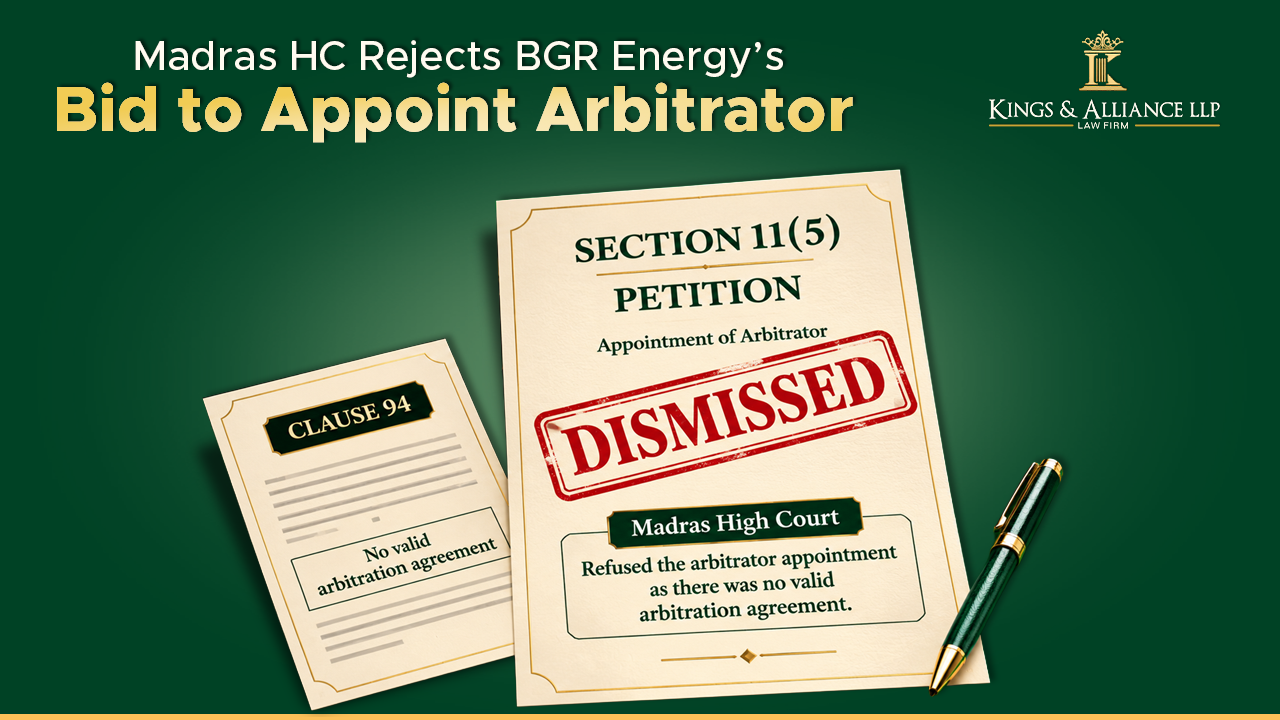
Can a contractual clause become an arbitration agreement simply because it provides for a hearing, the submission of evidence and a decision by a senior officer? The Madras High Court addressed this question in BGR Energy Systems Pvt. Ltd. v. Tamil Nadu Generation and Distribution Corporation & Anr.,1 holding that Clause 94, which provided for an internal departmental appeal, did not satisfy the essential requirements of a valid arbitration agreement under the Arbitration and Conciliation Act, 1996.
The Contractual Fallout: A ₹2,600-Crore Project and Competing Allegations
The dispute arose from a contract valued at ₹2,600.02 crore for the Balance of Plant package, including allied civil works, for the 1 × 800 MW North Chennai Supercritical Thermal Power Project, Stage III. BGR Energy Systems had also furnished a bank guarantee of approximately ₹77.80 crore. BGR alleged that delays in site handover, uncleared work fronts, pending engineering approvals, delayed payments and unresolved tax issues following the introduction of GST affected project execution. It further relied on the National Green Tribunal’s stay concerning a bridge across the Kosasthalaiyar River and claimed that it had completed nearly 95% of the work, with the plant commissioned on 7th March 2025. BGR also challenged the invocation of a bank guarantee and alleged that its equipment had been handed over to operation and maintenance vendors without its consent.
Tamil Nadu Generation and Distribution Corporation (TANGEDCO) presented a contrasting account. It maintained that the work remained incomplete despite the stipulated 36-month period, alleged that BGR had abandoned the site on 2nd February 2024, and stated that the contract was terminated on 18th July 2025. These competing allegations formed the background to the proceedings, but the High Court did not adjudicate their merits. The decisive question was whether the contract authorised the appointment of an arbitrator at all.
The Clause at the Centre of the Controversy
Clause 94 of the contract established a procedure under which a contractor dissatisfied with a work demand, drawing or record of ruling could seek written instructions or a decision from Tamil Nadu Generation and Distribution Corporation (TANGEDCO) or its representative. If no decision was provided within 15 days, or if the contractor remained dissatisfied, it could appeal to the Chief Engineer. The Chief Engineer was required to provide an opportunity to be heard, receive supporting evidence and issue a decision within the prescribed period.
BGR argued that this procedure contained the essential attributes of an arbitration agreement while TANGEDCO maintained that it was merely an inter departmental appeal, not an arbitration agreement.
Issues Before The Court
The principal issue before the Madras High Court was whether Clause 94 of the contract, titled “Settlement of Disputes”, constituted a valid arbitration agreement under Section 7 of the Arbitration and Conciliation Act, 1996,2 thereby enabling the Court to appoint a sole arbitrator under Section 11(5) of the Arbitration and Conciliation Act, 1996.3 The Court also examined whether the provision’s mechanism for seeking a decision from TANGEDCO officials and subsequently appealing to the Chief Engineer could be treated as arbitration, despite the absence of a clear agreement to refer disputes to an independent adjudicator. A further issue was whether Section 16 of the Arbitration and Conciliation Act, 1996,4 which empowers an arbitral tribunal to rule on its own jurisdiction, could be invoked to constitute a tribunal in the first place when the existence of a valid arbitration agreement was itself in question.
Arguments: Adjudication Versus Arbitration
Senior Counsel for BGR contended that the dispute resolution clause need not to expressly use the words “arbitration” or “arbitrator”. Relying on Jagdish Chander v. Ramesh Chander and others5 it submitted that a clause may constitute an arbitration agreement if it possesses the essential attributes of arbitration. It further argued that Section 16(1) empowered an arbitral tribunal to rule on its own jurisdiction and that the objection concerning the existence of an arbitration agreement should therefore be left to the arbitrator.
The Additional Advocate General for TANGEDCO argued that Clause 94 contained no clear and mutual intention to arbitrate. The Chief Engineer was an officer of the contracting corporation, not an independent adjudicator and the clause did not make his decision final and binding. TANGEDCO relied on K.K Modi v. K.N Modi and others6 and South Delhi Municipal Corporation v. SMS Ltd to contend that the contractual mechanism failed the legal requirements of an arbitration agreement.
The Court’s Reasoning
The Court examined the principles laid down in K.K Modi, Jagdish Chander and South Delhi Municipal Corporation. It concluded that the clause failed to demonstrate a clear intention to arbitrate, provide for a binding adjudication or ensure an independent adjudicator. Accordingly, Clause 94 did not qualify as an arbitration agreement under Section 7 of the Arbitration and Conciliation Act, 1996.
The Court also rejected the argument that the absence of the words “arbitration” or “arbitrator” was decisive. It further states that the existence of an adjudicatory process alone is insufficient and the agreement must reflect an intention to arbitrate and provide for an independent decision-maker.
The Court further rejected the petitioner’s reliance on Section 16(1) of the Arbitration and Conciliation Act,7 which empowers an arbitral tribunal to rule on its own jurisdiction. It clarified that this provision presupposes the existence of an arbitral tribunal and cannot be invoked to constitute one where the parties have not agreed to arbitration. Relying on Jagdish Chander, the Court reiterated that the existence of an arbitration agreement under Section 7 is a prerequisite to exercising the power to appoint an arbitrator under Section 11.
The Court also held that the earlier grant of liberty to approach the Court under Section 11 did not create an arbitration agreement where none existed. Consequently, it dismissed the petition as not maintainable, while leaving the petitioner free to pursue its claims and remedies before the competent court in accordance with law.
The Court’s Observations
The judgment reinforces the distinction between an adjudicatory mechanism and an arbitration agreement. A contractual provision does not become an arbitration agreement merely because it provides for a hearing, consideration of evidence or a decision on a dispute. The essential requirements are a clear intention to arbitrate binding adjudication and an independent decision maker.
The decision also clarifies the limits of Section 16 of the Arbitration and Conciliation Act, 1996. Although an arbitral tribunal may determine its own jurisdiction, that power cannot substitute for the parties agreement to arbitrate. The judgment highlights the importance of drafting dispute-resolution clauses that clearly establish the parties intention to submit their disputes to arbitration.
Conclusion
The Madras High Court dismissed BGR Energy Systems petition, holding that Clause 94 was not an arbitration agreement within the meaning of Section 7 and that an arbitrator could not be appointed under Section 11(5). However, BGR remained at liberty to pursue its claims before the competent court in accordance with law. Any request for exclusion of time under Section 14 of the Limitation Act, 1963, was left for that court to decide. The High Court expressly clarified that it had not examined the merits of the underlying contractual dispute or affected the pending writ proceedings.
The judgement reinforces a fundamental principle of arbitration law that a procedure for resolving disputes is not necessarily an agreement to arbitrate. The power to appoint an arbitrator arises from the parties agreement, not merely from the existence of a contractual disagreement or an internal adjudicatory mechanism.
Citations
- BGR Energy Systems Pvt. Ltd. v. Tamil Nadu Generation and Distribution Corporation & Anr. Arb.O.P.(Com.Div.) No. 157 of 2026 ↩︎
- Arbitration and Conciliation Act, 1996, s. 7 ↩︎
- Arbitration and Conciliation Act, 1996, s. 11(5). ↩︎
- Arbitration and Conciliation Act, 1996, s. 16. ↩︎
- Jagdish Chander v. Ramesh Chander and others (2007) 5 SCC 719 ↩︎
- K.K Modi v. K.N Modi and others (1998) 3 SCC 573 ↩︎
- Arbitration and Conciliation Act, 1996, s. 16(1) ↩︎
Expositor(s): Adv. Gaurangi Tandon
Topics
This article is for information only and is not legal advice. Read the disclaimer