Delhi High Court · GST Litigation
Supplier-Tax Requirement for GST Input Tax Credit: Rajasthan HC Upholds Section 16(2)(c) of CGST Act
On this page
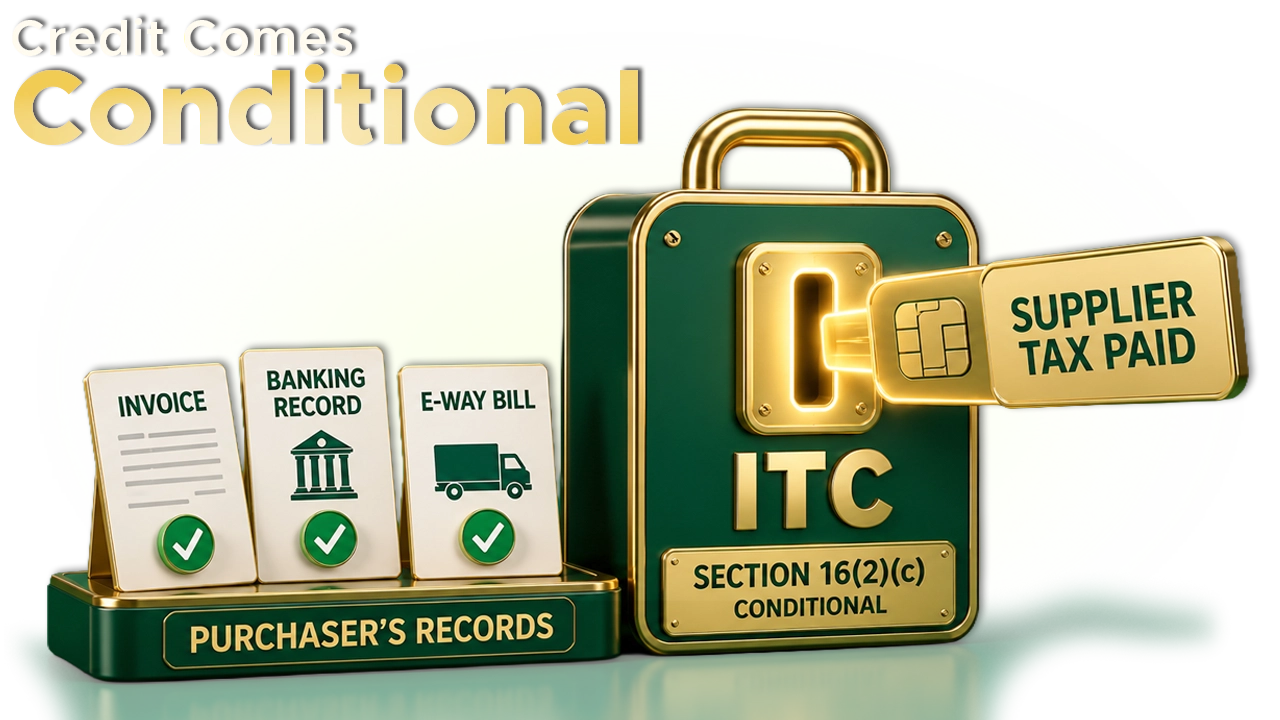
The Rajasthan High Court has upheld the constitutional validity of Section 16(2)(c) of the Central Goods and Services Tax Act, 2017,1 holding that actual payment of tax by the supplier to the Government is a statutory condition for the recipient to avail Input Tax Credit (ITC). In Sumetco Alloys Private Limited v. Union of India,2 the Court also declined to read down the provision to protect bona fide purchasers. However, the Court did not determine whether the petitioner’s transactions were in fact bona fide or whether the demand was ultimately sustainable. Those issues were left open for consideration by the statutory appellate authority.
The petitioner, Sumetco Alloys Private Limited, challenged the constitutional validity of Section 16(2)(c), alleging that the provision was arbitrary and violative of Article 14 of the Constitution.3 The challenge arose in the context of a GST demand of ₹56,44,08,265 for the financial years 2020–21 to 2023–24. The petitioner also sought quashing of the show cause notice dated 26 September 2025 and the Order-in-Original (O-I-O) dated 10 April 2026.
The petitioner maintained that its purchases were genuine and that it had maintained records including tax invoices, banking records, e-way bills, transport documents, weighment slips and other supporting material. It contended that ITC should not be denied merely because of a default attributable to suppliers over whom it had no control. The Department, however, had alleged wrongful availment of ITC in relation to purchases from certain suppliers. The Show Cause Notice (SCN) alleged fake invoices, bogus supplies and multi-layered transactions involving paper transactions without movement of goods. These allegations were made in proceedings under Section 74 of the CGST Act.4
The Court began its analysis with Section 16 of the CGST Act.5 Section 16(2)6 provides that a registered person shall not be entitled to ITC unless the prescribed conditions are satisfied. The Court emphasised that these conditions are cumulative. In its view, satisfaction of the other conditions cannot substitute compliance with Section 16(2)(c). The provision specifically requires that the tax charged in respect of the supply must have been actually paid to the Government, either in cash or through utilisation of admissible ITC.
The Court therefore rejected the argument that possession of invoices, receipt of goods and payment through banking channels, by themselves, establish an unconditional entitlement to ITC. It further relied on Section 155,7 which places the burden of proving eligibility for ITC upon the person claiming it. Referring to the Supreme Court’s decision in State of Karnataka v. Ecom Gill Coffee Trading Private Limited,8 the Court noted that merely producing invoices or showing payment by cheque is not sufficient; the claimant must establish the genuineness of the transaction and actual movement of goods.
The Court also examined Section 41,9 which operates alongside Section 16(2)(c). Section 41(2) provides for reversal of ITC where the supplier has not paid the tax relating to the supply. At the same time, where the supplier subsequently pays the tax, the recipient may re-avail the corresponding credit.
The Court considered this reversal and re-availment mechanism significant while examining the allegation that Section 16(2)(c) is arbitrary. It held that the statutory scheme places the risk of supplier default on the recipient while simultaneously providing a mechanism through which the credit may be restored once the supplier’s tax liability is discharged. The Court consequently held that ITC is a contingent statutory entitlement and not a vested or constitutional right. On this basis, it found no constitutional infirmity in Section 16(2)(c).
Supreme Court Ruling on Constitutional Validity
The Rajasthan High Court also considered the Supreme Court’s decision in Bhandari Scrap Traders v. Union of India,10 decided on 24 July 2026. The Supreme Court had upheld the Gujarat High Court’s decision sustaining Section 16(2)(c) and declining to read down the provision. It specifically held that there were no grounds to declare Section 16(2)(c) unconstitutional or to read it down. The Rajasthan High Court therefore held that the constitutional challenge could not be reopened before it.
Consequently, the Court answered the constitutional question against Sumetco and rejected the challenge to the vires of Section 16(2)(c).
What About Bona Fide Purchasers?
The petitioner also relied on decisions of the Tripura, Karnataka and Gauhati High Courts which had considered protection for bona fide purchasers in the context of Section 16(2)(c). The Rajasthan High Court, however, held that those decisions could not assist the petitioner after the Supreme Court’s decision in Bhandari Scrap Traders. The Supreme Court had expressly rejected the request to read down Section 16(2)(c).
Importantly, the Rajasthan High Court did not hold that a purchaser’s claim of bona fide conduct is irrelevant in every case. Instead, it observed that whether the transactions in the present case were bona fide was a question of fact. The Court noted that the Department’s case here involved allegations of fake invoices, bogus supplies and multi-layered paper transactions. Whether those allegations were ultimately established required examination of evidence and could not appropriately be determined in writ proceedings. Thus, the Court expressly kept Sumetco’s contention that its transactions were bona fide open for consideration by the appellate authority.
Why the Court Declined to Decide the Demand
Apart from the constitutional challenge, Sumetco had raised objections concerning the invocation of Section 74, non-issuance of Form GST DRC-01A, alleged bias on account of the same officer undertaking investigation and adjudication, and alleged inadequate consideration of its reply. The Court rejected these grounds as reasons for bypassing the statutory appellate mechanism.
On Form GST DRC-01A, the Court noted that Rule 142(1A),11 after its amendment in 2020, uses the word “may” rather than “shall”. It therefore held that the pre-notice intimation was not a mandatory condition precedent to issuance of a Section 74 notice.
On the allegation of bias, the Court observed that the statutory scheme itself permits the proper officer to undertake investigation and subsequently determine the liability. The mere fact that the same statutory authority performed both functions was therefore not, by itself, sufficient to establish bias. The Court also found that Sumetco had received the SCN, submitted a detailed reply and was afforded an opportunity of hearing. Any grievance concerning appreciation of its reply could therefore be examined in appeal.
Conclusion
The Rajasthan High Court rejected the challenge to Section 16(2)(c), as well as the challenge to the show cause notice and order-in-original. At the same time, it granted Sumetco liberty to pursue an appeal under Section 107.12 The Court directed that, if the appeal was filed within thirty days of uploading of the judgment, the period spent pursuing the writ petition would be excluded for limitation purposes.
The Court also directed that the ₹50 lakh deposited by Sumetco through Form GST DRC-03 be given credit towards the statutory pre-deposit, without prejudice to the rival contentions concerning the character of that deposit.
Most significantly, the Court expressly clarified that all contentions on merits, including Sumetco’s claim that the transactions were bona fide, remained open before the appellate authority. It stated that nothing in the judgment should be construed as an expression of opinion on the merits of the demand.
The decision in Sumetco Alloys reinforces the statutory nature of ITC under the GST framework. Section 16(2)(c) requires actual payment of the tax charged on a supply to the Government, and the Rajasthan High Court found no constitutional infirmity in imposing that condition. The Court confined its determination to the constitutional and writ-jurisdiction issues and left the factual merits, including the claim of bona fide transactions, for consideration in the statutory appeal.
Citation
- The Central Goods and Services Tax Act, 2017 s. 16(2)(c). ↩︎
- Sumetco Alloys Private Limited v. Union of India 2026 LLBiz HC(RAJ) 48 ↩︎
- The Constitution of India, art. 14. ↩︎
- The Central Goods and Services Tax Act, 2017 s. 74. ↩︎
- The Central Goods and Services Tax Act, 2017 s. 16. ↩︎
- The Central Goods and Services Tax Act, 2017 s. 16(2). ↩︎
- The Central Goods and Services Tax Act, 2017 s. 155. ↩︎
- State of Karnataka v. Ecom Gill Coffee Trading Private Limited (2023) 6 SCC 12 ↩︎
- The Central Goods and Services Tax Act, 2017 s. 41. ↩︎
- Bhandari Scrap Traders v. Union of India & Ors., SLP (C) Nos. 23931, 24088 and 24103 of 2026, Supreme Court ↩︎
- Central Goods and Services Tax (CGST) Rules, 2017 Part – A (Rules) rule 142(1A) ↩︎
- The Central Goods and Services Tax Act, 2017 s. 107. ↩︎
Expositor(s): Adv. Vatsala
This article is for information only and is not legal advice. Read the disclaimer