IBC · NCLT Judgement
When Adjudication Requires More Than the IBC Can Offer: NCLT in Jet Airways v. Boeing
On this page
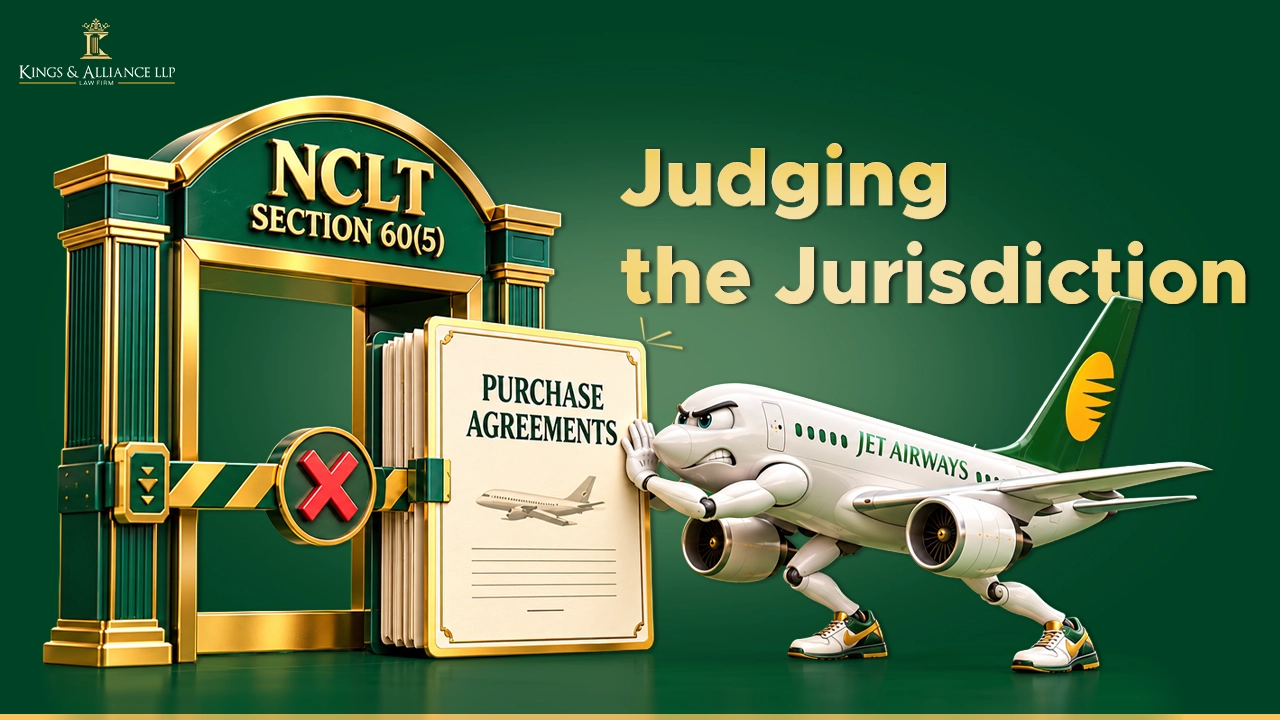
Jet Airways paid more than USD 92 million to The Boeing Company as advance and pre-delivery payments for aircraft that were never delivered. Jet Airways entered insolvency proceedings and was later ordered into liquidation, its Liquidator sought a refund of the amount from Boeing. Boeing disputed the claim. It argued that the advance payments had already been adjusted against its own claim against Jet Airways. The dispute eventually came before the National Company Law Tribunal (NCLT), Mumbai Bench, as Jet Airways (India) Limited vs The Boeing Company1 which had to consider whether the NCLT has the power to decide a disputed contractual claim under Section 60(5) of the Insolvency and Bankruptcy Code, 2016 (IBC).2
The dispute arose from two Purchase Agreements executed between Jet Airways and Boeing in 2013 for Boeing 737-8 and Boeing 787-9 aircraft. Under these agreements, Jet Airways paid USD 92,129,387 as an advance. The agreements were not placed before the Tribunal due to concerns about Boeing’s confidential proprietary information.
The relationship between the parties broke down as Jet Airways failed to make certain payments due under the Purchase Agreements. Due to payment delays, on May 22, 2019, Boeing issued a notice suspending its obligations under the agreements, and Jet Airways subsequently entered the Corporate Insolvency Resolution Process in June 2019.
During the CIRP, Boeing submitted a claim of USD 275,333,451.69. The Resolution Professional admitted a claim of Rs. 721.19 crore. During liquidation, the admitted amount increased to Rs. 873.79 crore because of currency fluctuations. Boeing later terminated the Purchase Agreements. No aircraft had been delivered to Jet Airways. After Jet Airways entered liquidation, the Liquidator asked Boeing to refund the USD 92,129,387 paid for undelivered aircraft.
Boeing challenged the NCLT’s jurisdiction, arguing that the dispute over the advance payments fell outside its scope of jurisdiction in insolvency-related contractual disputes. The Liquidator, on the other hand, argued that the dispute arose in the course of the insolvency and liquidation proceedings. Since Boeing had itself submitted a claim during the CIRP and had relied upon the insolvency framework, the Liquidator argued that the NCLT could decide the dispute under Section 60(5) of the IBC.
The question before the Tribunal was not whether Boeing had to return the advance. The Tribunal first had to determine what the Purchase Agreements provided for in the event of non-payment, suspension, termination, and non-delivery of aircraft. This became important while considering Section 60(5) of the IBC.
NCLT Analysis
The NCLT referred to the Supreme Court’s decision in Gujarat Urja Vikas Nigam Limited v. Amit Gupta,3 which clarified that Section 60(5)(c)4 grants wide jurisdiction to decide questions related to insolvency but excludes matters outside the insolvency proceedings.
The NCLT also considered decisions such as Ramchandra D. Chaudhary v. Bansal Trading Company,5 and Pooja Bahry v. Uttar Pradesh Rajkiya Nirman Nigam Limited,6 which recognises that disputed claims that require evidence and full adjudication cannot be summarily decided under Section 60(5). Applying these principles, the Tribunal found that the dispute between Jet Airways and Boeing depended upon the terms of their Purchase Agreements. The agreements had not been produced before the Tribunal. There were also competing claims regarding the treatment of the advance payments. The Tribunal concluded that resolving whether Boeing could suspend obligations or set off payments required examining the agreements and evidence, and conducting a full trial.
The question of set-off could not be decided separately either. The Tribunal held that the question of whether the advance could be set off against Boeing’s claim also depended on the interpretation of the Purchase Agreements. Since the underlying contractual rights had not yet been crystallised, the NCLT could not determine the legality of the set-off in its summary jurisdiction. The Tribunal also noted that the parties disputed which jurisdiction and governing law would apply to the contractual dispute. Boeing had contended that the agreements were governed by US law and that the appropriate jurisdiction had to be determined by examining the contractual terms. The NCLT held that this question, too, had to be decided by the competent forum dealing with the contract.
Conclusion
The Tribunal ultimately held that the dispute concerned the Purchase Agreements. Until the contractual terms are interpreted and claims crystallised, they will be deemed to arise solely from the insolvency process. This clarification underscores that jurisdiction under Section 60(5) depends on the nature of the dispute, emphasising the need for contractual interpretation for legal clarity. Accordingly, IA No. 2737 of 2026 filed by the Liquidator was dismissed and disposed of. Boeing’s IA No. 3221 of 2026 was also disposed of. The Tribunal made no order as to costs.
The order therefore distinguishes a dispute arising from the insolvency process and a contractual dispute that happens to involve a company undergoing insolvency. Section 60(5) grants the NCLT broad jurisdiction. However, the Tribunal’s reasoning shows that the provision cannot be invoked to decide contractual claims that require interpretation of agreements, evidence, and a full trial.
Citations
- Jet Airways (India) Ltd. v. The Boeing Company, I.A. Nos. 2737 & 3221 of 2026 in C.P. (IB) No. 2205 of 2019, National Company Law Tribunal, Mumbai Bench, order dated 11 September 2026. ↩︎
- The Insolvency and Bankruptcy Code, 2016 (Act 31 of 2016), s. 60(5). ↩︎
- Gujarat Urja Vikas Nigam Ltd. v. Amit Gupta, (2021) 7 SCC 209. ↩︎
- The Insolvency and Bankruptcy Code, 2016 (Act 31 of 2016), s. 60(5)(c). ↩︎
- Ramchandra D. Chaudhary v. Bansal Trading Company, 2022 SCC OnLine NCLAT 360 ↩︎
- Pooja Bahry v. Uttar Pradesh Rajkiya Nirman Nigam Ltd., Company Appeal (AT) (Ins.) No. 1561 of 2023. ↩︎
Expositor(s): Adv. Stephin Sinu Oommen
This article is for information only and is not legal advice. Read the disclaimer