Case Docket · IPR Spectrum
Who Owns ‘BENNE’? The Fight Over Trademark Rights
On this page
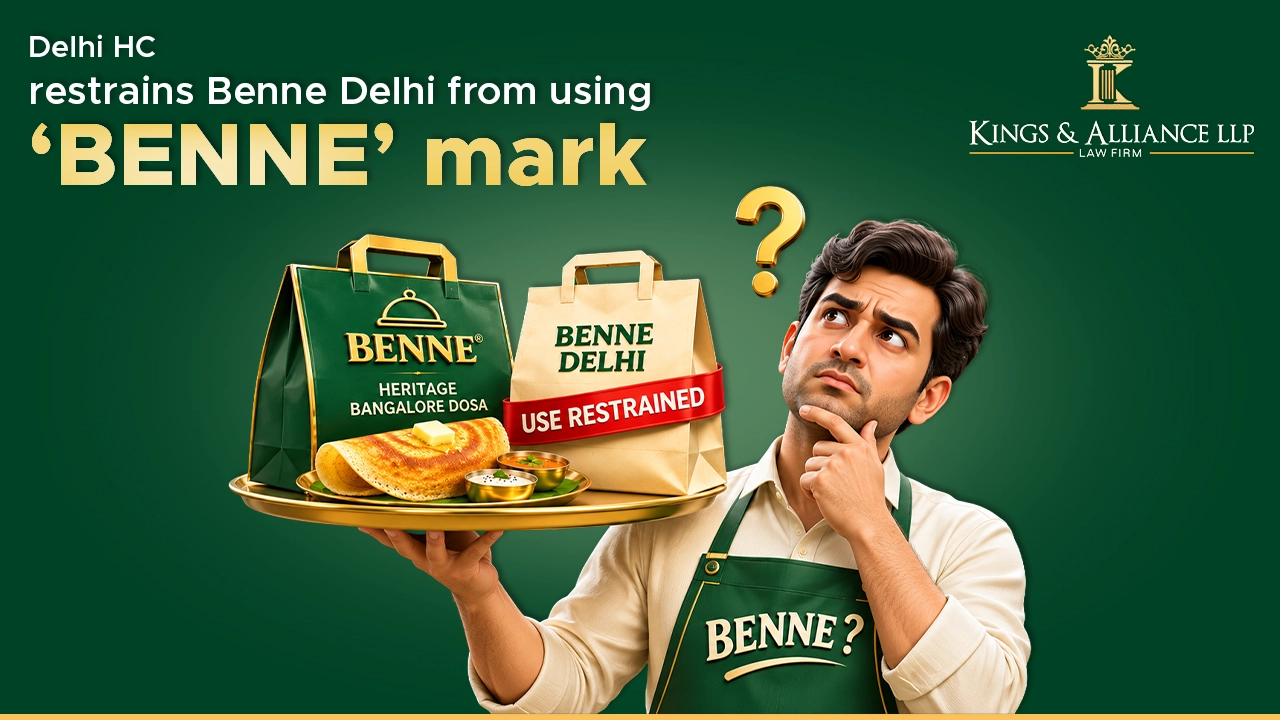
A plate of benne dosa may bring people together, but when two food businesses serve up the same brand name, things can get legally messy. In Shimow Hospitality Private Limited v. M/s Benne Delhi Through Its Proprietor1 the dispute centred on the use of the mark ‘BENNE’ by two businesses operating in the South Indian food industry. Shimow Hospitality claimed that it had established its brand through prior use, distinctive branding and growing customer recognition, alleging that Benne Delhi’s use of the identical name could confuse customers and create a false impression of commercial association.
The plaintiff, Shimow Hospitality Private Limited, was initially constituted as Shimow Foods LLP before being incorporated as a private limited company. The rights in the trademark ‘BENNE’ were initially held by Shimow Foods LLP and were subsequently assigned to Shimow Hospitality Private Limited through a Deed of Assignment dated 13 July 2026. According to its plaint, the business conceptualised its ‘benne’ trademark during 2023-24, drawing inspiration from Bengaluru’s Darshini dining culture. ‘Benne’, which means butter in Kannada, is commonly associated with butter dosa on restaurant menus. The plaintiff developed its brand around South Indian cuisine, combining traditional design elements with a modern, technology-driven quick-service restaurant model.
The plaintiff commenced business in 2024, opening its first outlet in Bandra, Mumbai, in April that year. By the time of the proceedings, it operated five outlets, three in Mumbai and two in Delhi-NCR. Its restaurants featured self-service ordering kiosks, communal standing tables and heritage-inspired decor. The plaintiff also adopted the tagline ‘HERITAGE BANGALORE DOSA’ and a circular logo inspired by the imperfect circle of life, claiming that these elements helped establish a recognisable brand identity.
To demonstrate its growing reputation, the plaintiff relied on coverage in newspapers, digital publications, food and lifestyle magazines, and social media platforms. It also referred to food vloggers, influencers and celebrity visitors, including Deepika Padukone, Ranveer Singh, Anushka Sharma and Vijay Verma. According to the plaintiff, its turnover had increased substantially within approximately two years. The plaintiff attributed its growing goodwill to continuous use, quality control and extensive publicity, contending that consumers had begun associating the ‘benne’ mark with its business.
The plaintiff stated that its trademark rights had been assigned by Shimow Foods LLP through a deed dated 13 July 2026. It had also sought trademark registration and claimed copyright ownership over its logo as an original artistic work under Section 2(c) of the Copyright Act, 1957.2 The conflict emerged in August 2026, when the plaintiff discovered that Benne Delhi was using the mark ‘BENNE’ for a cloud kitchen and/or outlet offering identical South Indian cuisine. The defendant’s business was listed on food delivery platforms such as Swiggy and Magicpin and advertised on Instagram and YouTube.
A key part of the plaintiff’s case was that the defendant had applied to register the disputed mark in Class 43 in April 2026 on a ‘proposed to be used’ basis and the registration status of the ‘BENNE’ mark remains unconfirmed in the order. The plaintiff relied on this application to support its claim of prior use, pointing out that its own business had commenced in 2024. It alleged that using an identical mark for competing services could confuse customers, weaken the distinctiveness of its brand and lead consumers to believe that the two businesses were connected.
The central issue was whether the plaintiff had established sufficient grounds for immediate protection against the defendant’s use of ‘BENNE’ and ‘BENNE DELHI’. The Court considered whether the material presented disclosed a prima facie case, whether the balance of convenience favoured the plaintiff and whether refusing interim relief would cause irreparable injury.
Appearing for the plaintiff, senior advocate Chander M. Lall relied on the plaintiff’s prior use, claimed goodwill, quality-control practices and publicity. The plaintiff alleged that the defendant had adopted an identical mark to benefit from its reputation and argued that the competing businesses’ identical cuisine and branding created a risk of consumer confusion and passing off. The plaintiff claimed that ‘BENNE’ had acquired secondary meaning, leading consumers to associate the mark with its goods and services. It also relied on its distinctive logo, inspired by the imperfect circle of life, and the tagline ‘HERITAGE BANGALORE DOSA’ to establish its brand identity.
Justice Vikas Mahajan found that the plaintiff had established a prima facie case for an ex parte ad interim injunction. The Court also found that the balance of convenience favoured granting protection and that the plaintiff would suffer irreparable loss and injury if the restraint were not imposed. The injunction was granted at an interim stage, before the defendant had filed its response. The order did not separately identify any observations as obiter dicta. Nor did it finally determine the validity or registrability of the mark, the full extent of the plaintiff’s goodwill or whether the defendant had deliberately copied the plaintiff’s branding. Those matters remain open for consideration as the proceedings continue. The Court’s findings were limited to a prima facie assessment for granting interim relief and did not constitute a final evaluation of the plaintiff’s evidence or claims.
The Court restrained the defendant and the specified persons associated with its business from using, marketing, advertising or offering services under ‘BENNE’, ‘BENNE DELHI’ or other identical or similar marks that could pass off the defendant’s services as those of the plaintiff. The restraint also covered use as a trademark, trade name, corporate name, domain name or social media handle, including permitting third parties to undertake such use.
The Court issued notice to the defendant, allowing four weeks to file a reply, with any rejoinder to be filed before the next hearing. Compliance with Order XXXIX Rule 3 of the Code of Civil Procedure, 1908,3 was directed within two weeks, followed by an affidavit of compliance within one week thereafter. The matter was listed before the Joint Registrar on 9 December 2026 for completion of service and pleadings, and before the Court on 9 February 2027. It also permitted additional documents to be filed, exempted the plaintiff from pre-institution mediation under Section 12A of the Commercial Courts Act, 2015,4 in view of the genuinely contemplated urgent relief, and directed that the outstanding court fee be filed within two weeks. For now, Shimow Hospitality has secured temporary protection for its claimed brand identity. However, the injunction is not a final determination of the parties trademark rights. As the case progresses, the competing claims over prior use, goodwill and consumer confusion will remain central to the dispute. The ultimate outcome will turn on whether the plaintiff can establish that its claim to the mark merits continued legal protection against the defendant’s competing use.
Citations
- Shimow Hospitality Private Limited v. M/s Benne Delhi Through Its Proprietor CS(COMM) 1131/2026 ↩︎
- The Copyright Act, 1957 (Act No. 14 of 1957), s. 2(c) ↩︎
- Order XXXIX, Rule 3, The Code of Civil Procedure, 1908. ↩︎
- The Commercial Courts Act, 2015, s. 12A ↩︎
Expositor(s): Adv. Gaurangi Tandon
This article is for information only and is not legal advice. Read the disclaimer