IBC · Supreme Court
Analyzing the Limits of Appeal Under Sections 61(3)(ii) and 62 of the IBC in Challenging a CoC-Approved Resolution Plan
On this page
Introduction
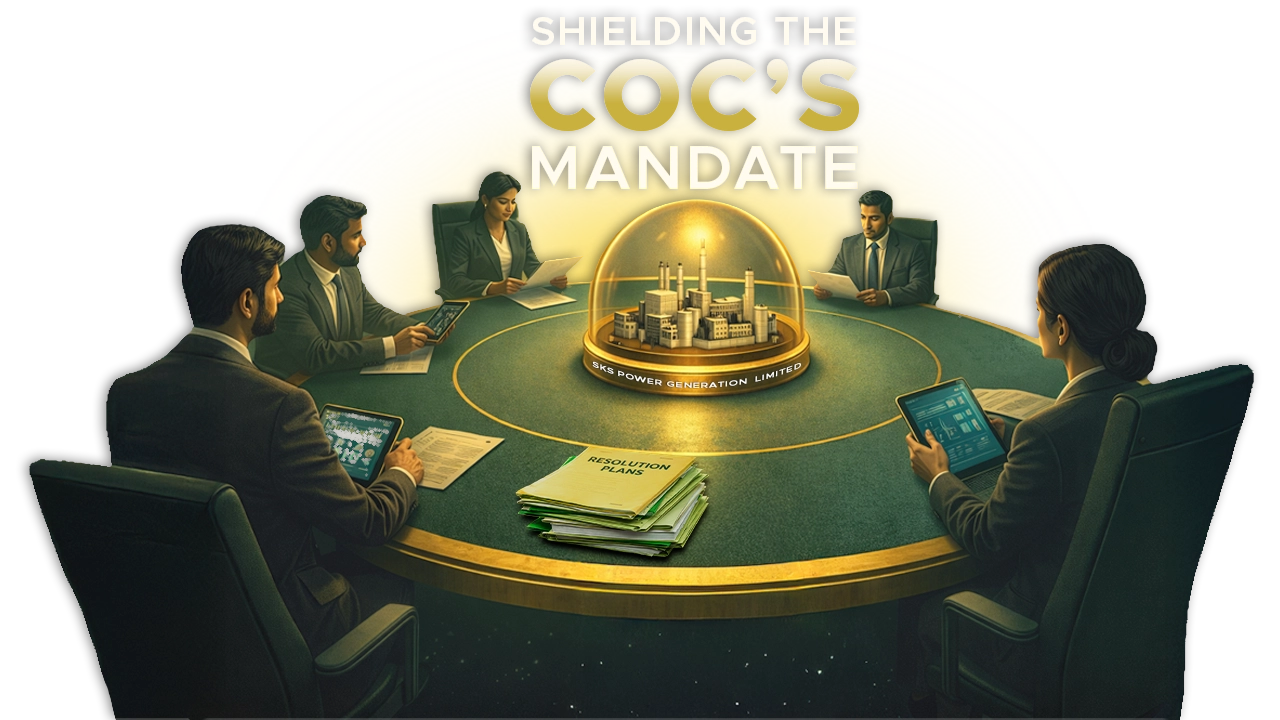
When a competitor enters the Corporate Insolvency Resolution Process (CIRP), the primary objective of industry participants is often the acquisition of the distressed entity through a comprehensive resolution plan. However, the bidding process is frequently characterised by intense competition, which may culminate in litigation challenging the decisions of the Committee of Creditors (CoC). One such dispute emerged during the CIRP of SKS Power Generation (Chhattisgarh) Limited, following the CoC’s approval of the resolution plan submitted by Sarda Energy and Minerals Limited (SEML) over
six other resolution applicants. Aggrieved by this decision, three unsuccessful resolution applicants, including Torrent Power Limited and Vantage Point Asset Management, challenged it under section 61(3)(ii) in NCLT. This application was rejected by the NCLT, dissatisfied by the decision the appellants filed an appeal in NCLAT which was also dismissed, ultimately the appellants moved to the Supreme Court under section 62 of the IBC, alleging “material irregularity” in the exercise of powers by the Resolution Professional and irregularities in the conduct of the resolution process.
The dispute thus presented the apex court with an opportunity to clarify an important question within the architecture of the Insolvency and Bankruptcy Code, 2016: how far can appellate forums interfere with a resolution plan approved by the CoC under Sections 61(3)(ii)1 and 62 of the IBC?
The Statutory Framework: Sections 61(3)(ii) and 62 of the IBC
The dispute before the Supreme Court required an examination of the statutory limits governing appeals against approved resolution plans. Under Section 61(3) of the IBC, an appeal against the approval of a resolution plan is permitted only on limited grounds. One such ground, set out under Section 61(3)(ii), is the existence of a “material irregularity in exercise of powers by the resolution professional during the corporate insolvency resolution period.” Section 62 of the IBC, in turn, provides for an appeal to the Supreme Court from an order of the NCLAT. However, such an appeal lies only on a question of law arising out of the order of the Appellate Tribunal. The IBC builds a tempered hierarchy of appeals. Section 61 serves as the first checkpoint, allowing for limited scrutiny before the NCLAT. However, Section 62 raises the bar significantly, narrowing the Supreme Court’s jurisdiction. At the apex level, the law pivots from facts to pure legal principles, ensuring that the highest court intervenes only when a question of law demands an answer.
Judicial Validation and the Primacy of Commercial Wisdom
Upon examining the record, the Supreme Court found that the challenge advanced by the appellants rested on an incorrect interpretation of the approved resolution plan. In a decisive affirmation of the insolvency framework, the Supreme Court systematically dismantled the appellants’ challenges by grounding its findings in the sanctity of the Committee of Creditors’ (CoC) role and the integrity of the resolution process. Upon a meticulous review of the record, the Court determined that the allegations of unauthorised plan modification were rooted in a fundamental misinterpretation of the resolution plan; specifically, it clarified that SEML’s treatment of bank guarantees including the release of ₹180.05 crores in margin money and the upfront vs. deferred payment options were inherent to the original proposal rather than subsequent alterations. By finding that these clarifications did not enhance the offer’s value but merely explained the existing commercial structure, the Court held there was no “material irregularity” under Section 61(3)(ii) of the IBC. It further noted that the Resolution Professional (RP) acted strictly under CoC instructions to seek clarity, rather than exercising independent or arbitrary decision-making power that would obfuscate the distinction between the RP’s administrative role and the CoC’s decision-making authority.
The Court’s reasoning was firmly anchored in the established legal landscape, drawing upon a consistent line of judicial precedents including K. Sashidhar v. Indian Overseas Bank2, Committee of Creditors of Essar Steel India Limited v. Satish Kumar Gupta3, Pratap Technocrats (P) Ltd. v. Reliance Infratel Ltd.4, and the more recent Kalyani Transco v. RP of Shree Ram Urban Infrastructure Ltd.5 By invoking these authorities, the Court reiterated that the “commercial wisdom” of the CoC is not subject to judicial review on its merits. These precedents reinforce that the IBC entrusts financial creditors not the courts with the responsibility of assessing the viability and feasibility of resolution plans. Consequently, once the statutory requirements are satisfied, the adjudicating authorities cannot substitute their own assessment for that of the creditors, thereby preventing appellants from using procedural objections as a guise to reopen the comparative merits of competing bids.
Conclusion
The decision in Torrent Power Limited v. Ashish Arjunkumar Rathi6 reinforces the limited nature of appellate intervention against a CoC-approved resolution plan. The ruling clarifies that Section 61(3)(ii) cannot be invoked to challenge the outcome of a commercial decision taken by the CoC unless the conduct of the Resolution Professional itself discloses a material irregularity within the meaning of the statute. Equally, Section 62 does not expand the scope of review, as the Supreme Court’s jurisdiction remains confined to questions of law arising from the order of the Appellate Tribunal. By reaffirming these statutory limits, the Court has strengthened the finality of the CIRP process and preserved the institutional balance envisaged under the IBC. The judgment serves as a reminder that the insolvency framework is designed to function as a time-bound, market-driven mechanism, where the commercial judgment of financial creditors occupies a central position.
- The Insolvency and Bankruptcy Code (IBC), 2016 ↩︎
- K. Sashidhar v. Indian Overseas Bank & Ors.(2019) 12 SCC 150 ↩︎
- Committee of Creditors of Essar Steel India Limited vs. Satish Kumar Gupta & Ors., (2020) 8 SCC 531 ↩︎
- Pratap Technocrats (P) Ltd. & Ors. vs. Monitoring Committee of Reliance Infratel Limited & Ors., (2021) 10 SCC 623 ↩︎
- Kalyani Transco v. Phillip Ventures2024 INSC 225 ↩︎
- Torrent Power Limited v. Ashish Arjunkumar Rathi C.A. No. 11746-11747/2024 ↩︎
Expositor(s): Adv. Jahnobi Paul
This article is for information only and is not legal advice. Read the disclaimer