IPR Laws
Biological Diversity Amendment Act 2023 Drives Surge in Biodiversity Linked IPR Filings in India
On this page

The landscape of Indian patent activity within the Intellectual Property Rights (IPR) framework is undergoing a structural transformation. Recent data released by the Ministry of Environment, Forest and Climate Change (MoEF&CC) in April 2026 confirms that India has moved past regulatory bottlenecks toward a phase of “Safe Velocity” in biotechnology and pharmaceutical innovation.
At the heart of this shift is the Biological Diversity (Amendment) Act, 2023, which has successfully reconciled the need for conservation with the imperative of industrial growth.
Regulatory Gaps in Pre-Amendment Era of Control and Risk
To appreciate the current growth, one must look at the restrictive “Stop Sign” framework of the original Biological Diversity Act, 2002. Before the 2023 reforms, the legal landscape was defined by high scrutiny and strict penalties that often stifled domestic innovation.
- The “Prior Approval” Barrier: Under Section 6, innovators were strictly prohibited from even applying for a patent without the previous approval of the National Biodiversity Authority (NBA). This created a significant “Time Lag,” often causing researchers to lose their competitive edge.
- Criminal Liability: Non-compliance was treated as a criminal offense. Under Section 55, failing to obtain approval for accessing resources or filing IPR was punishable by up to 5 years in prison.
- The Compliance Burden: There was a lack of distinction between “codified” traditional knowledge (like Ayurveda) and “uncodified” oral traditions, forcing small-scale local healers into a complex regulatory loop.
A Multi-Sectoral Revolution: Fueling the $300B Bioeconomy
The 2023 reforms serve as a vital indicator of India’s progress toward a $300 billion bioeconomy by 2030. While the pharmaceutical sector remains a primary driver, the April 2026 figures suggest a broad-based adoption across knowledge-driven industries. There are strong indications that companies are now successfully utilizing the streamlined regulatory mechanism in:
- Agrochemicals & Microbiology: For the protection of bio-fortified products and industrial microbial strains.
- Biochemistry & Biomedical Engineering: Leading to breakthroughs in diagnostic tools and specialized enzymes.
- Textile & Polymer Technology: Formalizing innovation in bio-polymers and natural dyes.
Year-Wise Performance: Applications vs. CoR Issuance
The 2023 Amendment redesigned the framework to prioritize efficiency. By shifting to a registration-based system, the National Biodiversity Authority (NBA) has significantly improved the “disposal rate” of applications through the issuance of Certificates of Registration (CoR).
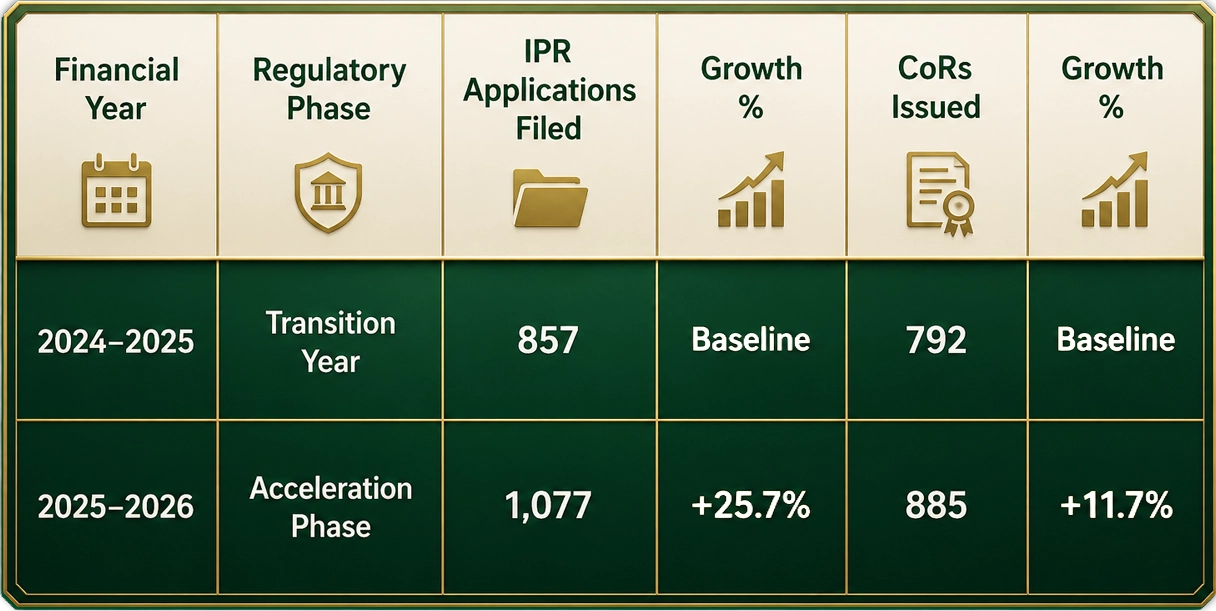
The data indicates that the NBA is not just receiving more applications but is clearing them faster. In the 2025–26 cycle, the NBA issued 885 CoRs out of 1,077 applications, maintaining a high disposal efficiency of ~82%.
Strategic Drivers of the 2026 Transformation
The 25.7% surge in biodiversity-linked filings is the direct result of the 2023 Amendment’s shift toward Enablement:
- The “Registration” Fast-Track: The new Section 7 introduced the Certificate of Registration (CoR). Innovators can now secure their “Patent Priority” immediately, while the administrative registration is processed in parallel.
- Decriminalization: By moving from Criminal to Civil liability, the government has replaced the threat of jail with monetary fines. This has provided the “Commercial Confidence” necessary for the 30.2% surge seen in overall Indian patent filings climbing to 143,729 applications in the year 2025-2026 from 110,364 in the previous year.
- Administrative Resilience: While applications jumped significantly, the 11.7% increase in CoR issuance proves that the digital, registration-based infrastructure can scale effectively without creating new backlogs.
Conclusion
The surge in biodiversity-linked IPR filings to 1,077 and the efficient issuance of 885 CoRs is shifting from Control to Enablement works. The Biological Diversity (Amendment) Act, 2023, has moved legal departments from being reactive compliance officers to becoming “Resilience Architects.” By clearing the path for domestic applicants who now make up over 69% of total filings the government has ensured that India’s pursuit of biotechnology and pharmaceutical innovation remains resilient, credible, and globally competitive. For companies in the sector, these indicators suggest that the mechanism is now a facilitator of innovation, positioning India as a global hub for responsible bio-property development.
Source: Ministry of Environment, Forest and Climate Change (MoEF&CC)
Expositor(s): Adv. Aparna Shukla
This article is for information only and is not legal advice. Read the disclaimer