Delhi High Court · GST Litigation
Factual Foundation Essential for Section 74 Proceedings: Delhi High Court
On this page
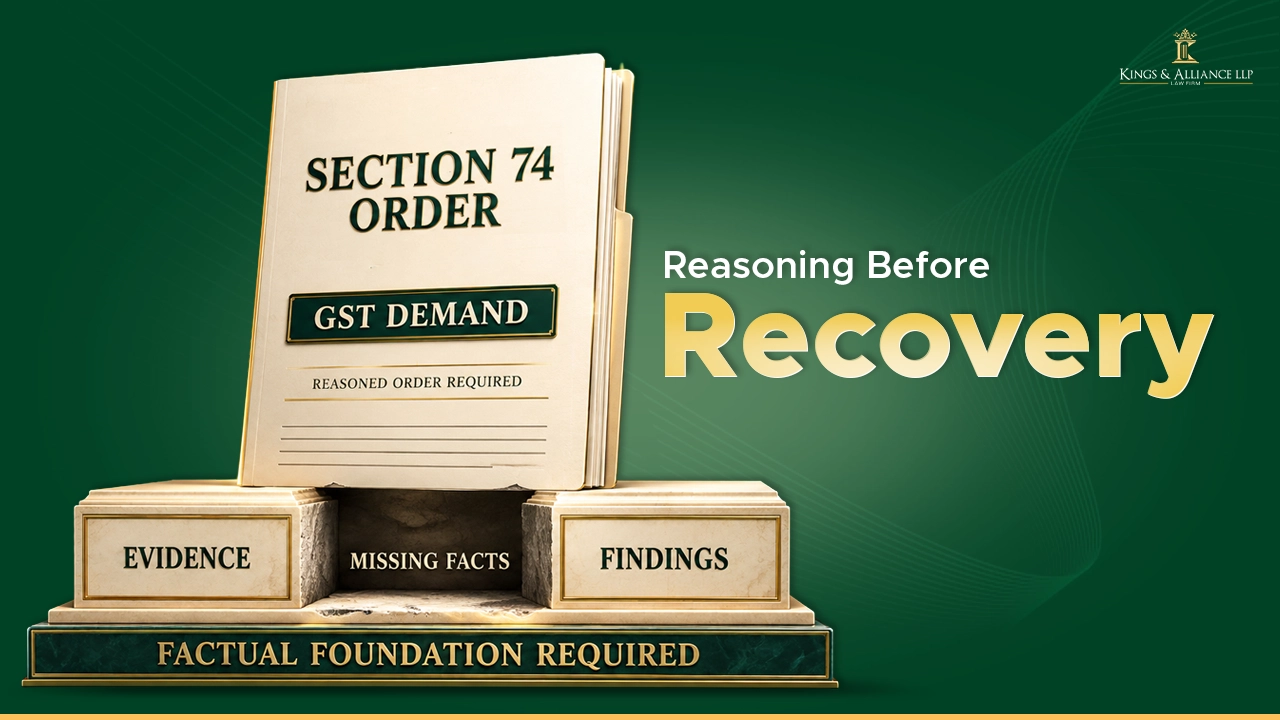
Whether an adjudication order invoking Section 74 of the CGST Act, 2017, must record specific findings establishing the statutory requirements for its application ? The Delhi High Court, in Treco Wire India Pvt. Ltd. v. Additional Commissioner Central Tax,1 answered in the affirmative. While setting aside the order of the adjudicating authority confirming the demand of Rs.3,34,21,261/- towards Input Tax Credit (ITC), the division bench held that the adjudication order must disclose the factual basis on which the statutory ingredients of the provision are said to have been satisfied. The court further observed that mere reproduction of the statutory language, without particulars supporting such satisfaction, would not, by itself, demonstrate the application of mind necessary to sustain an order under Section 74.
Treco Wire India Pvt. Ltd., the petitioner, is a manufacturer of copper wires and registered under the CGST Act. The Petitioner was subjected to an audit by the Respondent authorities for the period from 01.07.2017 to 31.03.2021. During the course of the audit, objections were raised regarding the ITC availed by the Petitioner. In particular, the authorities alleged that the Petitioner had availed ITC amounting to Rs.3,34,21,261/- in respect of supplies received from certain suppliers whose GST registrations were subsequently cancelled with retrospective effect. The authorities also proposed an additional demand of Rs.50,30,256/- towards interest, alleging that the Petitioner had failed to make payment to certain suppliers within 180 days of the relevant transactions.
The Petitioner disputed the allegations, asserting that the transactions were genuine commercial transactions and that the suppliers had valid and active GST registrations when the supplies were made. Despite these objections, a show-cause notice dated 22.09.2023 was issued under Section 74 of the CGST Act, stating that the petitioner has availed ITC (SGST+CGST) amounting to Rs.3,34,21,261/- on the supplies received from the suppliers whose GST registrations were cancelled with effect from a date which was earlier than the date of issuance of invoices and as per Section 37(1) of the CGST Act, 2017,2 read with Rule 36(4) of the CGST Rules, 2017,3 ITC is inadmissible on invoices issued after the supplier’s registration has been cancelled, as ITC can be claimed only subject to the applicable statutory conditions. In response, the Petitioner specifically contended that the essential statutory ingredients for invoking Section 74, namely fraud, wilful misstatement, or suppression of facts, had not been established. The proceedings ultimately culminated in the Order-in-Original dated 15.01.2024, whereby the adjudicating authority confirmed the ITC demand of Rs. 3,34,21,261/- under Section 74(1),4 along with applicable interest and an equivalent penalty, and further confirmed the interest demand of Rs. 50,30,256/- under Section 505 of the CGST Act.
Challenge to the ITC Demand and Section 16(2)(c)
The Petitioner contended that the said Order-in-Original does not disclose the names of the suppliers from whom the Petitioner allegedly received the supplies, the dates of the invoices in question, the dates from which the respective GST registrations were cancelled, or the material based on which it was concluded that the ITC availed by the Petitioner was liable to be denied. Further, it was contended that the mere assertion that the suppliers subsequently had their registrations cancelled cannot, by itself, satisfy the statutory ingredients of Section 74. The Petitioner also challenged the constitutional validity of Section 16(2)(c)6 of the CGST Act. The said section allows ITC only where the tax charged on the supply has actually been paid to the Government, either in cash or through utilization of admissible ITC. The Petitioner challenged the constitutional validity of Section 16(2)(c) or, in the alternative, sought that the said provision be read down to protect bona fide recipients in cases where the supplier has failed to discharge its tax liability. On the other hand, the Respondents, relying on the audit objections and the material available on record, sought to sustain the said Order-in-Original.
Section 74 Requires Specific Findings
While the Division Bench upheld the petitioner’s contention that the statutory ingredients of Section 74 were not satisfied, it did not accept the challenge to the constitutional validity of Section 16(2)(c) of the CGST Act. In upholding the validity of the said provision, the Division Bench relied on the judgment of the Gujarat High Court in Maruti Enterprises v. Union of India,7 which was subsequently upheld by the Supreme Court in Bhandari Scrap Traders v. Union of India.8 In Maruti Enterprises, the Gujarat High Court, while considering the principles of reading down, held that Section 16(2)(c) of the CGST Act is clear, self-explanatory and unambiguous, and that its plain reading does not give rise to any constitutional or legal infirmity.9 The Supreme Court, in Bhandari Scrap Traders, subsequently upheld the same reasoning adopted by the Gujarat High Court.10
Concerning Section 74 of the CGST Act, the Court observed that Section 74 is attracted in specified circumstances where tax has not been paid or has been short paid, a refund has been erroneously made, or ITC has been wrongly availed or utilized, by reason of fraud, willful misstatement or suppression of facts with an intent to evade tax. Therefore, where an authority invokes Section 74, the adjudication order must disclose the factual basis on which the statutory ingredients of the provision are said to be satisfied. The court analyzed that in the present case the audit objections made a general assertion that ITC was availed on supplies received from suppliers whose GST registrations had allegedly been cancelled with effect from dates preceding the relevant invoices. However, the Impugned Order failed to disclose the particulars of such suppliers, including their names and GSTINs.
Importance of Reasoned Adjudication
Setting aside the Order-in-Original along with the consequential proceedings, the Division Bench observed that the omission to disclose the particulars of the case is not merely a technical defect, but also deprives the petitioners of an effective opportunity to make a case against it. Further, a reasoned order assumes greater significance as adjudication under Section 74 results not merely in the confirmation of tax liability along with interest, but also in the imposition of an equivalent penalty under the said section. Lastly, the Court clarified that its observations in the present case were confined to the deficiencies in the impugned adjudication order and directed the adjudicating authority to pass a fresh order and independently examine whether the statutory requirements for invoking Section 74 of the CGST Act are satisfied on the facts of the case, and to record appropriate findings thereon.
The decision contributes to the evolving jurisprudence on GST adjudication by reinforcing the requirement that the exercise of statutory powers under Section 74 must be supported by specific factual findings and a reasoned application of mind. By distinguishing between a mere reproduction of statutory language and a demonstrable satisfaction of the statutory ingredients, the Court strengthens procedural fairness in tax adjudication and ensures that taxpayers are adequately informed of the basis of the demand against them. While the Court did not foreclose the possibility of invoking Section 74, it clarified the standard of reasoning and factual substantiation required to sustain such proceedings, thereby contributing to greater accountability and consistency in GST adjudication.
Citation
- Treco Wire India Private Limited v. Additional Commissioner, Central Tax, Delhi North & Ors., W.P.(C) No. 583 of 2026. ↩︎
- The Central Goods and Services Tax Act, 2017, s. 37(1). ↩︎
- The Central Goods and Services Tax Rules 2017, r. 36(4). ↩︎
- The Central Goods and Services Tax Act, 2017, s. 74(1). ↩︎
- The Central Goods and Services Tax Act, 2017, s.50. ↩︎
- The Central Goods and Services Tax Act, 2017, s. 16(2)(c). ↩︎
- Maruti Enterprise v. Union of India, 2026 SCC OnLine Guj 4013. ↩︎
- Bhandari Scrap Traders v. Union of India, 2026 SCC OnLine SC 1570 ↩︎
- Maruti Enterprise v. Union of India, 2026 SCC OnLine Guj 4013 para 67. ↩︎
- Bhandari Scrap Traders v. Union of India, 2026 SCC OnLine SC 1570, para 4. ↩︎
Expositor(s): Adv. Siddharath Shrivastava
This article is for information only and is not legal advice. Read the disclaimer