IBC · NCLT Judgement
Beyond Section 12A: Can NCLAT Close a CIRP When the Statutory Withdrawal Mechanism Fails?
On this page
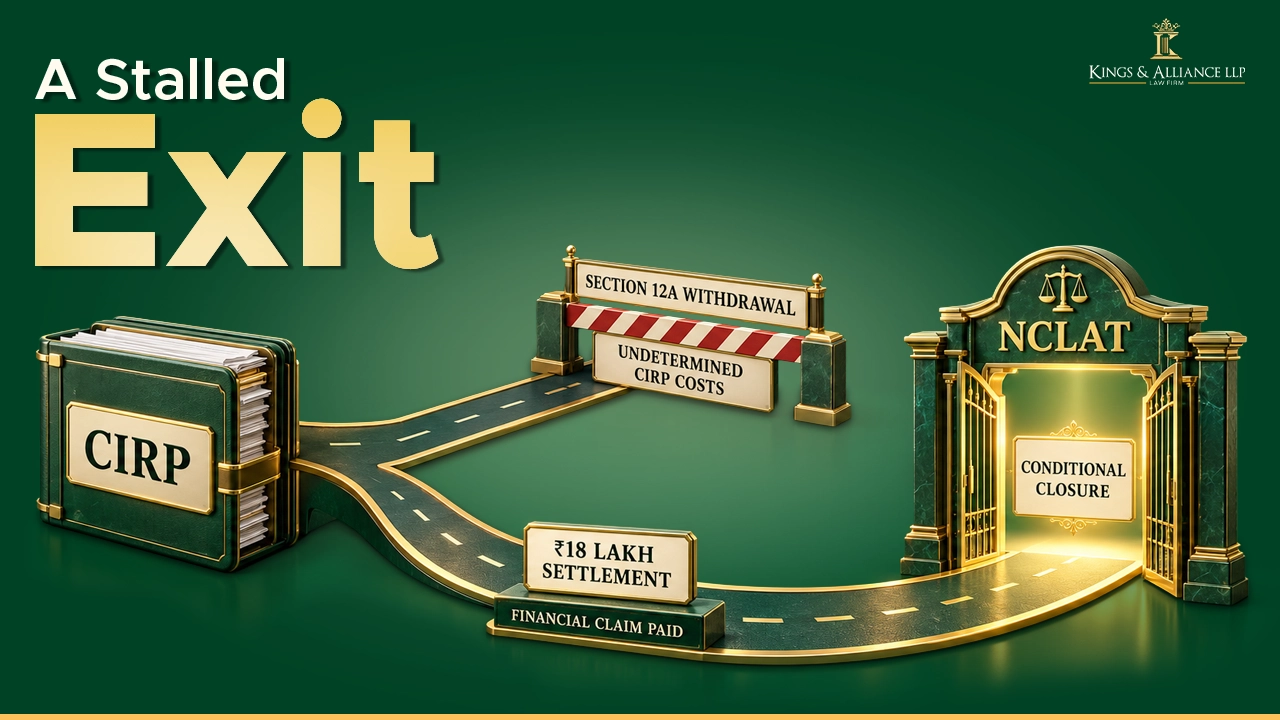
The Insolvency and Bankruptcy Code, 2016 (IBC)1 provides a structured mechanism for withdrawal of a Corporate Insolvency Resolution Process (CIRP) under Section 12A read with Regulation 30A of the CIRP Regulations.2 However, questions arise when the parties have effectively resolved the claims, but the statutory withdrawal mechanism cannot be completed because of procedural requirements that cannot practically be fulfilled.
In Deepak Modi v. Shalfeyo Industries Private Limited & Ors.3 The National Company Law Appellate Tribunal (NCLAT), Principal Bench, took this issue into consideration. The CIRP had been initiated on an operational debt of approximately ₹11.90 lakh. By the time the appeal was considered, the sole Financial Creditor, Axis Bank, had been paid in full, while the sole Operational Creditor, Prime Impex, had agreed to accept ₹18 lakh as full and final settlement. However, the CIRP costs remained uncrystallised, creating difficulty in furnishing the bank guarantee required for withdrawal under Regulation 30A.
The NCLAT ultimately closed the CIRP, while directing payment of the settlement amount and subsequent determination and payment of the CIRP costs. Prime Impex initiated proceedings under Section 9 of the IBC4 against Shalfeyo Industries Private Limited. The CIRP was admitted on 16 August 2022 and the Interim Resolution Professional (“IRP”) was appointed and subsequently confirmed as the Resolution Professional.
Axis Bank submitted a claim of approximately ₹1.04 crore as the sole Financial Creditor. The CIRP continued. The CoC resolved to proceed towards liquidation, and the RP filed an application under Section 33(2) of the Code.5 Separately, the RP filed an application for determination of CIRP costs, which remained pending before the NCLT.
Several attempts were made to settle the claim of Prime Impex. The Appellant filed an application under Section 12A read with Regulation 30A seeking withdrawal of the CIRP. The NCLT, however, dismissed the application.
The Adjudicating Authority noted that the Financial Creditor’s claim had been paid and that the Operational Creditor’s entire claim had been offered through a demand draft. However, relying upon the Supreme Court’s decision in Glass Trust Company LLC v. Byju Raveendran,6 the NCLT held that the statutory requirements governing withdrawal had not been fulfilled.
In particular, the application had been filed by the suspended director rather than through the Resolution Professional, and the proposal had not obtained the requisite 90% voting approval of the CoC. The NCLT also noted the requirements relating to Form FA and the CIRP-cost-related security or bank guarantee. The matter therefore reached the NCLAT with the statutory withdrawal application having failed.
Subsequent Developments Before the NCLAT
During the pendency of the appeal, the circumstances changed further.
On 1 July 2026, the Appellant offered ₹17 lakh to Prime Impex as full and final settlement, including interest and other amounts, while undertaking to pay the CIRP costs as determined by the Adjudicating Authority. The NCLAT recorded that Prime Impex did not dispute the amount of ₹17 lakh at that stage, while the remaining difficulty concerned Form FA and the bank guarantee.
The Appellant subsequently filed an affidavit dated 29 July 2026 undertaking to pay the CIRP costs as determined by the NCLT. On 5 August 2026, the settlement proposal was enhanced to ₹18 lakh. The Appellant’s counsel stated that ₹18 lakh would be paid to Prime Impex as full and final settlement, and Prime Impex agreed to accept that amount. The Appellant also agreed to abide by the amount of CIRP costs determined by the NCLT.
Thus, by the time the NCLAT considered the matter, Axis Bank had no subsisting financial claim, Prime Impex had agreed to accept ₹18 lakh, and the Appellant had undertaken to pay the CIRP costs determined by the NCLT.
The NCLAT nevertheless recognised that the statutory requirements under Section 12A and Regulation 30A could not simply be disregarded.
The Tribunal specifically observed that an application for withdrawal had to be made by the applicant who had initiated the CIRP, in Form FA. It further noted that a bank guarantee equivalent to the CIRP costs up to the date of filing of the withdrawal application was required under Regulation 30A(2).
The difficulty was that the CIRP costs had not yet been crystallised. The determination of those costs was pending before the NCLT. Consequently, the amount of the bank guarantee could not be determined. The NCLAT also recorded that the Operational Creditor was unwilling to provide the bank guarantee because the CIRP costs claimed by the RP were substantially higher than the original operational debt.
This resulted in a procedural stalemate. Although the creditors’ claims had been addressed through payment or settlement, the statutory withdrawal mechanism could not practically be completed in the prevailing circumstances.
NCLAT’s Findings
The NCLAT expressly stated that the statutory requirements under Section 12A and Regulation 30A could not ordinarily be ignored. It also acknowledged that the RP’s concern regarding CIRP costs was legitimate because such costs are statutory expenses and could not simply be waived or assumed.
The Tribunal noted that the CIRP had originated from an operational debt of approximately ₹11.90 lakh; Axis Bank, the sole Financial Creditor, had already been paid in full; Prime Impex, the sole Operational Creditor, had agreed to accept ₹18 lakh as full and final settlement; there was no other creditor; and no resolution plan was available to take the Corporate Debtor towards resolution.
The NCLAT further noted that the Appellant had agreed to pay whatever CIRP costs were ultimately determined by the NCLT. Therefore, the RP’s legitimate interest in recovery of properly determined CIRP costs remained protected.
The Tribunal concluded that keeping the CIRP alive would not serve a meaningful purpose. It characterised the situation as a procedural stalemate arising because the CIRP costs remained uncrystallised and the amount of the bank guarantee could therefore not be determined.
The NCLAT closed the CIRP subject to specific conditions. First, the Appellant was directed to pay ₹18 lakh to Prime Impex within two weeks of the order as full and final settlement. Second, the NCLT was directed to determine the CIRP costs in the pending application within four weeks after considering the RP’s claim and the Appellant’s submissions. Third, the Appellant was directed to pay the CIRP costs determined by the NCLT within two weeks of that determination. Pending applications, if any, were also closed, with no order as to costs.
Conclusion
Deepak Modi demonstrates the difficulty that can arise when the substantive dispute between creditors has effectively been resolved, but the statutory withdrawal mechanism cannot be completed because of an unresolved procedural requirement.
The NCLAT did not dispense with Section 12A or Regulation 30A as a matter of general principle. Rather, it considered the particular circumstances: the Financial Creditor had been paid in full, the Operational Creditor had agreed to a full and final settlement of ₹18 lakh, no resolution plan was available, and the Appellant had undertaken to bear the CIRP costs as determined by the Adjudicating Authority. With the CIRP costs yet to be crystallised, the bank guarantee required for the statutory withdrawal process could not be quantified.
The decision therefore addresses a narrow but significant procedural situation: where adherence to the ordinary withdrawal mechanism has itself become impracticable, continuation of the CIRP may serve little purpose if the Tribunal can protect the outstanding statutory costs through appropriate conditions.
Citations
- The Insolvency and Bankruptcy Code, 2016 s. 12A ↩︎
- The Insolvency and Bankruptcy Board of India (Insolvency Resolution Process for Corporate Persons) Regulations, 2016 Regulation 30A ↩︎
- Deepak Modi v. Shalfeyo Industries Private Limited & Ors. 2026 LLBiz NCLAT 346 ↩︎
- The Insolvency and Bankruptcy Code, 2016 s. 9 ↩︎
- The Insolvency and Bankruptcy Code, 2016 s. 33(2) ↩︎
- Glass Trust Company LLC v. Byju Raveendran 2024 SCC OnLine SC 3032 ↩︎
Expositor(s): Adv. Vatsala
This article is for information only and is not legal advice. Read the disclaimer