GST Litigation
Bombay High Court Calls for Administrative Clarity on Pre-Deposits Through Form GST DRC-03 in Legacy Tax Appeals
On this page
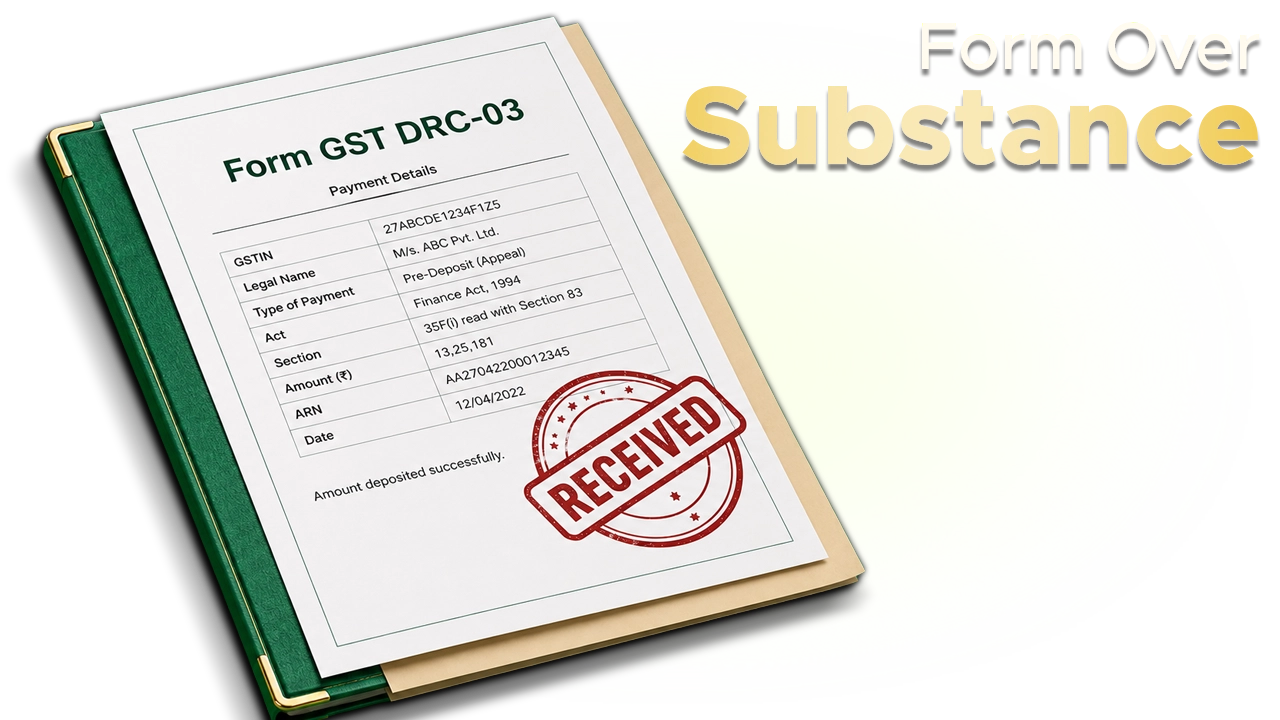
The transition from the erstwhile indirect tax regime to the Goods and Services Tax (GST) framework has presented taxpayers with several procedural challenges, particularly in respect of pending proceedings under the legacy tax laws. One such issue came before the Bombay High Court in Sodexo India Services Pvt. Ltd. v. Union of India & Ors1, where the Court considered whether statutory appeals under the Finance Act, 1994 could be dismissed solely because the mandatory pre-deposit had been made through Form GST DRC-03 on the GST portal. The decision highlights the need for administrative certainty where taxpayers have admittedly deposited the mandatory pre-deposit, but ambiguity persists regarding the prescribed mode of payment.
Factual Background
Sodexo India Services Pvt. Ltd. filed four appeals under Section 85 of the Finance Act, 1994 challenging service tax orders. As a statutory precondition for maintaining the appeals, the petitioner deposited ₹13,25,181 and ₹5,01,859 towards the mandatory pre-deposit under Section 35F(i) of the Central Excise Act, 1944, as made applicable to service tax proceedings through Section 83 of the Finance Act, 1994, by using Form GST DRC-03 on the GST portal.
The appellate authority accepted and registered the appeals, allotted appeal numbers, and afforded the petitioner an opportunity to present submissions during a personal hearing. However, by four separate orders dated 13 April 2022, the Commissioner (Appeals) dismissed all the appeals without examining their merits. The appeals were dismissed solely on the ground that the mandatory pre-deposit had been made through Form GST DRC-03, which the appellate authority regarded as an impermissible mode of payment for proceedings arising under the erstwhile service tax regime.
Significantly, the impugned orders themselves acknowledged that the prescribed amounts had been credited to the Government through valid Application Reference Numbers (ARNs). Despite treating the payment mechanism as procedurally defective, the orders neither identified the correct mode of payment nor explained how the petitioner ought to have complied with the statutory requirement. The petitioner further contended that no objection regarding the mode of payment had been raised during the personal hearing.
Aggrieved by the dismissal of its appeals on this technical ground, the petitioner invoked the writ jurisdiction of the Bombay High Court.
Proceedings Before the High Court
The petitioner contended that the statutory requirement under Section 35F stood satisfied because the prescribed amounts had admittedly been credited to the Government. It was argued that dismissal of the appeals solely on the basis of the payment mechanism was unwarranted, particularly after the appeals had been admitted, registered, and heard on merits.
Pursuant to an earlier direction of the Court, the Commissioner (Appeals) filed an affidavit explaining that proceedings under the Central Excise Act, 1944 and the Finance Act, 1994 were distinct from proceedings under the Central Goods and Services Tax Act, 2017, and that the existing legal framework and departmental circulars did not expressly permit mandatory pre-deposits for legacy proceedings to be made through Form GST DRC-03. The affidavit also disclosed that similar payments had been accepted in two earlier matters, although the Commissioner explained that such acceptance had occurred inadvertently due to oversight.
During the hearing, counsel appearing for the Revenue submitted that, if directed by the Court, the appellate authority would accept the payments made through Form GST DRC-03 as valid pre-deposits and hear the appeals afresh on their merits.
Decision of the Court
A Division Bench comprising Justice K. R. Shriram and Justice A. S. Doctor quashed the impugned orders and remanded the appeals to the Commissioner (Appeals) for de novo adjudication on merits.
The Bench noted that the impugned orders themselves acknowledged receipt of the mandatory pre-deposit. In these circumstances, treating the petitioner as having failed to satisfy the statutory precondition under Section 35F was unwarranted. The Court further observed that the appellate authority had neither identified the appropriate mode of payment in the impugned orders nor raised any objection during the personal hearing before dismissing the appeals solely on a technical ground relating to the payment mechanism.
The judgment further records that the difficulty arose because there was no clear legal mechanism for accepting pre-deposits made through Form GST DRC-03 in legacy indirect tax proceedings. The Court also took note of official departmental correspondence demonstrating that several taxpayers had encountered similar difficulties. Different assessees had adopted different payment mechanisms—including service tax challans, Form GST DRC-03 and other available modes—in the absence of a uniform statutory procedure, reflecting broader administrative uncertainty rather than isolated taxpayer error.
Recognising the wider implications of the issue, the Court observed that it required intervention by the Central Board of Indirect Taxes and Customs (CBIC). Accordingly, while granting relief to the petitioner, the Court directed that a copy of its judgment be placed before the Chairman of the CBIC for consideration at the earliest meeting of the Board. It further expected the Board to issue suitable instructions, clarifications, guidelines or FAQs to address the recurring uncertainty surrounding pre-deposits in pending legacy tax proceedings.
The Court also directed the appellate authority to dispose of the remanded appeals within six weeks, grant the petitioner a personal hearing with at least seven working days’ advance notice, and pass a reasoned order dealing with all submissions advanced by the petitioner. Importantly, the Bench expressly clarified that it had not expressed any opinion on the merits of the underlying service tax dispute.
Conclusion
The decision highlights the procedural challenges that continue to arise during the migration from the erstwhile indirect tax regime to the GST framework. While granting relief on the facts before it, the Bombay High Court recognised that uncertainty regarding the prescribed mode of payment should not, in appropriate cases, result in the rejection of statutory appeals where the mandatory pre-deposit has admittedly reached the Government.
Equally significant is the Court’s emphasis on institutional reform. By directing the CBIC to consider issuing suitable instructions, clarifications and procedural guidance, the judgment acknowledges that recurring transitional issues affecting legacy tax proceedings require consistent administrative solutions rather than divergent practices across appellate authorities.
The judgment is, however, confined to its own factual matrix and should not be construed as laying down a universal proposition that every pre-deposit made through Form GST DRC-03 would necessarily satisfy the statutory requirements applicable to proceedings under the legacy indirect tax laws. Instead, it reinforces the importance of administrative certainty, procedural consistency and reasoned decision-making in ensuring that taxpayers are not deprived of their statutory appellate remedies because of unresolved transitional issues arising from the implementation of the GST framework.
Citation
- Sodexo India Services Pvt. Ltd. v. Union of India & Ors., W.P. No. 6220 of 2022 (Bom. H.C.) ↩︎
Expositor(s): Adv. Jahnobi Paul
This article is for information only and is not legal advice. Read the disclaimer