CGST · Taxation
Gameskraft and the GST Treatment of Online Gaming: Supreme Court on Skill-Based Gaming, Actionable Claims and the 2023 Amendments
On this page
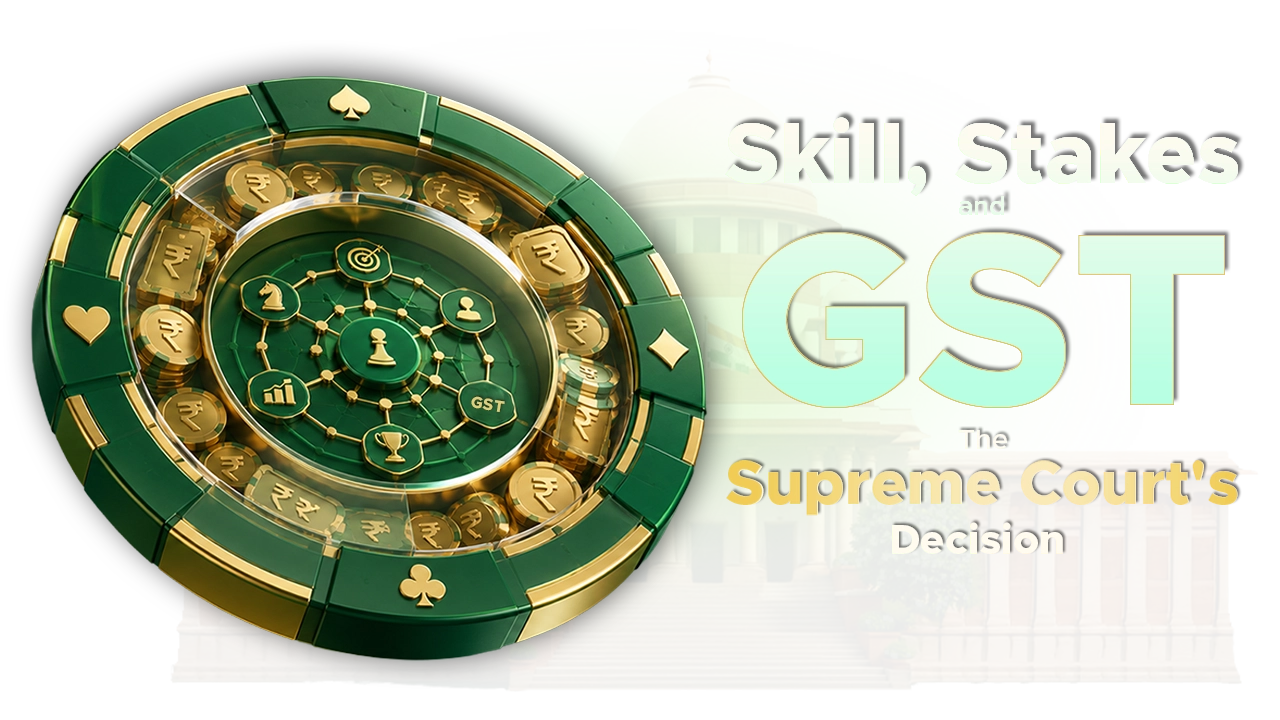
Can a game that is legally recognised as a game of skill be treated as “betting and gambling” merely because it is played for stakes? More importantly, can tax authorities impose GST on the entire amount deposited by players by treating online gaming operators as suppliers of actionable claims relating to betting and gambling? These questions came before the Supreme Court in Director General of GST Intelligence & Ors. v. Gameskraft Technologies Private Limited & Ors.1, a batch of matters concerning the GST treatment of online gaming. The dispute arose from a series of show cause notices issued to online gaming operators on the premise that games played for stakes constituted betting and gambling and that GST was therefore payable on the full value of player deposits rather than on the platform fee retained by the operators.
While the dispute concerned the levy and valuation of GST, it also required the Court to examine the long-settled distinction between games of skill and games of chance, the treatment of actionable claims under the Central Goods and Services Tax Act, 2017 (“CGST Act”), and the significance of the legislative changes introduced in 2023 governing online money gaming.
From Skill-Based Gaming to “Betting and Gambling”
Gameskraft and other online gaming operators provide digital platforms through which users participate in games such as rummy, fantasy sports and poker. Under this model, participants contribute entry amounts to contests, a portion of which is retained by the platform as a fee for providing its services while the remaining amount forms the prize pool.
Historically, operators discharged service tax, and later GST, only on the platform fee retained by them. The tax authorities position changed when it sought to characterise online games played for stakes as betting and gambling. Proceeding on this basis, the Department assessed that online gaming operators were supplying actionable claims in the nature of betting and gambling and were therefore liable to GST on the entire amount deposited by players.
The department argued that the presence of stakes was the decisive factor. According to the Department, once money was staked on an uncertain outcome, the activity assumed the character of betting and gambling irrespective of whether the underlying game involved skill. It was further contended that participation in such games resulted in the creation and supply of actionable claims attracting GST under the statutory framework.
The operators challenged this position by relying upon the settled jurisprudence governing games of skill. The Court examined the principles laid down in State of Bombay v. R.M.D. Chamarbaugwala2 and R.M.D. Chamarbaugwala v. Union of India3, where competitions substantially involving skill were recognised as distinct from gambling activities. The same principle was applied in State of Andhra Pradesh v. K. Satyanarayana4, where rummy was held to be “mainly and preponderantly” a game of skill, and later subsequently recognised by the Supreme Court in K.R. Lakshmanan v. State of Tamil Nadu5.
Drawing from these authorities, the operators contended that the legal character of a game depends upon whether skill or chance predominates. A game that is predominantly dependent upon skill does not lose that character merely because participants play for stakes. This position also found support in decisions of various High Courts, including Junglee Games India Pvt. Ltd. v. State of Tamil Nadu6, Head Digital Works Pvt. Ltd. v. State of Kerala7 and All India Gaming Federation v. State of Karnataka8, which consistently held that games involving a preponderance of skill do not become gambling merely because money is involved.
The Court’s analysis proceeded against this settled legal background. It reiterated that the distinction between games of skill and games of chance remains central to determining whether an activity falls within the ambit of betting and gambling. The existence of stakes, by itself, does not determine the legal character of the underlying activity.
Actionable Claims and the Pre-Amendment GST Framework
Having considered the nature of the activity, the Court turned to the GST framework.
Section 2(52) of the CGST Act9 includes actionable claims within the definition of goods. However, Entry 6 of Schedule III excludes actionable claims from GST except in relation to lottery, betting and gambling. The department sought to bring online gaming within this exception by contending that participation in games played for stakes amounted to betting and gambling.
The operators, on the other hand, argued that the exception could not be invoked unless the underlying activity itself fell within the legal meaning of betting and gambling. They pointed out that both under the service tax regime and during the initial years of GST, online gaming platforms had consistently been treated as service providers and had discharged tax only on the platform fee earned by them. The Service Accounting Codes notified by the Central Board of Indirect Taxes and Customs were also relied upon to demonstrate that the statutory framework distinguished between platform services and gambling or betting services.
The Court examined the statutory scheme in light of the established distinction between skill-based activities and gambling. It emphasised that the taxability of an actionable claim depends upon its legal character and that the statutory exception relating to betting and gambling cannot be applied merely because participants stake money while playing a game. The department also relied upon Rule 31A of the CGST Rules, 2017 to support taxation on the full face value of player deposits. The Court, however, approached the issue by first examining whether the activity could be characterised as betting and gambling under the statutory framework that existed at the relevant time.
The 2023 Amendments and the Question of Retrospectivity
A significant aspect of the judgment concerns the amendments introduced through the Finance Act, 2023.
Parliament introduced a separate statutory framework governing online money gaming, expanded the relevant definitions and incorporated specific valuation provisions. The amended regime also introduced deeming provisions treating gaming companies as suppliers for the purposes of the GST framework. The Court attached considerable significance to these legislative changes. During the proceedings, it was argued that the very introduction of a deeming provision demonstrated that, under the earlier framework, gaming companies could not be regarded as suppliers of actionable claims. A deeming fiction was therefore considered necessary to bring such entities within the scope of the charging provisions.
This feature assumed importance while considering the Revenue’s contention that the amendments merely clarified the existing legal position. The Court examined the nature and scope of the changes introduced by Parliament and drew a distinction between the legal framework that existed prior to October 2023 and the framework created thereafter. The judgment recognises that Parliament consciously enacted a dedicated regime governing online money gaming. The introduction of specific definitions, valuation provisions and deeming mechanisms formed an important part of the Court’s analysis while assessing whether liabilities could be imposed for periods governed by the earlier statutory framework.
The Court ultimately held that the amended provisions operate prospectively and cannot be relied upon to retrospectively alter the legal consequences of transactions undertaken before their introduction.
Conclusion
The Supreme Court’s decision in Gameskraft addresses one of the most significant questions concerning the GST treatment of online gaming. By examining the issue through the framework developed in R.M.D. Chamarbaugwala, K. Satyanarayana and K.R. Lakshmanan, the Court reaffirmed the relevance of the distinction between games in which skill predominates and activities falling within betting and gambling.
The judgment also provides important guidance on the treatment of actionable claims under the CGST Act and the significance of the legislative changes introduced in 2023. In recognising that the amended provisions created a distinct statutory framework for online money gaming and operate prospectively, the Court drew a clear distinction between the legal position that existed before October 2023 and the regime that now governs such activities. Beyond the online gaming sector, the decision serves as an important reminder that tax liability must be determined by reference to the statutory framework applicable during the relevant period and cannot be imposed through a retrospective application of subsequent legislative changes.
Citations
- Director General of GST Intelligence & Ors. v. Gameskraft Technologies Private Limited & Ors ↩︎
- State of Bombay v. R.M.D. Chamarbaugwala ↩︎
- R.M.D. Chamarbaugwala v. Union of India ↩︎
- State of Andhra Pradesh v. K. Satyanarayana ↩︎
- K.R. Lakshmanan v. State of Tamil Nadu ↩︎
- Junglee Games India Pvt. Ltd. v. State of Tamil Nadu ↩︎
- Head Digital Works Pvt. Ltd. v. State of Kerala ↩︎
- All India Gaming Federation v. State of Karnataka ↩︎
- Section 2(52) of the CGST Act ↩︎
Expositor(s): Adv. Aparna Shukla
This article is for information only and is not legal advice. Read the disclaimer