CGST · Taxation
Limits of Tolerating an Act Under GST: Bombay High Court Draws a Boundary Around Taxability of Arbitral Award Settlements
On this page
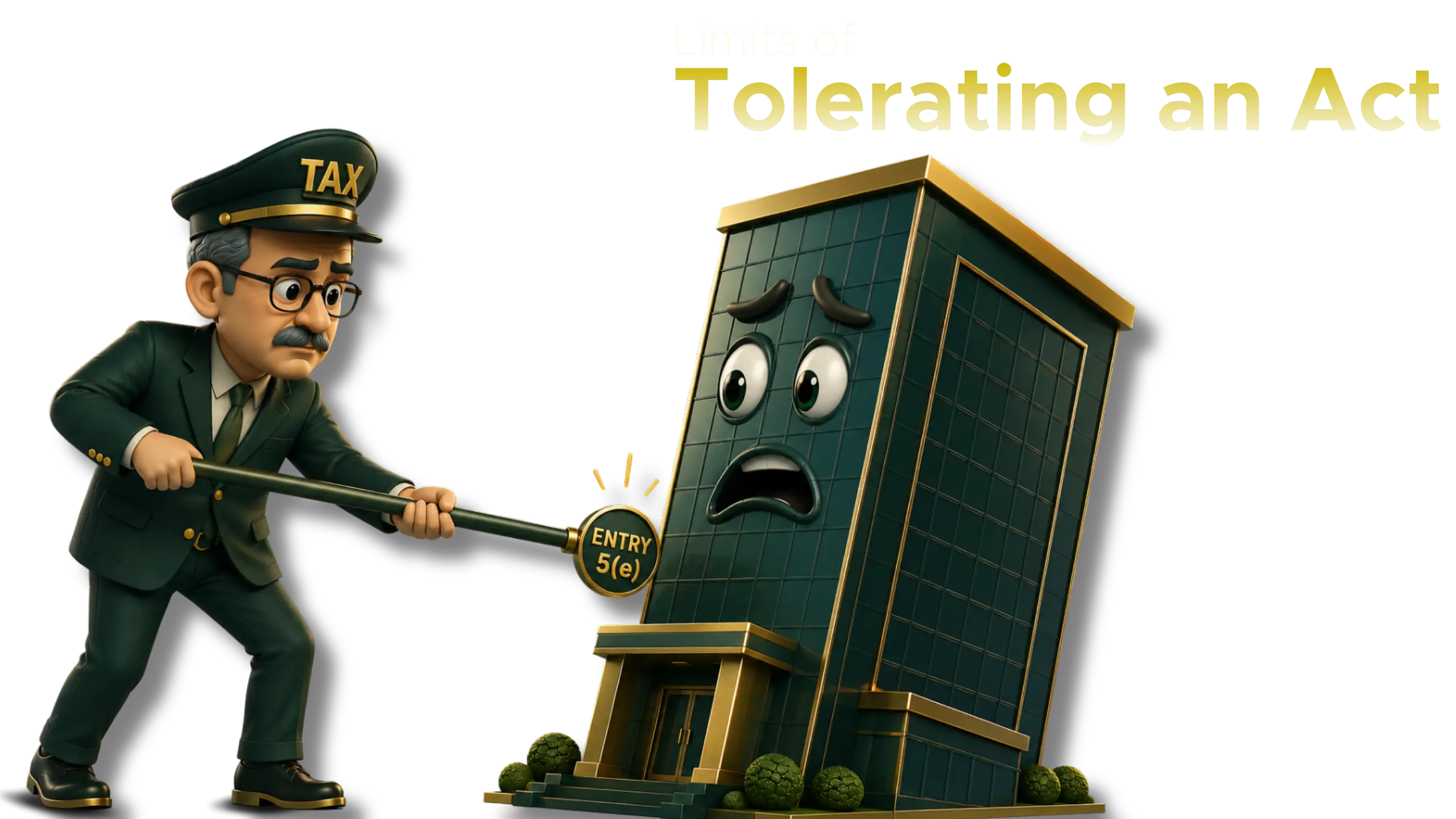
Few provisions under the GST framework have witnessed interpretive expansion as aggressively as Entry 5(e) of Schedule II to the Central Goods and Services Tax Act, 2017 (“CGST Act”)1, which treats “agreeing to the obligation to refrain from an act, or to tolerate an act or a situation, or to do an act” as a supply of services. What was originally conceived as a narrowly tailored deeming fiction has increasingly been invoked to tax liquidated damages, termination payments, contractual penalties, and commercial settlements.
The central debate has now moved beyond contractual compensation and into the terrain of adjudicated liabilities. The real question confronting courts is whether every monetary settlement arising from breach of contract can itself be recharacterized as consideration for “tolerating” a breach under the GST framework. Such an approach effectively collapses the distinction between compensation arising from breach and consideration flowing from consensual performance.
It was this issue that came up before the Division Bench of the Bombay High Court in Tata Sons Pvt. Ltd. v. Union of India2, decided on 30 April 2026 by Justice G.S. Kulkarni and Justice Aarti Sathe. The central issue before the Court was whether the settlement payments made by Tata Sons to NTT Docomo originating from an arbitral award and formalized via consent terms fell within the tax net of Integrated GST (IGST).
The Bombay High Court rejected this formulation. In doing so, the Court drew a significant doctrinal boundary between consensual contractual forbearance and adjudicated damages arising from breach of contract. The ruling substantially narrows the expanding use of Entry 5(e) as a residual taxing provision for commercial disputes and arbitral settlements.
GST demand on settlement payments
The dispute arose from a Shareholders Agreement dated 25 March 2009 executed between Tata Sons Pvt. Ltd. (“Tata”), Tata Teleservices Ltd. (“TTSL”), and NTT Docomo Inc. (“Docomo”), under which Docomo acquired a 26% equity stake in TTSL. The agreement contained exit protection clauses requiring Tata to secure a buyer for Docomo’s shares at a pre-agreed sale price upon failure of certain performance indicators.
Following non-fulfilment of those benchmarks, disputes arose between the parties and were referred to arbitration before the London Court of International Arbitration (“LCIA”). By an award dated 22 June 2016, the arbitral tribunal directed Tata to pay damages exceeding USD 1.17 billion along with interest and costs.
Docomo thereafter initiated enforcement proceedings before courts in the United Kingdom, the United States, and before the Delhi High Court under Sections 47, 48 and 49 of the Arbitration and Conciliation Act, 1996. During the enforcement proceedings, Tata and Docomo entered into consent terms before the Delhi High Court under which Tata agreed to satisfy the award and Docomo agreed to suspend and subsequently withdraw foreign enforcement proceedings upon receipt of payment.
The primary point of contention emerged when the Directorate General of GST Intelligence (“DGGI”) sought to levy IGST exceeding ₹1,524 crore on the payments made by Tata to Docomo. According to the Department, Docomo, by suspending and withdrawing enforcement proceedings and refraining from further action against Tata, had rendered a taxable service of “agreeing to tolerate an act” within the meaning of Entry 5(e) of Schedule II to the CGST Act.
What began as an enforcement of an arbitral award thus evolved into a larger doctrinal question concerning the limits of the deeming fiction under GST law.
The Doctrinal stand off
Tata challenged the GST demand on the ground that the payments represented adjudicated damages under an arbitral award and not consideration for any independent service. Tata relied extensively on Union of India v. Raman Iron Foundry, (1974)3, where the Supreme Court clarified that damages for breach of contract do not constitute a debt payable until adjudicated.
Reliance was also placed on the Bombay High Court’s decision in Iron & Hardware (India) Co. v. Shamlal & Bros.4, where Chief Justice Chagla explained that damages are compensation arising from breach and not consideration under a subsisting reciprocal promise. The argument was therefore straightforward damages awarded under Sections 73 and 74 of the Indian Contract Act, 1872 cannot be converted into consideration for “tolerating” a breach merely because payment is eventually made pursuant to a decree or settlement.
Tata further relied upon CBIC Circular No. 178/10/2022-GST dated 3 August 2022 and Circular No. 214/1/2023-Service Tax dated 28 February 2023, both of which clarified that liquidated damages are generally not taxable unless there exists an independent arrangement involving separate consideration for tolerating an act. To reinforce the binding nature of such circulars upon tax authorities, reliance was placed on Paper Products Ltd. v. Commissioner of Central Excise5.
Tata also argued that once the arbitral award attained enforceability under Section 49 of the ACA as a deemed decree of the Delhi High Court, the payment assumed the character of decretal satisfaction. Consequently, withdrawal of enforcement proceedings was merely consequential to discharge of the award and could not constitute an independent taxable supply.
The Union of India, however, argued that the consent terms executed before the Delhi High Court created obligations independent of the arbitral award itself. According to the Department, Docomo’s agreement to suspend enforcement proceedings in the UK and US for six months amounted to a separate contractual arrangement involving “forbearance” and “toleration” under Entry 5(e).
The Department therefore attempted to distinguish between the arbitral award and the subsequent settlement structure adopted for its enforcement.
The Judicial Approach
The Bombay High Court framed the central issue as “Whether the settlement between the parties in the proceedings filed by Docomo under Sections 47 and 48 of the Arbitration and Conciliation Act, 1996, under which the arbitral award for damages stood settled between the parties, would amount to ‘supply’ within the definition of Section 7(1) of the CGST Act?”
The Division Bench emphasised that the arbitral award represented adjudicated damages arising from breach of contractual obligations and not consideration for any commercial service. In doing so, the Court relied substantially upon the Delhi High Court’s earlier enforcement judgment, which had unequivocally held that the amounts payable to Docomo were “damages” and not consideration for transfer of shares.
Significantly, the Bombay High Court rejected the Department’s attempt to isolate the consent terms from the arbitral award. The Court held that suspension and withdrawal of enforcement proceedings were merely incidental and consequential to satisfaction of the decree and did not constitute an independent commercial arrangement capable of qualifying as “supply” under Section 7 of the CGST Act.
The Court also relied upon settled principles governing compromise at the execution stage of decrees and arbitral awards. Reliance was placed upon The Oudh Commercial Bank Ltd. v. Thakurain Bind Basni Kuer6, Moti Lal Banker v. Maharaj Kumar Mahmood Hasan Khan7, and N.K. Rajgarhia v. Mahavir Plantation Ltd8 , all of which recognise that parties may lawfully settle disputes even during execution proceedings.
Equally significant was the Court’s reliance on the CBIC Circular9 dated 3 August 2022, which clarified that Entry 5(e) applies only where there exists an independent agreement involving conscious toleration for separate consideration. The Court found that no such independent consideration existed in the present case.
The ruling therefore reinforces a crucial distinction under GST law: compensation arising from breach of contract and crystallised through adjudication does not become taxable merely because the decree-holder agrees to suspend or withdraw enforcement proceedings upon payment.
Conclusion
The Bombay High Court’s decision is significant because it restrains the increasingly expansive use of Entry 5(e) of Schedule II as a residual taxing provision for commercial settlements and arbitral enforcement arrangements.
The ruling clarifies that adjudicated damages and decretal satisfaction cannot be casually recharacterised as consideration for “tolerating an act.” If the Department’s position had been accepted, virtually every commercial compromise, execution settlement, or arbitral enforcement arrangement could potentially be transformed into a taxable supply under GST.
The judgment also restores doctrinal discipline to the interpretation of Section 7 of the CGST Act. By distinguishing consensual commercial forbearance from consequences flowing from adjudicated breach, the Court reaffirmed that the deeming fiction under Entry 5(e) cannot override the settled legal character of damages under contract law.
For arbitration practitioners, the judgment provides significant clarity that settlement structures entered during enforcement proceedings do not alter the legal nature of the underlying arbitral award. For businesses engaged in shareholder disputes, infrastructure projects, telecom disputes, and cross-border commercial arbitration, the ruling offers an important safeguard against aggressive attempts to impose GST on damages and settlement payments.
More fundamentally, the judgment signals judicial unwillingness to permit tax authorities to transform every contractual consequence into a taxable commercial service merely by invoking the language of “toleration” under the GST framework.
Citations
- Entry 5(e), Schedule II, Central Goods and Services Tax Act, 2017 ↩︎
- Tata Sons Pvt. Ltd. v. Union of India & Others, Writ Petition No. 4914 of 2022 (Bombay High Court, decided on 30 April 2026) ↩︎
- Union of India v. Raman Iron Foundry, (1974) 2 SCC 231 ↩︎
- Iron & Hardware (India) Co. v. Shamlal & Bros., 1954 SCC OnLine Bom 5 ↩︎
- Paper Products Ltd. v. Commissioner of Central Excise, (1999) 112 ELT 765 (SC) ↩︎
- The Oudh Commercial Bank Ltd. v. Thakurain Bind Basni Kuer, (1939) 41 Bom LR 708 ↩︎
- Moti Lal Banker v. Maharaj Kumar Mahmood Hasan Khan, AIR 1968 SC 1087 ↩︎
- N.K. Rajgarhia v. Mahavir Plantation Ltd., (2006) 1 SCC 502 ↩︎
- Paragraphs 7.1.4 to 7.1.6, CBIC Circular No. 178/10/2022-GST dated 03.08.2022 ↩︎
Expositor(s): Adv. Jahnobi Paul
This article is for information only and is not legal advice. Read the disclaimer