Arbitration · bombay high court
Principle v. Proximity: The Supremacy of the Juridical Seat over Arbitral Venue
On this page
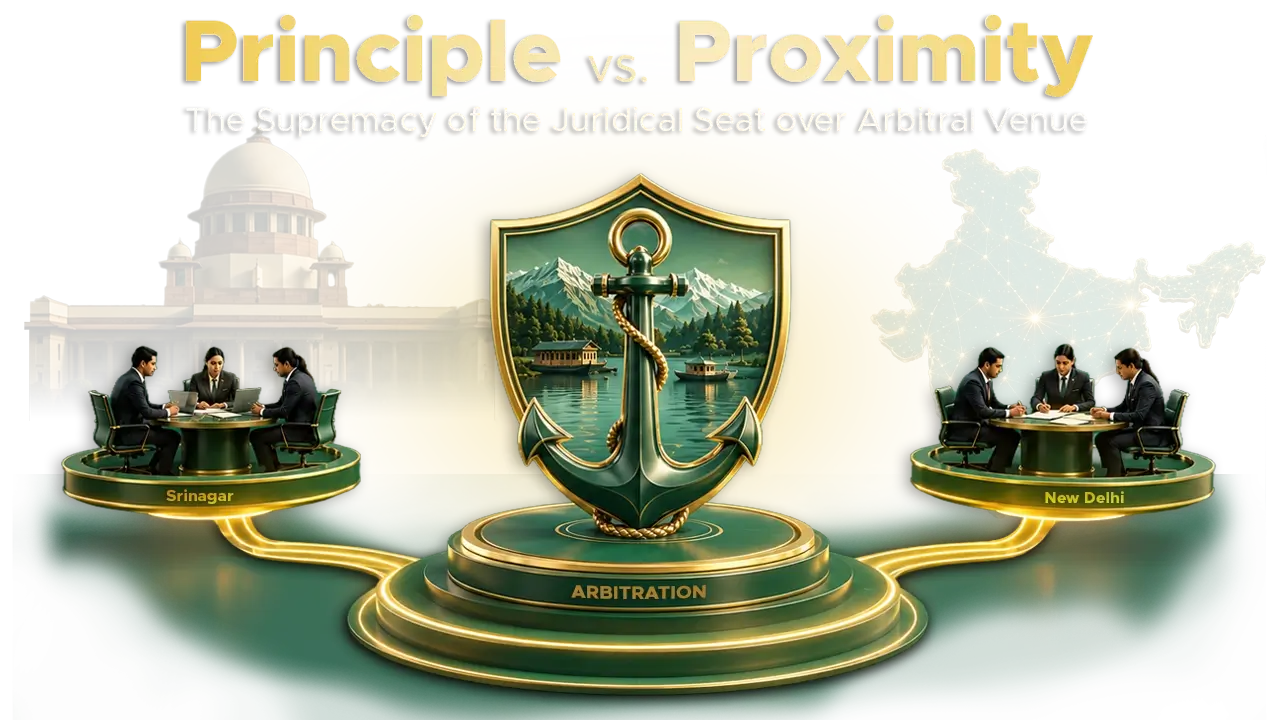
Can the physical location where an arbitrator signs an award or where the parties meet for convenience override an express agreement on the “seat” of arbitration? The Supreme Court of India, in its landmark ruling in J&K Economic Reconstruction Agency v. Rash Builders India Pvt. Ltd1, rejected this view. In a move to settle persistent confusion at the High Court level, the Court reaffirmed that the juridical seat acts as the “legal home” of the arbitration, vesting exclusive supervisory jurisdiction in the courts of that seat. Even if every hearing takes place elsewhere and the final award is rendered in a different city, the designated seat remains the immutable anchor of the proceedings.
The dispute originated from infrastructure projects in Jammu & Kashmir (J&K) managed by the J&K Economic Reconstruction Agency (JKERA). When contractual disagreements led to arbitration, a pivotal moment occurred during the tribunal’s proceedings: on 26th March 2016, with the express consent of both parties, the Arbitral Tribunal fixed Srinagar as the “seat” and New Delhi merely as the “venue.” Despite this, the final award was delivered in New Delhi in 2024. When JKERA challenged the award before the High Court at Srinagar under Section 34 of the Act, the respondent objected, arguing that because the award was signed and the proceedings conducted in New Delhi, the Srinagar court lacked jurisdiction.”The High Court erroneously agreed and returned the petition. Aggrieved by the said decision, JKERA preferred an appeal before the Supreme Court asserting that the designation of Srinagar as the arbitral seat vested exclusive supervisory jurisdiction in the Srinagar courts and could not be displaced merely because hearings were conducted and the award signed in New Delhi. Thus, the principal question before the Supreme Court was whether the conduct of arbitral proceedings and rendering of the award at a venue different from the designated seat could confer supervisory jurisdiction upon courts of that venue.
Conflating Convenience with Jurisdiction
The Supreme Court’s rationale rests upon the distinction between the “seat” as a legal construct and the “venue” as a logistical one. Drawing from the Constitution Bench in BALCO v. Kaiser Aluminium Technical Services Inc2, the Court highlighted that Section 20 of the Arbitration Act prioritizes party autonomy in choosing a seat, while sub-section (3) merely allows for hearings at a convenient venue. This principle was further strengthened by Indus Mobile Distribution Pvt. Ltd. v. Datawind Innovations Pvt. Ltd.3, which established that designating a seat is equivalent to an exclusive jurisdiction clause. In the present case, since Srinagar was explicitly recorded as the seat with party consent, the “closest and most intimate connection” test often used to determine an implied seat was unnecessary, though the Court noted that all connections (contract execution and work performance) led back to J&K regardless.
The Court further integrated its reasoning with recent precedents like BGS SGS Soma JV v. NHPC Ltd.4 and Arif Azam Co. Ltd. v. Micromax Informatics FZE5, emphasizing that once a seat is fixed, it is “judicial-anchor” that determines which court has the power to set aside an award. It dismissed the respondent’s reliance on stray recitals in the award that labeled New Delhi as the “place of arbitration,” holding that an arbitrator’s administrative choices cannot unilaterally alter the parties’ original jurisdictional agreement. The “Shashoua principle,”6 which sometimes allows a venue to be treated as a seat, was deemed inapplicable here because the parties’ intention to keep Srinagar as the seat was never in doubt.
Conclusion
Ultimately, the Rash Builders judgment serves as a vital safeguard for the principle of party autonomy. By ruling that the location of the award’s signing is a matter of mere convenience, the Supreme Court has prevented the “seat” from becoming a roving concept. This decision ensures that jurisdiction remains predictable and anchored to the parties’ intent, rather than being subject to the geographical happenstance of where a tribunal chooses to hold its final meeting. In the architecture of Indian arbitration, the seat remains the keystone, providing the necessary legal certainty that prevents jurisdictional chaos.
Citations
- J&K Economic Reconstruction Agency v. Rash Builders India Pvt. Ltd., Civil Appeal No. 4461 of 2026 (Decided on April 15, 2026) ↩︎
- Bharat Aluminium Co. (BALCO) v. Kaiser Aluminium Technical Services Inc., (2012) 9 SCC 552 ↩︎
- Indus Mobile Distribution Pvt. Ltd. v. Datawind Innovations Pvt. Ltd., (2017) 7 SCC 678 ↩︎
- BGS SGS Soma JV v. NHPC Ltd., (2020) 4 SCC 234 ↩︎
- Arif Azim Co. Ltd. v. Micromax Informatics FZE, (2024) 11 SCC 411 ↩︎
- Roger Shashoua v. Mukesh Sharma, (2017) 14 SCC 722 ↩︎
Expositor(s): Adv. Jahnobi Paul, Shreya Shukla (Intern)
This article is for information only and is not legal advice. Read the disclaimer