Introduction
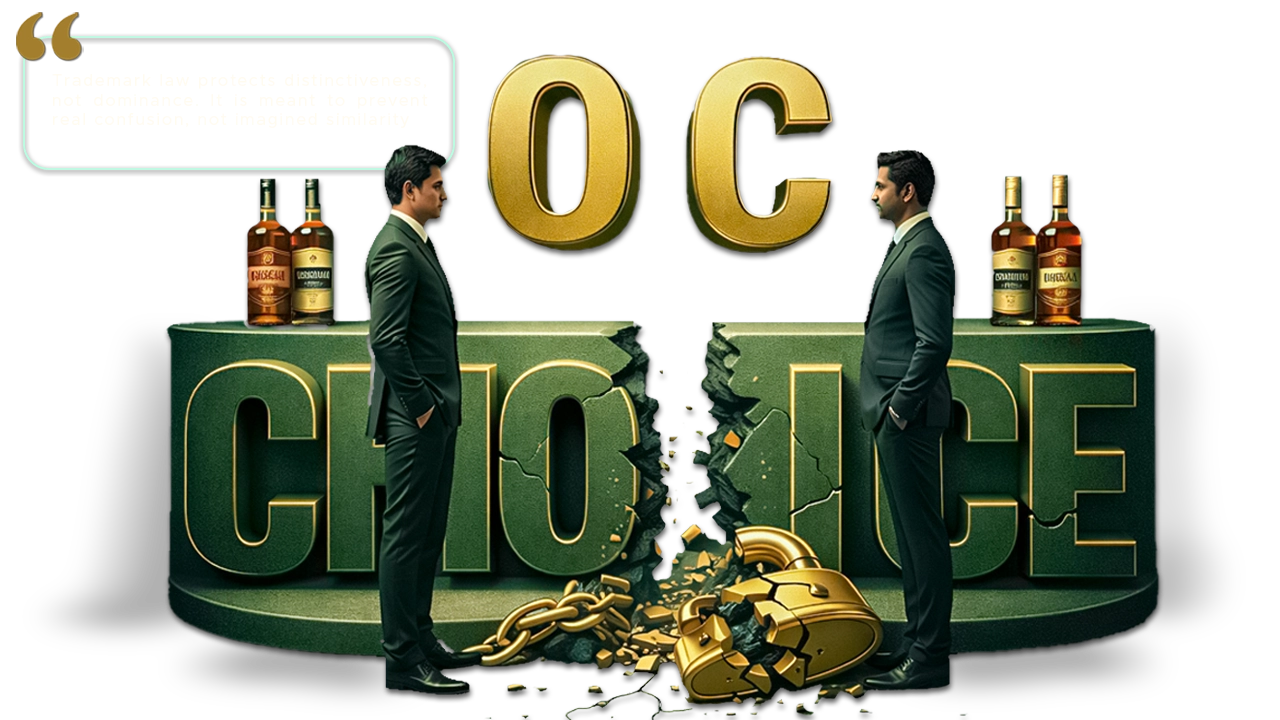
The central question that currently intoxicates Indian trademark law is deceptively simple yet legally profound: Can a single, commonplace word, widely used across industries, be claimed as a proprietary mark to the exclusion of all others? This issue lies at the heart of the ongoing, closely watched conflict between two titans of India’s liquor industry, Allied Blenders and Distillers Pvt. Ltd., the makers of Officer’s Choice, and John Distillers Ltd., the proprietors of Original Choice.
The litigation, Allied Blenders and Distillers Pvt. Ltd. v. John Distillers Ltd1., currently before the Supreme Court of India, originated from the Madras High Court’s order. It has become a pivotal point in Indian trademark jurisprudence, forcing a reassessment of the doctrinal limits of distinctiveness, consumer perception, and the boundaries of judicial interpretation in determining trademark similarity.
The core dispute revolves around the Plaintiff’s assertion that the Defendant’s mark, Original Choice, is deceptively similar to their long-standing brand, Officer’s Choice, constituting infringement and passing off. The alleged similarity rests not only on the shared suffix “Choice,” a common, laudatory term, but, controversially, on the potential for both brands to be abbreviated to “OC.” The Madras High Court concurred with this view, finding that the phonetic resemblance, coupled with the speculated abbreviation-based confusion, established a likelihood of deception among consumers. Consequently, the High Court restrained the Defendant from using the Original Choice mark for whiskey and allied goods. This ruling, however, marks a significant departure from settled principles of trademark comparison previously laid down by the Supreme Court.
The High Court’s approach appears to have sidestepped the critical standard set by the Supreme Court in Pernod Ricard India Pvt. Ltd. v. Registrar of Trademarks2 (the Blenders Pride case). In that seminal judgment, the Court held that a word like “Pride” was a common laudatory term, incapable of exclusive appropriation unless it had acquired secondary meaning. The core mandate was for a holistic comparison, assessing the overall impression of the marks rather than dissecting them into individual components. By placing undue emphasis on the shared word “Choice,” the Madras High Court effectively dissected the mark, conferring an unwarranted degree of distinctiveness upon what is fundamentally a common, descriptive term. This judicial act of dissection is directly contrary to the “anti-dissection rule” and the principle of holistic assessment.
The most striking and controversial element of the High Court’s rationale is its reliance on hypothetical abbreviations. By concluding that confusion was likely because both marks could be shortened to “OC,” the Court introduced a speculative basis for infringement. Trademark law is designed to guard against real-world confusion, not conjectural or speculative scenarios. This reliance on judicially created abbreviations fundamentally reverses the logic of trademark protection. Trademarks must reflect the realities of commercial use and consumer perception, not judicial imagination. By overextending protection based on speculation, the Court risks stifling fair competition and granting a monopoly over a common linguistic abbreviation.
Furthermore, the High Court’s finding failed to adequately account for consumer sophistication. The Supreme Court in Pernod Ricard had already observed that consumers of Indian Made Foreign Liquor (IMFL) are generally discerning, brand-loyal, and well-informed, a factor that significantly reduces the likelihood of confusion between similarly named products. Regular consumers who use pet names or abbreviations for their brands do so out of familiarity, not confusion. The failure to incorporate this consumer reality creates a direct doctrinal inconsistency with both the Pernod Ricard judgment and its precursor, Cadila Healthcare Ltd. v. Cadila Pharmaceuticals Ltd3., which mandates that the likelihood of confusion must be determined from the standpoint of an average consumer with imperfect recollection.
The Plaintiff’s claim of infringement stands against a consistent line of judicial precedents that collectively seek to balance protection and free speech. While cases like Ram Krishan & Sons Charitable Trust v. ILM Consulting Pvt. Ltd4. and Neon Laboratories Ltd. v. Themis Medicare Ltd5. affirm the protection of distinctive marks, particularly when used on cognate goods, other cases restrict the scope of protection for common terms. Godfrey Phillips India Ltd. v. Girnar Food & Beverages Pvt. Ltd6. clarified that descriptive or generic words are not inherently distinctive without proven secondary meaning. Similarly, the Science Olympiad Foundation v. Shivalik Olympiad Foundation7 case, while restraining the use of an identical acronym (SOF), emphasized that infringement must be based on actual, not speculative, consumer confusion. These authorities collectively underscore a crucial tenet: coined and distinctive marks deserve the highest degree of protection, but common words or abbreviations cannot be judicially invented or monopolised absent clear evidence of acquired secondary meaning or actual, demonstrated consumer deception.
The Supreme Court referred the dispute to mediation, a pragmatic step favoring negotiated settlement in commercial conflicts however mediation cannot resolve doctrinal inconsistencies. The core legal question remains starkly unresolved: Can a court rely on speculative abbreviations and shared descriptive elements to find infringement, thereby disrupting the established “holistic comparison” test? The Supreme Court’s eventual pronouncement will likely determine the future contours of Indian trademark law, clarifying the delicate balance between robust brand identity protection and preventing an overreach that monopolizes the common linguistic domain. “Trademark law protects distinctiveness, not dominance. It is meant to prevent real confusion, not imagined similarity.” The decision will either reaffirm or redefine the foundational doctrines governing distinctiveness, abbreviation, and consumer perception.
Conclusion
The high-stakes trademark conflict between Officer’s Choice and Original Choice hinges on a fundamental reassessment of distinctiveness in Indian trademark law, particularly concerning the limits of proprietary claims over common terms like “Choice.” The controversy stems from the Madras High Court’s finding of infringement based on two legally fragile grounds: the undue emphasis placed on the shared, descriptive suffix “Choice” (violating the established “anti-dissection rule” which mandates a holistic comparison of the marks), and the reliance on the speculative, judicially-invented abbreviation “OC” as a source of confusion. The Supreme Court’s upcoming decision is pivotal, as it must reconcile this approach with prior precedents like the Blenders Pride case, which restrict the exclusive appropriation of common, laudatory terms and require courts to guard against real-world confusion among discerning consumers rather than imagined similarity, ultimately determining the critical balance between robust brand identity protection and preventing the monopolization of the common linguistic domain.
Citations
- Allied Blenders & Distillers Pvt. Ltd. v. John Distillers Ltd., W.P. Nos. 19734 & 25296 of 2013.
- Pernod Ricard India Pvt. Ltd. v. Registrar of Trademarks, 2023 SCC OnLine SC 765.
- Cadila Healthcare Ltd. v. Cadila Pharmaceuticals Ltd., (2001) 5 SCC 73.
- Ram Krishan & Sons Charitable Trust v. ILM Consulting Pvt. Ltd., 2017 SCC OnLine Del 8371.
- Neon Laboratories Ltd. v. Themis Medicare Ltd., 2014 (60) PTC 621 (Bom).
- Godfrey Phillips India Ltd. v. Girnar Food & Beverages Pvt. Ltd., (2005) 30 PTC 1 (SC)
- Science Olympiad Foundation v. Shivalik Olympiad Foundation, (2015) 08 DEL CK 0222.
Expositor(s): Adv. Archana Shukla