Introduction
The architecture of India’s nuclear patent regime is undergoing a quiet but profound reset, transitioning from a philosophy of complete exclusion to a model of conditional permission. With the enactment of the Sustainable Harnessing and Advancement of Nuclear Energy for Transforming India (SHANTI) Act, 2025, the nation has moved away from treating all atomic energy inventions as inherently sensitive. The question for the Indian Patent Office is no longer whether an invention touches nuclear energy at all, but rather whether it is strategically sensitive or primarily a peaceful, commercial technology.
Is the Absolute Bar Over? Moving from Blanket Exclusion to Calibrated Control
For over six decades, Section 4 of the Patents Act, 1970, read alongside Section 20 of the Atomic Energy Act, 1962, functioned as a blunt legal instrument. Under this previous regime, any invention relating to “atomic energy” was automatically excluded from patentability, irrespective of whether the subject matter was a high-stakes fuel cycle step or a routine hospital imaging device. The state asserted total control, viewing private intellectual property rights as incompatible with the security needs of a young nuclear program.
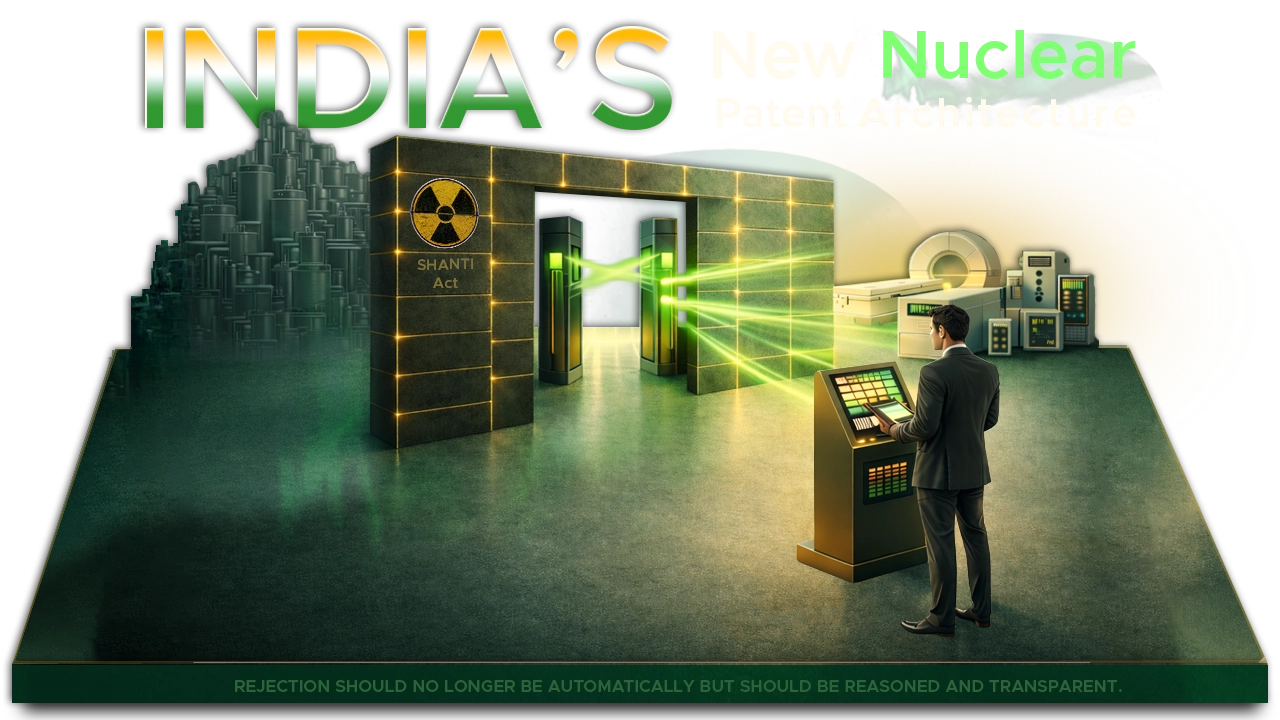
The SHANTI Act rewrites this architecture by introducing a specialised filter through Section 38. This provision now authorises the Central Government to permit patents for inventions “for the peaceful uses of nuclear energy and radiation,” while maintaining clear boundaries for state-reserved activities. This transition signifies a move toward calibrated control, where the state aims to protect its strategic core while finally opening a door for civilian innovation.
A critical question for the industry is: what remains under lock and key? The Act establishes a “reserved core” under Section 3(5), listing specific fuel cycle and backend functions that remain entirely off-limits for private patenting. These activities, including enrichment, isotopic separation, spent fuel management, and heavy water production, are treated as if they were made by the state itself. However, outside this core lies a vast new perimeter of “peaceful use” technologies. This includes radiation detection systems, safety instrumentation, medical applications, and advanced components for Small Modular Reactors (SMRs). By distinguishing these from the fuel cycle, the law creates a path for devices and methods that previously could not be patented in India simply because they operated in a nuclear environment.
The central hinge of this new framework is the concept of “sensitive” inventions. Section 38 requires the Controller of Patents to refer questions of sensitivity or reserved scope to the Central Government. If the government concludes that an invention has national security implications, it is deemed to belong to the state, and no patent is granted. The statute notably does not define “sensitivity” in concrete terms, providing no predetermined list of parameters for applicants to consult. While this legislative choice keeps the state’s hands free in a fast-changing geopolitical environment, it introduces a dimension of uncertainty. Under the old regime, the answer was harsh but predictable; under the SHANTI framework, the default is more applicant-friendly, yet the risk of a late-stage sensitivity determination looms over any application falling near the strategic line.
What are the Compliance Burdens? Pre-Disclosure Duties and Research Freedom
A distinctive feature of the new regime is the pre-disclosure duty mandated by Section 38(5). Any individual or entity with reason to believe an invention relates to nuclear energy must inform the Central Government before disclosing it to any third party, including potential commercial partners. This “first look” requirement acts as a security layer that does not exist in ordinary patent practice and necessitates rigorous internal compliance processes for research institutions. Balanced against this control is a deliberate opening for research. Section 9 of the SHANTI Act grants broad freedom to carry out research, development, and innovation related to peaceful nuclear energy, provided it avoids reserved areas or flagged security risks. This attempt to reconcile scientific progress with security oversight allows for the use of small quantities of prescribed substances in research without the need for elaborate licensing.
The SHANTI Act does not simply repeal Section 4 of the Patents Act in isolation; it pulls the Patents Act into its new regulatory orbit. Practically, this means examination now involves a two-stage hurdle: an application must first meet the standard criteria of novelty and inventive step, and then survive the SHANTI filter on sensitivity. For patent professionals, this demands a shift in instinct. The older strategy of “scrubbing” nuclear context from specifications is now counterproductive. Instead, a strategy of complete and technically honest disclosure is required to explain the civilian and peaceful character of an invention.
In the context of the SHANTI Act 2025, the judicial rationale has shifted from strict exclusion to ensuring that procedural hurdles do not stifle innovation in the newly opened “peaceful use” sector. The most pivotal recent authority is Nippon Steel Corporation v. The Controller of Patents (2023)1, where the Delhi High Court established that procedural requirements such as the “proof of right” or assignment of inventions should be interpreted flexibly and not used as substantive barriers to reject a patent. This is crucial for the SHANTI framework because it suggests that while the government maintains a “sensitivity filter,” the Patent Office cannot use the complexity of nuclear regulations to arbitrarily deny applications that otherwise meet technical standards.
Furthermore, the foundational logic of the new regime is supported by the principle in Dr. Snehlata C. Hyane v. Union of India (2010)2, which mandates that the Controller must provide “speaking orders” with clear reasoning. In the reimagined landscape, this provides a safeguard against the “sensitivity” clause of Section 38 being used as a blanket, unexplained veto. By requiring the state to distinguish between the “reserved core” (like fuel enrichment) and “peaceful perimeters” (like medical imaging), the courts are ensuring that the exclusion of atomic energy is no longer a blind reflex, but a reasoned decision based on whether an invention truly impacts national security.
Conclusion
The SHANTI Act, 2025, represents a fundamental re-alignment of India’s intellectual property and energy policies. By recognizing a legitimate space for private rights in nuclear-related inventions, the state has opened a corridor that did not exist for over half a century. However, the final character of this landscape will be shaped not just by the statute, but by the transparency of the government’s sensitivity determinations and the efficiency of the referral process. If the state uses its discretion to treat security as a narrow exception rather than a default barrier, the SHANTI Act will successfully convert its reformist promise into a functioning innovation system.
Citations
Expositor(s): Adv. Archana Shukla, Srijan Sahay (Intern)