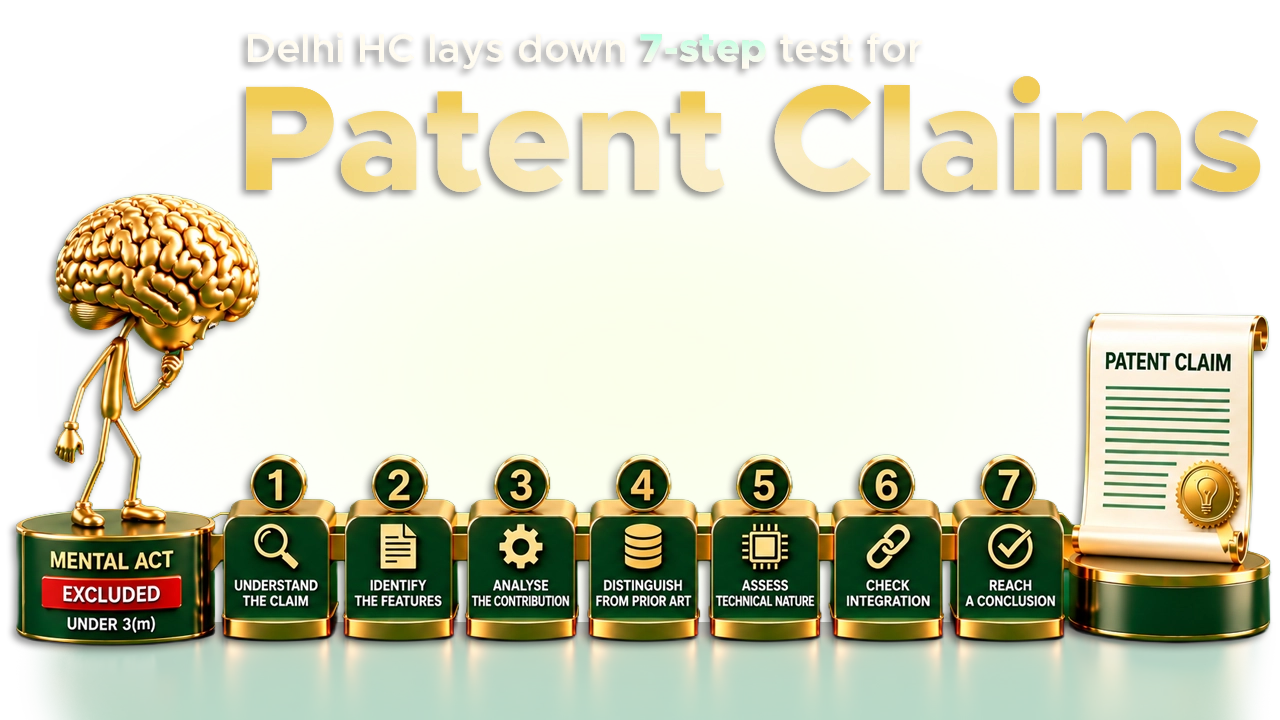
For over two decades, Section 3(m)1 of the Patents Act, 1970 which bars patentability of invention over a “mere scheme or rule or method of performing mental act” has been applied by patent examiners without any settled framework for what actually counts as a mental act. In T-Mobile International AG v The Controller General of Patents, Designs and Trademarks2 (order dated 4 August 2026), the Delhi High Court closed that gap. A single-judge bench of Justice Tushar Rao Gedela, assisted by an amicus curiae, laid down a structured seven-step test for examining Section 3(m) objections, with worked illustrations, and directed the guidelines be placed before the Patent Office within six weeks. For patent practitioners and applicants navigating computer-implemented and process claims, this is likely to become the reference framework for Section 3(m) examination going forward.
T-Mobile had appealed against a 2016 order refusing its patent application for a method of optimising the operational times and cell-change performance of mobile terminals, rejected under both Section 3(k)3 (computer programmes per se) and Section 3(m). The Court had already remanded the appeal for fresh consideration on the merits in February 2026. What kept the matter alive was a narrower, public-interest point; counsel on both sides candidly told the Court that no guidelines existed for how the Patent Office was meant to evaluate Section 3(m) objections at all. Rather than let that gap persist, the Court appointed an amicus curiae, invited draft guidelines from all sides, and used this otherwise-concluded appeal as the vehicle to settle the framework. The core issue was interpretive: when does a claimed method cross the line from a patentable technical process into an unpatentable “mental act,” and how should an examiner test for that especially where a claim recites some physical component alongside an otherwise cognitive process?
The Seven-Step Framework
Step No. 1- Construe the claim: Every claim must first be read on its own terms, the way a person skilled in the relevant art would understand it. The examiner cannot import limitations from the specification that don’t actually appear in the claim language itself, the claim is the operative instrument.
Step No. 2- Product claims fall outside Section 3(m) entirely: A claim that is, in substance, a genuine product claim; an apparatus or device defined by its physical features, cannot be objected to under Section 3(m) at all. The exclusion is built to catch process or method claims; it simply has no bite on a claim for a physical product.
Step No. 3- Identify what the claim monopolises: For process claims, the examiner must look at what the claim, read as a whole, actually monopolises. A claim cannot be excluded by dissecting it into individual steps and isolating one that happens to involve a mental act. The protection conferred is defined by the entire claim, not by picking apart its components.
Step No. 4- Apply the exclusion: This is the operative test. The question is not whether the claimed method could theoretically be carried out in someone’s head, but whether the claim, as construed, confers a monopoly over nothing more than thinking, reasoning, calculating, judging, or deciding. The Court’s practical formulation: could the claim be infringed by a person doing nothing but thinking? If so, it is excluded. The exclusion falls away, however, where the claim recites physical means integral to performing the method, requires hardware and software interacting to produce a practical result, or results in a tangible output.
Step No. 5- Token additions don’t save a claim: The Court closed the opposite workaround here; a claim cannot escape Section 3(m) merely by naming a physical object or a physical field of use. The physical means must be integral to the actual performance of the claimed steps. A nominal, post-solution gesture, the Court’s own example was “displaying, presenting, or printing” a result that does not take a claim outside Section 3(m) where the substance of the monopoly remains mental.
Step No. 6- No conflation with novelty or inventive step: The Section 3(m) inquiry is confined to what the claim monopolises. It is independent of the novelty and inventive-step requirements under Sections 2(1)(j)4 and 2(1)(ja)5, and a claim is not excluded merely because the invention appears to be an obvious or trivial advance that is a separate objection, governed by separate tests.
Step No. 7- Computer-implemented claims go to Section 3(k), not 3(m): Where a claim recites that the method is performed by a computer or computer programme, that fact alone does not attract Section 3(m). Such claims are to be examined separately under Section 3(k), which deals specifically with computer programmes per se.
The Court illustrated the test with six worked examples, ranging from a Sudoku-solving method (excluded, since the claim monopolises pure logical deduction) to a fuel-preheating method using sensors and a control unit (not excluded, since it recites physical means integral to a physical process) a deliberate effort to give the Patent Office concrete reference points rather than an abstract standard alone.
Reasoning Behind the Test
The Court traced Section 3(m)’s legislative history from the Ayyangar Committee’s report through its 2002 insertion, noting it is pari materia with Article 52(2)(c)6 of the European Patent Convention, and drew on EPO Boards of Appeal decisions (including General Electric and Quest International) for guidance on distinguishing technical implementations from purely abstract ones. Domestically, the Court relied on its own recent decisions in Koninklijke Philips v Maj (Retd) Sukesh Behl7 and Lava International v Telefonaktiebolaget LM Ericsson8, both of which had already held that claims involving genuine physical or technical implementation fall outside Section 3(m) the seven-step test essentially systematises the reasoning already emerging from that line of cases into a single applicable framework.
Why this matters ?
The Court was explicit about the vacuum it was filling. During arguments on the remanded appeal, “counsel had fairly submitted that there are no guidelines in respect of the manner in which the objections under Section 3(m) of the Act, is to be ascertained and evaluated by the Patent Office” prompting the Court to keep an otherwise-concluded appeal alive, appoint an amicus curiae, and treat the framing of guidelines as a matter of public interest in its own right. This order does not decide a contested dispute between two commercial parties so much as it fills that structural void directly, a function the Court itself recognised in invoking “public interest” as the basis for keeping the appeal open.
The Court’s own reasoning, developed well before the formal seven-step guidelines were set out, already anticipated the two principles that do the most work in the test. On reading a claim as a whole, the Court cautioned that “one has to be careful not to dissect the claim into its individual components while applying Section 3(m), inasmuch as the protection conferred by the Patent Act is defined and dependent upon the entire claim and not its individual parts”. On keeping Section 3(m) separate from novelty and inventive step, the Court held that the exclusion “would act as an independent category and has to be considered and dealt with as a separate and distinct objection, not to be mixed or conflated with steps or tests of novelty and/or inventive step”. For patent applicants particularly in telecommunications, computing, and other technical fields where claims blend physical components with data-processing or decision-making steps these two principles, together with the seven-step test and its illustrations, offer a far more predictable basis for drafting claims and responding to objections than existed previously.
Compliance is not left optional in form: the guidelines “may be suitably placed before the Controller General of Patents and Designs, Delhi for appropriate steps to be undertaken within a period of 6 weeks from receipt of this order”. And in closing the matter, the Court framed its own purpose plainly expressing the “fond hope that the aforesaid humble attempt provides the Patent Office as also the patentees some guiding principles in testing/evaluating the objections under section 3(m)”, language that itself signals this was conceived as a practical tool for examiners and applicants alike, not merely an academic clarification of the law.
Whether examiners apply the test consistently in practice and whether it withstands scrutiny in future appeals; will determine if this becomes settled doctrine or an early draft revisited by a larger bench.
Citations
Expositor(s): Adv. Pratistha Dahiya