Arbitration · bombay high court
Arbitral Award Cannot Be Set Aside for Subsequent Change in Law as Delhi High Court Reaffirms Limited Scope of Patent Illegality under Section 34
On this page
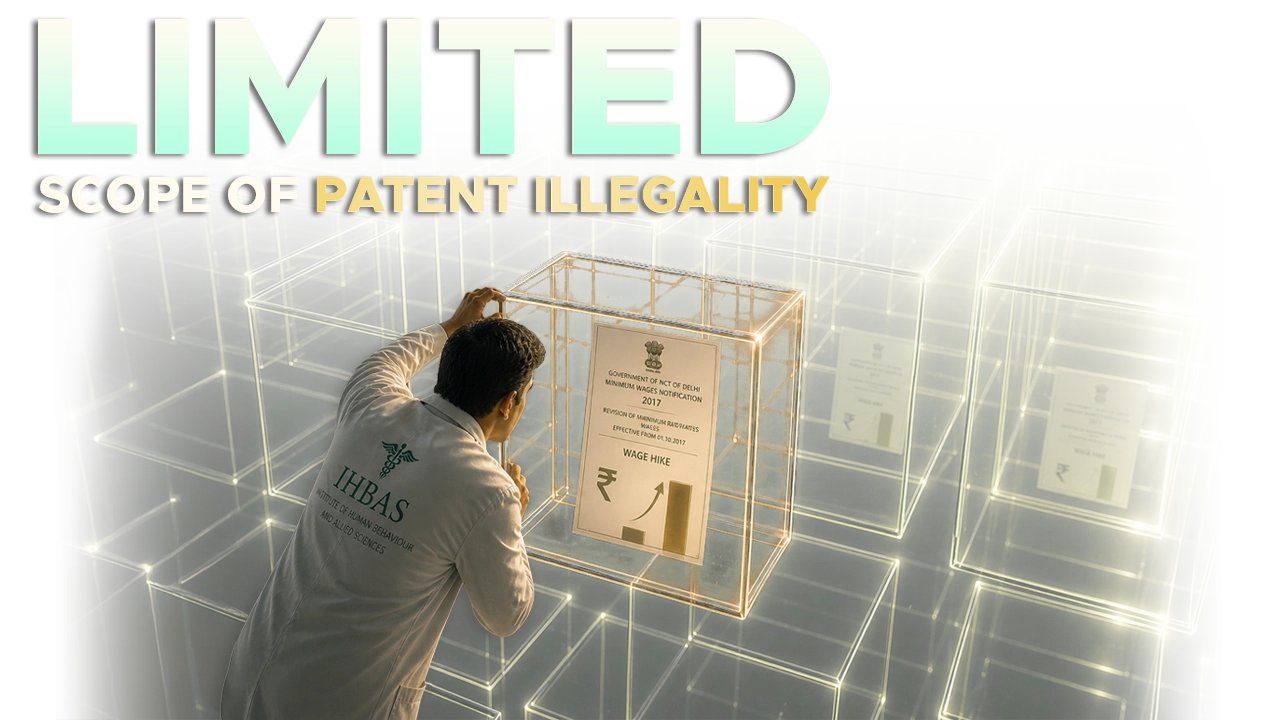
Does a post-award change in the legal interpretation of minimum wage notifications by a High Court justify the setting aside of an arbitral award under the narrow gateway of “patent illegality” or “public policy”? In Institute of Human Behaviour and Allied Sciences (IHBAS) v. Mi 2 C Securities and Facilities1, the Delhi High Court rejected the point of dispute, reinforcing the principle that an arbitrator is the sole master of both facts and the interpretation of a contract. The Court held that unless an award is so perverse that it shocks the judicial conscience or is based on no evidence at all, the judiciary cannot intervene simply because an alternative legal view even one subsequently affirmed by a higher court exists. This decision underscores that the “patent illegality” ground under Section 34 of the Arbitration and Conciliation Act is not an avenue for a merit-based review or a “second look” at the arbitrator’s findings.
The dispute emerged from a 2018 Service Agreement wherein Mi 2 C Securities was engaged to provide security and facility management services to IHBAS, a premier mental health institute. Central to the conflict was a clause providing for the reimbursement of minimum wage increases mandated by the Government of NCT of Delhi. Following a 2017 notification that significantly hiked minimum wages, the contractor sought arrears. While IHBAS initially released partial payments, it later withheld substantial sums, leading to the invocation of arbitration. The sole arbitrator eventually awarded the contractor over ₹2.77 Crores, plus interest, after finding that the contractor had indeed complied with the statutory wage requirements. IHBAS challenged this award, primarily contending that a subsequent Division Bench judgment in Social Jurist, A Civil Rights Group v. Govt. of NCT of Delhi2 had quashed the 2017 wage notification, thereby rendering the arbitrator’s reliance on it a “patent illegality.”
The rationale provided by the High Court for upholding the award centers on the “limited interference” doctrine and the autonomy of the arbitral tribunal. The Court noted that the arbitrator had meticulously analyzed the evidence, including PF and ESI contributions, to conclude that the higher wages had been paid to the staff. Regarding the impact of the Social Jurist judgment, the Court relied on the Supreme Court’s reasoning in State of Haryana v. G.D. Steel Rolling Mills3, establishing that an award based on the prevailing law at the time of its passing does not become “patently illegal” merely because that law is later modified or clarified by a court. Furthermore, the Court applied the rigorous standards set in SSANGYONG Engineering & Construction Co. Ltd. v. NHAI4 and Delhi Airport Metro Express Pvt. Ltd. v. DMRC5, emphasizing that a “permissible view” taken by an arbitrator even if arguably erroneous in law is immune from challenge under Section 34. The Court clarified that the arbitrator’s interpretation of the “escalation clause” was a contractual matter, and as per Konkan Railway Corpn. Ltd. v. Chenab Bridge Project6, the court cannot substitute its own interpretation for that of the tribunal.
Conclusion
The Delhi High Court’s dismissal of the challenge serves as a potent reminder that arbitration is intended to be a final and binding resolution mechanism rather than a preliminary step to protracted litigation. By shielding the award from a “merit-based” assault, the Court protected the commercial efficiency of the arbitration process. The judgment clarifies that the “public policy” and “patent illegality” exceptions are high hurdles, intended only for cases of egregious unfairness or fundamental legal breakdowns, rather than routine disagreements over statutory interpretation. Ultimately, IHBAS was directed to honor the award, affirming that once a party submits to the jurisdiction of a tribunal, they must accept the finality of its wisdom, provided the process remains within the broad boundaries of legal reason.
Citations
- Institute of Human Behaviour and Allied Sciences v. Mi 2 C Securities and Facilities, (2026) ibclaw.in 2181 HC ↩︎
- Social Jurist, A Civil Rights Group v. Govt. of NCT of Delhi, (2018) SCC OnLine Del 10540 ↩︎
- State of Haryana v. G.D. Steel Rolling Mills, (2022) SCC OnLine SC 141 ↩︎
- SSANGYONG Engineering & Construction Co. Ltd. v. NHAI, (2019) 15 SCC 131 ↩︎
- Delhi Airport Metro Express Pvt. Ltd. v. DMRC, (2022) 1 SCC 131 ↩︎
- Konkan Railway Corpn. Ltd. v. Chenab Bridge Project, (2023) 9 SCC 85 ↩︎
Expositor(s): Adv. Jahnobi Paul
This article is for information only and is not legal advice. Read the disclaimer