Arbitration · Supreme Court
Can a Party Walk Away from Arbitration Midway and Later Restart the Same Dispute Under Section 11?
On this page
Introduction
Can a party walk away from an arbitration midway and later come back to restart the same dispute by seeking an appointment of a fresh arbitrator under Section 11? On April 1, 2026, a division bench of the Supreme Court of India comprising Justice Pamidighantam Sri Narasimha and Justice Alok Aradhe in Rajiv Gaddh v. Subodh Parkash1 dealt with this contentious issue that sits at the intersection of procedural discipline and the prevention of abuse of process. The court observed that the prohibition against initiating fresh proceedings on an identical cause of action, as established under Order 23 Rule 1 of the CPC, extends to Section 11 of the Arbitration Act to safeguard public policy and prevent the tactical abuse of the judicial process.
The Confluence of Procedural Discipline and Public Policy
This legal necessity arose from a dispute over a 2005 joint bid for land in Hoshiarpur, Punjab, where the parties Rajiv Gaddh and Subodh Parkash had structured their interests through a Tripartite Agreement and three subsequent contracts containing an arbitration clause.
The Respondent first invoked arbitration in 2015, but after a series of appointments and recusals, he ceased participation in 2017 while alleging bias. By 2019, he explicitly communicated his refusal to participate, yet the Arbitrator proceeded to issue an award in 2020 that dismissed the Respondent’s claims while granting the Appellant’s. Following a separate 2021 Supreme Court judgment that upheld the original land auction, the Respondent attempted to file a fresh arbitration notice, asserting a new cause of action. Although the High Court allowed this second Section 11 application, The Supreme Court set aside the High Court’s order, holding that the subsequent application filed by the respondent was not maintainable as Order 23 Rule 1 of the Code which applies to proceedings under Section 11 of the Act is founded on Public Policy.
The Court’s rationale was anchored in the principle that while Section 11 primarily concerns the existence of an agreement, it cannot be exploited to bypass established procedural bars or circumvent the sanctity of prior proceedings. In expanding on this, the Court emphasized that statutory provisions must be read in a manner that upholds the efficiency of the legal system rather than providing a platform for litigious strategy. Drawing from the precedent in HPCL Bio-Fuels Ltd. v. Shahaji Bhanudas Bhad2. The Court affirmed that the rigors of Order 23 Rule 1 of the CPC designed to prevent the harassment of defendants through multiple suits extend to Section 11(6) applications. This interpretation effectively prohibits a fresh appointment request if a party previously abandoned the same claim without judicial leave, ensuring that a party cannot unilaterally “reset” the clock on a dispute once it has chosen to withdraw.
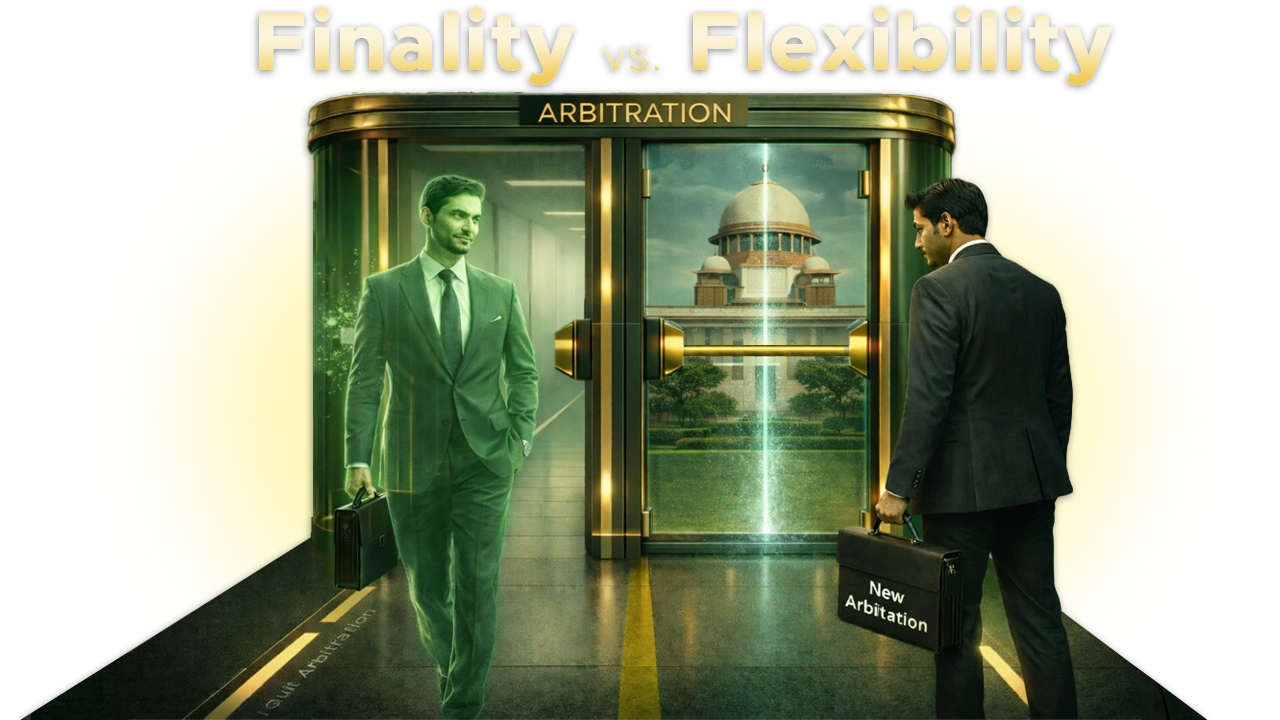
To provide further clarity on what constitutes such a withdrawal, the Court utilized the framework established in Dani Wooltex Corporation v. Sheil Properties Pvt. Ltd.3, defining “withdrawal of claims without leave,” not merely as a passive delay, but as active conduct manifesting an unequivocal intent to relinquish a claim. In the present case, the Court found that the Respondent’s explicit and recorded refusal to participate in the original proceedings met this high threshold. By treating such a refusal as a formal abandonment, the Court sought to protect the arbitral process from being rendered “optional” or subject to the whims of a party who chooses to exit a proceeding only to attempt a re-entry when it becomes tactically advantageous to do so. This reasoning reinforces the idea that the right to arbitrate is coupled with a duty to maintain procedural consistency and respect for the finality of the process.
Conclusion
The Court hence dismantled the argument for a “fresh” cause of action, clarifying that external litigation regarding the land auction did not alter the fundamental nature of the internal dispute between the parties. Ultimately, the Court held that permitting a restart of arbitration after such abandonment would violate public policy and constitute an abuse of the legal process. Rajiv Gaddh v. Subodh Parkash thus reinforces the integrity and finality of the arbitral process in India. By ensuring that arbitration is not a “trial run” to be discarded and restarted at will, the judgment underscores procedural discipline, discourages tactical misuse of the law, and strengthens public confidence in the finality of alternative dispute resolution.
- Rajiv Gaddh v. Subodh Parkash,(2026 INSC 302) ↩︎
- HPCL Bio-Fuels Ltd. v. Shahaji Bhanudas Bhad, [Insert Report Citation, e.g., (2024) INSC] ↩︎
- Dani Wooltex Corporation v. Sheil Properties Pvt. Ltd., [Insert Report Citation, e.g., (2008) 7 SCC 410] ↩︎
Expositor(s): Adv. Jahnobi Paul
This article is for information only and is not legal advice. Read the disclaimer